Gomer
Biblical Locations
of the Lost Ten Tribes
Scriptural Proof
The Joseph Aspect
by Yair Davidiy
Biblical Evidence:
The Predicted Role of the Ten Tribes
Gomer
Descendants of the Lost Ten Tribes in the Book of Hosea
are described as the sons of a loose woman called Gomer.
Gomer was also the name of a group of nations descended from Japhet who
elsewhere are described as being in Europe.
Before moving to Europe Gomer son of Japhet was to be found in the Middle
East. Regions attributed to Gomer son of Japhet in Midrashic and related
sources are also those attributed to the Lost Ten Tribes.
The Book of Hosea indicates a union of the exiled northern Israelites
with Gomer.
We may therefore assume some type of geographical association between
Gomer of Japhet and Gomer of Israel.
The name Gomer was also the name given to the Cimmerians. The Cimmerians
were a people who first appeared on the fringes of the Assyrian Empire
shortly after the Isrsaelites were exiled. From the Cimmerians emerged the
Scythians and Goths.
The term Gomer (Gameri or Gumri in Akkadian) is also similar to how
the name for Israel, <<Khumri>> could have been pronounced by
the Assyrians. Khumri was the Assyrian name for Israel and cases are known
where the Assyrians switched g for the kh sound.
Gomer was the name of a son of Japhet son of Noah. Gomer was the father
of Ashkenaz, Riphat, and Togarmah (Genesis 10).
From the union of Hosea emerged three children who are shown to represent
the Lost Ten Tribes. The Prophet Hosea symbolize the Almighty or
Israel According to the allegory that hosea explicitly gives us, from his union with Gomer emerge descendants of the Lost
Ten Tribes in their state of exile. This corresponds with our historical
researches that show that Gomer is the Cimmerian peoples.
Israelites either:
1. Became identified as the Cimmerians and company
OR at the least
2. merged with them and are to be found amongst peoples derived from
Cimmerian-descended groups.
THE GENEALOGIES OF GOMER AND HIS SONS:
"And the sons of Gomer; Ashkenaz, and Riphah, and Togarmah" (Genesis
10;3). Gomer was identified with Afrikey and with Germamia or Germaniah
(Genesis Rabah 37). Afrikey appears to have been an area in Elam near Susiana
where (according to de Gobineau) the name Afrikey was given
to a sacred region of the Medes. Others have tried to identify Afrikey
with Iberia in the Caucasus or with Phrygia in Turkey. Wherever "AFRIKEY" actually
was, the Lost Ten Tribes of Israel were also reported to have been
there!
"Germamia" or "Germaniah" may be Carmania in southwest Iran which Herodotus
(1;125) termed Germania and wherein Israelite groups for a time were
to be found. Alternative identifications for "Germaniah" are "Mannae" in
Armenia and Germanikey in the Bosporus area. A connection with the European country of Germany
should also be considered.
One ancient source (Targum Jerushalemi on Genesis 10) lists Afrikey,
Germania, Madai, Macedonia, Bythinia, Thrace, as belonging to Gomer.
The Cimmerians at a later stage did invade these regions whence they moved
further westward. Ashkenaz is often identified with the Scyths. Ashkenaz
was attributed "Asia" (Genesis Rabah 37) meaning an area by Sardes in Lydia (Western Turkey by Phrygia),
as well possibly as a region in Cilicia(Southeast Turkey, and to part of Afghanistan. The
name Ashkenaz was also given (Targum Jehonathan on Ezekiel 27;23) to Haydayb
(i.e. Adiabene) in Northern Syria which in the Talmud (Yebamot 17) is equated with Habor
whereto part of the Exiled Israelites were taken (2-Kings 17;6). The Targum
Jerushalemi identifies Ashkenaz with the BARBARI which is an ethnic connotation
for the so called "Germanic" peoples who attacked and invaded the Roman
Empire ca.200-500 c.e. Elsewhere both the Barbari and the Germans
are identified with Edom. In ancient times the term BARBAR was used
synonymously with the term for Hebrew. Adiabene, which one source
ascribed to Ashkenaz, is also attributed (Genesis Rabah
37) to Riphah brother of Ashkenaz. Riphah is connected to the Riphaean (Ural)
and/or Carpathian Mountains by some. Greek (such as Aristotle) and Roman
sources applied the name Riphas or Riphai to the Alpine Mountains in Central
Europe. The Targum Yehonathan placed Riphah in Parkvi which is located in
the region of Areia east of the Caspian Sea. "Areia" is the Greek rendition
of HARA whereto part of the Lost Ten Tribes were taken (1-Chronicles 5;26).
Togarmah the brother of Ashkenaz has been identified with the region of
Tilgarimu just north and northeast of Cilicia. Also in the Hara and neighboring
region east of the Caspian Sea was Tukharistan and a people called Togar
or Tukharian in Classical literature. These names relate to Togarmah and
are connected both with the Germans and with the Turks. In this same general
area were the Chumaru, the Chomari, and the Komari which names all connect
with the Cimmerians and with Gomer. Later Rabbinical traditions were to
link both Gomer proper and Ashkenaz with the Germans. Riphah was associated
with peoples in France. Togarmah with the Turks. The Anglo-Saxons also emerged
from Turkish areas in Central Asia and are associated with the Turks in
Medieval Mythology. The Khazars (who were part of the Lost Ten Tribes and
related to the Scots, Anglo-Saxons, Finns, and Scandinavians) were
subjected to Turkish cultural influences and have WRONGLY been attributed
Turkish origins. Josephus identified Gomer with the Celtic Galatians while
Josephon linked Gomer to the Franks of Western Europe. All of the above
identifications have some historical pertinence. They are not intended to
be all exclusive and these same sources sometimes attribute one ancestor
to several people or one people to several ancestors. Sometimes the attributions
refer to temporary historical situations in which the countries mentioned
were conquered for a time by a small group belonging to the identified ancestor,
and so on.
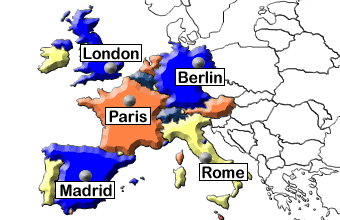
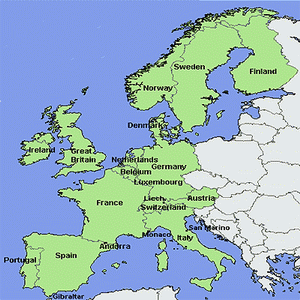
THE OVERALL GIST of the sources IS TO IDENTIFY GOMER AND SONS WITH PEOPLES
WHO EVENTUALLY SETTLED IN CENTRAL AND WESTERN EUROPE! Since the exiled
Israelites are identified with entities who in their places of exile were
to combine (temporarily?) with Gomer so too must these same Israelites
be sought after in those same regions towards which "Gomer" gravitated!
[Hosea 1:4]
AND THE LORD SAID UNTO HIM, CALL HIS NAME JEZREEL; FOR YET A LITTLE WHILE,
AND I WILL AVENGE THE BLOOD OF JEZREEL UPON THE HOUSE OF JEHU, AND WILL
CAUSE TO CEASE THE KINGDOM OF THE HOUSE OF ISRAEL.
Jezreel is the name of a town and a valley. It was a place of significance
in Israelite history. In prophecy its significance involves the meaning
of its name from the root Yezer meaning to scatter. Jehu was an
Israelite king. The name is pronounced is Yehu or Hu in short since
the Ye-component is one of the names of God. In Welsh tradition, the Welsh
were known as Gomri and as Cyrmy (i.e. Cimmerians) and were led by Hu from
Drephrobane opposite Byzantium across the sea to Defene in Wales. In our
book Ephraim we have shown how these traditions coincide with Jewish
traditions about the Lost Ten Tribes. This is not an absolute proof but taken in context
it is a legitimate indication and should be seen in both a Biblical and
historical perspective.
Rabbi Eliyahu of Vilan as interpreted by Shlomoh Koslavski, "Va-Asher Tovanah Yagidu", Jerusalem, 5764) used a system that would have placed Gomer in Scandinavia or in Northern Europe in general and Magog to the south of Gomer. On the other hand Rabbi Eliyahu of Vilan understood the Talmud as identifying Gomer with Germany.
On the whole the sources incline to identify Gomer in our time as descriptive of "Celtic" and "Germanic" peoples.
The Brit-Am identification of the Lost Ten Tribes with groups in Western and Northern nations corresponds with the above. Historically the entities we identify as Israelites were on the whole associated with "Celtic" and "Germanic" and migrated westward with them. This fits the description of Hosea who described the Lost Ten Tribes in Exile as offshoots of Gomer.