"Brit-Am Now"-1071
Contents:
1. Adam: "Hebrew and Irish culture and
Dancing"
2. Hosea chapter 10 Upgraded
3. Scythian Arrowheads of Israelite Origin?
###################################################
1. Adam: "Hebrew and Irish culture and Dancing"
From: Daoine Sidhe Academy <brandydancer05@yahoo.com>
Re: "Brit-Am Now"-1070
#5: Francis Hynds: Ulster, Eire, and Dancing
In response to....
<<Irish dancing as it is called would be
more correctly
labelled
as Roman Catholic dancing, as it was RC priests at the time who permitted
dancing between male & female provided they kept
their hands to themselves, hence the hands glued
to their sides......""
This is entirely inaccurate and based on North/South,
Catholic vs Protestant bickering. Something you just
suggested be overlooked in regard to evidence.
(Yair, this goes back on topic)
I am the Chief historian for the American Association
of Irish Dancers and a champion dancer/Teacher. We are currently
in the process of compiling a book for mass publication
to undo these tired myths.
The version of things you present are not least based in reality.
Further, our research supports the Ephraimite theory.
You say: "IT" is an invention of around the early 1800's, though nobody can say
for sure....
Certainly someone who obviously does not dance! But historians CAN indeed say
for sure and have. The problem is that Church and the Dancing Organizations continue
to foster false ideas based on politics and religion.
Irish dancing is not just "Riverdance" There are at least dozens of distinct
dance traditions known and to date, no one has claimed to be an expert on them all. Personally, I
will only speak for what I know for sure.
You are trying to speak for the relatively recent evolution of Step dancing.
But you don't know the whole story. You seem to be saying that because step
dancing is "new" it can not be part of an older tradition. That is faulty.
But I wont get that far off topic here. Feel free to email me.
You suggest with authority that the Catholics allowed
dancing between make and female only if they kept their arms
at their sides. First, this is not why we keep the arms down.
Second, In ALL Irish social dances (North and South)the men and
women MUST link arms and hold hands. These are, after all, circle dances.
To dismiss those you must dismiss their ancient connections with Irish
culture. The circle dances have been traced back for thousands of years and
a former post correctly observes that the Quadrilles are similar,
and these can also be traced back to ancient times and are directly related
to Ceili dancing. (I also dance Hora and can speak for the related foundations)
To dismiss the origins of Irish dancing based on the Protestant view,
which is entirely recent, is to deny much evidence for the ancient sanctity of
Ireland and also throws our Hebrew roots out the window entirely.
The reason the arms are held down during STEP DANCING alone,
is for center of gravity. You can not dance solo the steps step while holding
onto a partner. Male or Female.
Further, holding the hands down keeps the center of gravity inside so that the
feet can execute fast and powerful movements. Its common sense. Not a penal law.
Step dancing evolved from Sean Nos dancing which does not hold the arms down,
but does not have to because it is less athletic.
(The point here is that both countries today are largely Presbyterian, and Presbyterians by tradition don't dance....
This is incorrect as well. The Ceili and Set are of Northern origin.
Our book will illustrate definitive proof of the connections
between Hebrew and Irish culture and Dancing is one of the keys
to this proof.
PS. I'm not Catholic.
Adam
2. Hosea chapter 10 Upgraded
http://britam.org/hosea10.html
Summary:
In a sense this chapter could have been the beginning of the Book of Hosea.
Division amongst Israelite Tribes invites disaster. The cult of the Golden
bull-calves at Beth-el and Beth-Aven will have corrupted Ephraim and this
corruption will be responsible for terrible punishments. Ephraim will have acted
similarly to the homosexual monsters who once inhabited Gibeah of Benjamin.
Numerous foreign peoples will sense the weakness of Ephraim and attack him.
Ephraim was nicknamed "Aegel" or "Angle" (as in "Anglo-Saxon" and Angle-land:England)
meaning bull-calf but sometimes Ephraim acts like a little cow. If we repent and
do as well as we can God will have mercy on us and redeem us.
3. Scythian Arrowheads of Israelite Origin?
In a coming article (that will be posted to the Brit-Am Web Site)
by Cam Rea, "The War Machine of Scythia"
Cam describes the Scythian bow and Scythian arrow head.
Cam refers to an interesting source describing this arrow head,
http://www.vkrp.org/studies/historical/scythian-point/
Excerpts:
Parallels for the point come from east
and west of the Jordan River. In Jordan excavators found similar
trilobate
points at 'Umayri,
a site just south of Amman in Ammonite territory. Ammonites, along with the
Moabites, were all groups of people living east of the Jordan River mentioned in
the Hebrew Bible. The points discovered at 'Umayri
came from various locations on the site. A point found in Field A, designated
the Ammonite Citadel, came from a mixed locus with pottery ranging from the Iron
I period up to the Persian period. A second point from Field F came out of a
Late Iron II phase. Another point out of Field F came from a mixed locus with
pottery ranging in date from the Late Bronze up to the Byzantine period. The
trilobate
points from both Mudaybic
and Umayri
are made of bronze. Examples from ancient Israel came from Samaria, which was
the capital of the Northern Kingdom of Israel. Other
trilobate
points came from Tell el-Ajjul,
Tell Fara,
and Jerusalem. The Samaria
trilobate points dated to the 7th
century B.C.E.
The one found in Jerusalem dated to the 6th century Babylonian siege of the city
in the same context as leaf shaped points like those also found at
Mudaybic.
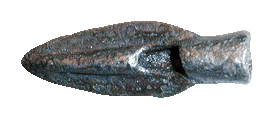
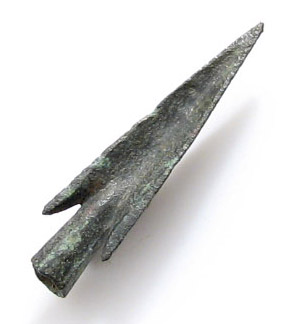
What is a Scythian Point? A Scythian, or
Irano-Scythian
projectile point is a type of point that is
trilobate
in shape as opposed to leaf shaped. The Scythians received credit for inventing
this type of arrowhead. This type of point dates predominately from the 7th to
4th centuries BC Often trilobate
points were made of bronze because that material was more conducive to the
production of mold made points like this. This type of arrow is
socketed
at one end. The shaft of the arrow would have been inserted into the socket.
Trilobate
points were better for piercing armor than the other leaf shaped variety. Also,
they were lighter. Archers used
trilobate points with compound
bows, made of several pieces of wood connected with glue, tendons, or cord. This
increased the force of an arrow shot from the bow. The arrow flew further than
with a simple bow. When the Scythians came into contact with forces in the Near
East like Assyria it is probable that the use of the
trilobate
point spread to other groups because this type of projectile point proved useful
against armor.
The arrowhead in question first appeared in the areas of Moab, Israel, and Judah
in the 600s BCE. During this time the Scythians together with King Josiah of
Judah were prominent in the area as explained in our works:
"The Tribes"
http://britam.org/the-Tribes.html
and "Lost Israelite Identity"
http://www.britam.org/Identity.html
Later the arrowhead was associated with the Scythians although used by other
peoples.
Perhaps the arrowhead originated in the Land of Israel?