
Contents:
Jerusalem News nos 541-570
Jerusalem News-541
Date: 10 Kislev 5767, 30 November 2006
Contents:
1. Pakistan and Saudi Arabia have launched a joint military exercise
2. New Saudi force aims to prevent fatal stampedes at Mecca
3. Iran, Syria synchronizing air defense, signals intelligence to counter any U.S. attack
4. Milosevic Assassinated in UN Prison?
5. Guysen Israel News
1. Pakistan and Saudi Arabia have launched a joint military exercise
From: imra@netvision.net.il
Subject: Pakistan and Saudi Arabia have launched a joint military exercise
Pakistan and Saudi Arabia have launched a joint military exercise
ABU DHABI [MENL] -- Pakistan and Saudi Arabia have launched a joint military
exercise.
A statement by the Pakistan military said the two armies began the Sharp
Sword-2 exercise on Nov. 27 in Bahawalpur in the eastern Punjab province.
The statement said Sharp Sword, the latest in a series of joint maneuvers,
would last three weeks.
"Exercise Al Samsaam-2 [Sharp Sword] is a sequel to the series of exercises
that are routinely and periodically conducted between the two armed forces,"
the statement said.
The statement said the Royal Saudi Land Forces contributed a mechanized
force as well as aircraft to Sharp Sword. The Saudis were also said to have
sent armored units, artillery and anti-aircraft systems for the exercise.
--------------------------------------------
IMRA - Independent Media Review and Analysis
Website: www.imra.org.il
2. New Saudi force aims to prevent fatal stampedes at Mecca
http://www.worldtribune.com/worldtribune/
ABU DHABI Saudi Arabia has organized a force to prevent stampedes at the annual Islamic pilgrimage. This was the second force created by the ministry to maintain order during the Haj. Every year, hundreds of people have been killed in stampedes that result from the stone-throwing ceremony at Jamrat.
3. Iran, Syria synchronizing air defense, signals intelligence to counter any U.S. attack
http://www.geostrategy-direct.com/geostrategy%2Ddirect/
LONDON Iran and Syria have begun an effort to ensure military interoperability. Western intelligence sources said the effort is meant to ensure that the two militaries could coordinate attacks, share information and launch joint ground and missile operations. The effort began in 2005 and was formalized in a defense cooperation accord signed last November.
4. Milosevic Assassinated in UN Prison?
A Death Designed for Shock Effect
http://www.debka.com/article.php?aid=1148
DEBKAfile Special Report
March 11, 2006, 11:22 PM (GMT+02:00)
[Extracts Only]
Former Yugoslav president Slobodan Milosevic, 64, was found dead in his cell at The Hague early Saturday, March 11. His lawyer Zdenko Tomanovic announced a few hours later that Milosevic had told him Friday that he feared he was being poisoned in the UN detention facility. He at once passed that information to the Russian embassy and now demanded that the official autopsy be conducted in Moscow, not The Hague.
The truth may never be known about the alleged poisoning claim.
The lawyer is in close touch with the Milosevic family in Moscow, who immediately announced their suspicion of foul play. The tribunal, they said was responsible for his death by refusing to let him have medical treatment for high blood pressure and a heart condition in Moscow.
Milosevic, extradited in 2001, chose to defend himself against 66 counts of war crimes and genocide in Croatia, Bosnia and Kosovo in the 1990s in a trial that dragged on more than four years, with endless delays, interruptions and grandstanding. The international justices promised a final decision this summer.
The manner of Milosevic’s death has opened two fronts:
(1. The Russians are on the spot. President Vladimir Putin faced the option of demanding the body be handed over for autopsy or the presence of a Russian pathologist at the post mortem.
It will be recalled that Russian opinion under Boris Yeltsin backed Milosevic in the Balkan Wars as a great Serbian patriot and admired his willingness to defy the Americans and the Europeans and fight a Muslim takeover of the Balkans. He also had the support of the Russian Orthodox Church.
Putin will not be happy about confronting the US and the European Union on this matter. For the West, the former Yugoslav president is a war criminal who plunged his country into four ruinous wars among Serbs, Bosnians and Croatians, and was responsible for 200,000 deaths and countless atrocities.
But Moscow is involved, whether it likes it or not.
(2. The second front concerns his funeral.
Held in Serbia, it would have to be a state even for a former president. However his widow and son are both wanted in Belgrade on criminal charges, Furthermore, he still has enough supporters at home to disrupt a funeral staged by his pro-Western successors. Given the enormous difficulties, burying him Russia makes the most sense and also fit in with the dead man’s wishes. A state funeral in Belgrade would mark the end of Serbia’s Milosevic era, a favor he is anxious to deny the incumbents, whereas a tomb in Russia would become a shrine for Serbian nationalists and keep alive their dream of a Greater Serbia.
Six days before the Serbian leader’s death, one his associates, the Serbian Croat Milan Babic, committed suicide in the same UN prison. He was serving a 13-year sentence on the charge of ethnic cleansing. The War Crimes Tribunal faces an awkward inquiry over the two Serbian deaths in UN custody in less than a week.
The conduct of the Milosevic trial bears comparison with the proceedings against Saddam Hussein in Baghdad both charging wily opponents with war crimes and genocide and both posing overwhelming difficulties for the prosecution. Learning from mistakes in the Milosevic case, US policy-makers narrowed down the charges against the former dictator of Iraq to a single provable count, instead of making the tribunal wallow through 66 charges, none of which have been proved beyond doubt.
5. Guysen Israel News
Extracts
[] 2006-11-29 , 8 Kislev 5767
18:45 [France] On the 23 November, people leaving a stadium were asked if they were Jewish. They were insulted, hit and pursued if they looked Jewish. The Representive Council for Jewish Institutions in France declared, "the people who attacked Jews at Saint-Cloud should not be seen as marginal, anomalous figures, but as guineau pigs for a new barbarism". (Guysen.Isra l.News)
16:12 Israel and Germany signed an agreement for youth exchanges today. The cooperation will lead to exchange visits between young people from both countries to strengthen ties and to allow a better knowledge of both cultures. (Guysen.Isra l.News)
11:44 59 years ago the UN voted for the creation of the Jewish State in Israel. Although it is an historic date it is not officially marked in Israel. On the 29 November 1947, the General Assembly of the United Nations adopted the partition plan that provided for the creation of a Jewish State. 33 states voted for, 13 against and 10 abstained. (Guysen.Isra l.News)
[Brit-Am Remark: The Voting was in alphabetical order. The first country to vote was Afghanistan who said "No!".
The first country to say, "Yes!" was Australia.]
Jerusalem News-542
Date: 12 Kislev 5767, 3 December 2006
Contents:
1. George Bush a Second Churchill?
2. China on the Prowl in Arabia
3. US Favorite Nations: England, Canada and Israel
1. George Bush a Second Churchill?
From: Benayahu Zentgraf <ben@menorah.org.za>
Subject: Will George W. Bush follow in Churchill's footsteps?
Right On: Sound familiar, Mr. Bush?
Michael Freund, THE JERUSALEM POST Nov. 28, 2006
www.jpost.com/servlet/Satellite?cid=1162378505302&pagename=JPost%2FJPArticle%2FShowFull
Extracts:
He was labeled a "hound," a "fool" and one whose "judgment is always at fault." Denigrated as "hopeless when in power," this wartime head of
government was scorned as being arrogant, ignorant and just about everything
else in between. His strategic judgment was called into question, his
military approach was belittled and maligned, and his own generals even
mocked him, accusing him of spouting "absurdities" and being oblivious to
detail.
Does any of this sound familiar, Mr. Bush? The subject of the vitriol
described above was none other than the fearless lion of Britain, Sir
Winston Churchill. That's right. The man now credited with saving Western
civilization from the Nazi onslaught was the target of ruthless censure and
disapproval.
His critics were fierce and unrelenting, but that did not stop this great
visionary from seeing beyond the headlines and standing up for what he knew
to be right.
The question now is: Will George W. Bush follow in this great man's
footsteps? The threat facing the Western world is no less urgent or grave
than it was in Churchill's day. Then the Nazi leader spoke openly of
murdering the Jews, and of conquering the world. Now the modern-day Hitler
of Persia vows to commit genocide and boasts that the West will soon falter
and collapse.
The only difference between the two is that while the Fuehrer could merely
dream of obtaining an atomic arsenal, the tyrant of Teheran is dangerously
close to getting one.
And the only person standing in his way, the one whom God Himself has given
the ability to stop him, is none other than the president of the United
States.
And as The New York Times reported on Monday, the bipartisan Iraq Study
Group headed by former US secretary of state James Baker will recommend that
Washington engage rogue states such as Iran and Syria and open a dialogue
with them. In other words, it is sounding more and more like 1940 all over
again.
WHEN WINSTON Churchill took office in May of that year, an emboldened
Germany was on the march and the pressure
to appease the Nazi dictator was at its peak. The British Foreign Secretary,
Lord Halifax, was a firm believer in negotiations, and he wanted nothing
more than to reach an understanding with Hitler, in the hope that such a
deal would hold.
But Churchill knew that the time for diplomacy had passed. He understood
that the Nazis would honor an accord only for as long as it might serve
their interests, and that they would not hesitate to break it in order to
achieve their destructive, long-term goals.
And so, virtually alone in his belief, Churchill pressed forward, convinced
that only by confronting the Nazis could the danger to his country, and the
world, be averted once and for all.
At a time when others were busy closing their eyes to the mounting threat,
Churchill bravely sounded the alarm and refused to back down, setting the
stage not for appeasement, but for victory. It is this approach, and this
approach alone, that should guide the US president in the weeks and months
ahead. Diplomacy has failed, and sanctions will not deter Mahmoud
Ahmadinejad from pursuing his aims. Military force is the only way to
prevent the ayatollahs from joining the nuclear club, and time is running
out if they are to be stopped.
THE SO-CALLED experts and realists are dead wrong when they predict that
military action against Iran would kindle a firestorm throughout the Middle
East. Precisely the opposite is true.
The reverberations of putting Iran in its place would be entirely positive,
and would be felt throughout the region.
Right now the radicals are emboldened because they sense that America is
weak and in retreat. Hence, they feel free to make mischief and continue
destabilizing the area.
What is needed now is decisive action, and fast, to slap them down and put
the radicals back in their place.
"Had Britain stopped fighting in May 1940, Hitler would have won his war,"
wrote historian John Lukacs in Five Days in London. "He was never closer to
victory." The same now holds true of Mahmoud Ahmadinejad, who may be just
months, or even weeks away from crossing the nuclear point of no return. It
was Churchill himself who once said, "I never worry about action, only
inaction." As a result, he led his nation and the civilized world to
victory.
Mr. President, may that now become your motto too.
2. China on the Prowl in Arabia
From: imra@netvision.net.il
Subject: New Saudi alignment with China may pose challenge to US
New Saudi alignment with China may pose challenge to US
Reuters - 02 December, 2006
www.gulfinthemedia.com/index.php?id=266130&news_type=Economy&lang=en
When Haytham Zam-zami began studying Chinese, the rising superpower had only
just begun to register on the horizon for Saudi Arabia.
Eight years later China is all the rage.
China's insatiable demand for oil - and Saudi Arabia's position as the
world's top exporter - have become the basis for a trade partnership that
analysts say could upset Riyadh's decades-old oil-for-security relationship
with Washington.
"We were the pioneers, the first group," says Zamzami, a chemical engineer
with state oil firm Saudi Aramco, which this month opened an office in the
Chinese business hub of Shanghai.
"The Chinese are a proud people, with a long history and glorious
civilisation behind them. Understanding them well will bring benefit to both
sides," he said.
Saudi Arabia has become the key regional player as China quietly moves onto
traditional US turf in the Middle East.
This new alignment has also seen China boosting ties with six booming Gulf
Arab states, including oil producers Qatar, Kuwait and the UAE. China
National Offshore Oil Co. (CNOOC) is in talks with Qatar for liquefied
natural gas supplies, PetroChina is studying plans with Kuwait to build a
refinery and petrochemical complex in South China, and Aramco is negotiating
refinery joint ventures in China.
China's economic thrust has coincided with a time when US prestige in the
Arab world is at a low ebb due to the Iraq war and US support for Israel.
In addition, once-cosy US-Saudi ties have not fully recovered from the shock
of the September 11 attacks in which 15 of the 19 suicide hijackers were
Saudis.
This has hit the oil-for-security "special relationship" long based on the
role of U.S. military forces as guarantor of Saudi Arabia's safety, largely
to protect huge Saudi oilfields.
Trade at $ 20 billion
Bilateral trade is expected to hit $ 20 billion for 2006, a 30 per cent rise
on the previous year, said Li Yanlin, China's trade attache in the Saudi
capital Riyadh.
"The economy is booming in both countries and Chinese production is getting
cheaper and better," he told Reuters, adding that in the last two years
Chinese firms have won some $ 4 billion in construction contracts.
Saudi Aramco was the largest supplier of oil to China for the last four
years, in addition to being the biggest supplier to India, Japan, South
Korea and Singapore.
China has even started discussions with Aramco to provide it with a
strategic oil reserve, opening up the possibility of future tension over
global access to Saudi crude oil.Chietigj Bajpaee, research associate at the
Center for Strategic and International Studies in Washington, D.C., said
China risks being seen as trying to "lock up" Saudi oil at the expense of
Washington, or India, another Asian tiger economy with a billion-plus
population and a voracious appetite for oil.
"(China and the United States) have an increasingly symbiotic relationship,"
Bajpaee said. "This has led to fears in the United States that China is
encroaching into its 'sphere of influence' and undermining relations with
its traditional allies."
--------------------------------------------
IMRA - Independent Media Review and Analysis
Website: www.imra.org.il
3. US Favorite Nations: England, Canada and Israel
Date: Sat, 02 Dec 2006 12:20:25 -0500 (EST)
From: imra@netvision.net.il
Subject: Poll find Americans have warmest feelings towards UK,
Canada and Israel
Extracts Only
November 30, 2006 - Americans Have Warmer Feelings Toward The World,
Quinnipiac University National Thermometer Finds; But Several Nations Still
Get The Cold Shoulder
www.quinnipiac.edu/x1284.xml?ReleaseID=993&What=&strArea=;&strTime=0
England, Canada and Israel remained the nations generating the warmest
feelings among Americans. Americans' warmth toward China, India and Israel
grew the most.
Iran and North Korea remain at the bottom of the rankings. North Korea, Iraq
and Venezuela were the nations whose ratings fell.
"Israel's rating of 68.2 is a substantial increase since the last survey,
and even more impressive when compared to its rating of 62.9 in the June
poll, which was before its war with Hezbollah in Lebanon," said Brown.
The nations and the mean score of the warmth of American voters' attitudes,
and in parentheses the mean score from August 28 are:
1) England - 78.9 (78.3)
2) Canada - 73.4 (71.7)
3) Israel - 68.2 (65.9)
4) Germany - 58.1 (first time included)
5) India - 56.6 (53.4)
6) Mexico - 51.4 (51.4)
7) United Nations - 50.4 (49.2)
8) Russia - 46.2 (45.5)
9) France - 44.6 (43.2)
10) China - 44.2 (39)
11) Saudi Arabia - 40.4 (38.2)
12) Venezuela - 30.9 (35.9)
13) Iraq - 25.9 (27.7)
14) Syria - 24.3 (21.7)
15) Palestinian Government - 23.8 (22.8)
16) Cuba - 24.1 (24)
17) Iran - 15.5 (13.9)
18) North Korea - 13.5 (15)
From November 13 - 19, Quinnipiac University surveyed 1,623 registered
voters nationwide. The survey has a margin of error of +/- 2.4 percentage
points.
The Quinnipiac University Poll, directed by Douglas Schwartz, Ph.D.,
conducts public opinion surveys in New York, New Jersey, Connecticut,
Pennsylvania, Florida, Ohio and nationwide as a public service and for
research. More data at www.quinnipiac.edu and click on Institutes and
Centers, or call (203) 582-5201
Full survey:
www.quinnipiac.edu/x1284.xml?ReleaseID=993&What=&strArea=;&strTime=0
--------------------------------------------
IMRA - Independent Media Review and Analysis
Website: www.imra.org.il
Jerusalem News-543
Date: 13 Kislev 5767, 4 December 2006
Contents:
1. "A Welshman playing a Jew"
2. Will Saudia Arm the Sunnis in Iraq?
(a) Arab News Extract
(b) Debka Version
3. Archaeology: The Brit-Am Version of 9.31-32
4. Report: Arab, Jewish birthrates in Jerusalem equal for first time
5. Foreigners Vrs in USA in Iraq
1. "A Welshman playing a Jew"
http://www.thevillager.com/vil_95/playingshylocks.html
Playing Shylocks Jewish apologist
Royal Shakespeare companys Gareth Armstrong discusses his one-man portrayal of Tubal
By Jerry Tallmer
Extract:
The soups of the day, said the waiter, were chicken rice, potato leek and matzoh ball. Gareth Armstrong opted for the matzoh ball, I kid you not.
Sounds appropriate for a Welshman playing a Jew, he said.
During the give and take at the Y, a man -a lawyer in his 40s- stood up to say that The Merchant of Venice should never be played because it incited hatred.
He said that Shylock is more sinned against than sinning, and that all the other guys in the play are villains. "It was as if he was arguing with Shakespeare," said Armstrong. "I told him hed answered his own question."
Born June 26, 1948, in the Welsh mining town of Tedegar, Armstrong is now 56. His grandfather was a miner. His father was a Welsh-speaking Presbyterian minister.
"There's something about the Welsh and the Jews. They do say that Welsh is one of the lost tribes."
2. Will Saudia Arm the Sunnis in Iraq?
(a) Arab News Extract
ARAB NEWS (Saudi) 3 Dec.'06:"Post Article on Iraq Baseless: Kingdom", by
Siraj Wahab
QUOTE FROM TEXT: "Obaid said Saudi would intervene with funding and weaponry
to prevent Shiite
militias from attacking Iraq's Sunnis once the United States starts pulling
out"
------------------------------------------------------------------------------------------------------------------------------
EXCERPTS:
JEDDAH, 3 December 2006 - Saudi Arabia has strongly rejected...an article
carried by The Washington Post which alleged that the Kingdom would arm
Sunnis in Iraq in the event of a wider sectarian conflict in the US-occupied
country....Op-Ed piece written by Nawaf Obaid in the US daily on Wednesday.
"The writer does not represent any official agency in Saudi Arabia. What he
published is his own personal opinion and does not in any way represent the
policy or positions of the Kingdom," SPA quoted the official source as
saying. "Riyadh has always reiterated its support for Iraq's security, unity
and stability with all of its sectarian groups," the source added.. . .
.
In the article, Obaid said Saudi Arabia would intervene with funding and
weaponry to prevent Shiite militias from attacking Iraq's Sunnis once the
United States begins pulling out of Iraq.
"If the US pulls out leaving a security vacuum in Iraq... remaining on the
sidelines would be unacceptable to Saudi Arabia," wrote Obaid. "To turn a
blind eye to the massacre of Iraqi Sunnis would be to abandon the principles
upon which Saudi Arabia was founded. It would undermine the Kingdom's
credibility in the Sunni world and would be a capitulation to Iran's
militarist actions in the region.". . .
"King Abdullah is a sagacious leader. He would certainly not do anything
that would plunge the region into endless turmoil," ... . By virtue of
being the Custodian of the Two Holy Mosques, he represents all Muslims, not
just Shiite and Sunni," .... ..
"I know this article doesn't represent Saudi policies," said Iraqi Prime
Minister Nuri Al-Maliki on Thursday. "I am in contact with the Saudi
government and they realize the necessity of protecting the democratic
process."
====================================================================
Sue Lerner - Associate, IMRA
--------------------------------------------
IMRA - Independent Media Review and Analysis
Website: www.imra.org.il
(b) Debka Version
http://www.debka.com/
Saudi Arabia denies truth of article by a Saudi security adviser suggesting the kingdom would back Iraqs Muslim Sunnis after the US pullout
December 2, 2006, 10:48 PM (GMT+02:00)
A former government spokesman, Nawaf Obaid, said Riyadh will use money, weapons or oil power to prevent Iraqi Sunnis from being massacred by Iranian-backed Shiite militias even at the risk of a regional war. Obaid says his views do not represent those of the Saudi government. Earlier, DEBKAfiles Middle East sources noted that he appears to speak for a group of very influential Saudis in Washington, including ambassador Prince Turki al-Faisal. US vice president Dick Cheney visited Riyadh Saturday, Nov. 25, ahead of the US presidents talks in Amman Wednesday and Thursday. Obaid listed Saudi options as being: providing assistance to Sunni military leaders primarily ex-Baathists leading the insurgency; establishing new Sunni brigades, or strangling Irans funding of Iraqs Shiites by boosting oil production and halving prices.
3. Archaeology: The Brit-Am Version of 9.31-32
From: david meadows <rogueclassicist@gmail.com>
================================================================
explorator 9.31-32 December 3, 2006
================================================================
================================================================
AFRICA
================================================================
Nice feature on petroglyphs in South Africa:
http://news.yahoo.com/s/nm/20061122/lf_nm/safrica_rock_dc_1
On the treasures of Timbuktu:
http://www.smithsonianmagazine.org/issues/2006/december/timbuktu.php
================================================================
ANCIENT NEAR EAST AND EGYPT
================================================================
Did the Egyptians use concrete when building the pyramids? (didn't
someone else suggest this a while back?):
http://www.nytimes.com/2006/11/30/science/30cnd-pyramid.html
http://tinyurl.com/vbwom (KC Star)
http://www.timesonline.co.uk/article/0,,3-2480751,00.html
They're talking (again) about sending a little robot up a shaft
of the Great Pyramid:
http://tinyurl.com/ym69tl (AFP via Yahoo)
http://www.news.com.au/story/0,10117,20852379-1702,00.html
http://english.people.com.cn/200612/01/eng20061201_327276.html
http://tinyurl.com/yka2vo (IOL)
A sort of overviewish thing on what has been found at Tel Megiddo:
http://www.haaretz.com/hasen/pages/ShArt.jhtml?itemNo=789534
On peaches at Masada:
http://www.haaretz.com/hasen/spages/794492.html
More on Qumran latrines:
http://tinyurl.com/yaeqbq (Sun)
Latest video at the Archaeology Channel is about mummy preparation:
http://www.archaeologychannel.org/
================================================================
ANCIENT GREECE AND ROME (AND CLASSICS)
================================================================
And, of course, there was that She-Wolf story:
http://dsc.discovery.com/news/2006/11/22/shewolf_arc.html
Interesting curse tablet from Leicester:
http://www.sciencedaily.com/releases/2006/11/061130081359.htm
http://www.eurekalert.org/pub_releases/2006-11/uol-uol112806.php
http://tinyurl.com/yfxuph (LA Times)
http://www.thesun.co.uk/article/0,,2-2006550819,00.html
Norwegians in the Legions?:
http://www.chnpress.com/news/?section=2&id=6838
================================================================
EUROPE AND THE UK (+ Ireland)
================================================================
More coverage of Stonehenge as an ancient Lourdes:
http://tinyurl.com/yzrmqa (Telegraph)
http://archive.gulfnews.com/articles/06/11/29/10085841.html
http://www.guardian.co.uk/comment/story/0,,1961314,00.html
Vandal burial in Slovakia:
http://mujweb.atlas.cz/veda/archaeology/Tatry_find.htm
http://tinyurl.com/yzamx5 (Slovak (?), with photos)
http://www.sme.sk/c/2994753/germansky-tutanchamon-pod-tatrami.html
(ditto)
================================================================
NORTH AMERICA
================================================================
An interesting article on Desert Archaic Indians:
http://www.desertusa.com/ind1/ind_new/ind3.html
================================================================
OTHER ITEMS OF INTEREST
================================================================
An avalanche on Mount Etna some 8000 years b.p. appears to
have triggered a massive tsunami:
http://www.sciencedaily.com/releases/2006/11/061128083754.htm
http://www.sys-con.com/read/307495.htm
http://news.xinhuanet.com/english/2006-12/01/content_5419215.htm
http://www.msnbc.msn.com/id/15971504/
http://www.upi.com/NewsTrack/view.php?StoryID=20061128-113115-5955r
And also on the natural disaster front ... an 18th century Icelandic
volcano eruption has been linked to famine in Egypt:
http://www.sciencedaily.com/releases/2006/11/061121232204.htm
http://www.newscientist.com/article.ns?id=dn10649&feedId=online-news_rss20
One of the alchemists' secrets appears to have been cracked:
http://www.eurekalert.org/pub_releases/2006-11/ucl-2ct112006.php
A history of poisoning:
http://www.npr.org/templates/story/story.php?storyId=6569885
A 15th century drawing of Stonehenge:
http://arts.guardian.co.uk/news/story/0,,1957926,00.html
Tomb robbing in Israel and Palestine:
http://tinyurl.com/ymv5zb (Chronicle)
4. Report: Arab, Jewish birthrates in Jerusalem equal for first time
http://www.haaretz.com/hasen/spages/795830.html By Nadav Shragai, Haaretz Correspondent
For the first time ever, in 2005 the Arab and Jewish birthrates in Jerusalem were equivalent at 3.9 children per woman. An American-Israeli research report recently submitted to Jerusalem Mayor Uri Lupolianski found that the Arab fertility rate in Jerusalem has dropped in recent years, while the fertility rate among Jewish women in the capital has risen.
Dr. Maya Choshen of the Jerusalem Institute for Israel Studies, who edits the Statistical Yearbook of Jerusalem, confirmed that the data used to compare Jewish and Arab birthrates was accurate, but noted it only covered one year. "Statistical trends must be examined over a number of years before reaching conclusions," Choshen added.
The researchers Bennett Zimmerman, Roberta Seid, Michael Wise and Yoram Ettinger recommend annexing 100,000 Palestinians to Jerusalem in order to resolve the city's demographic problem. According to the four, as a result of annexing additional East Jerusalem territory leading toward Ma'aleh Adumim, Givat Ze'ev and Gush Etzion, the Jewish population will also increase by tens of thousands and negative Jewish emigration out of the capital will be reduced.
Advertisement
Recently, the political parties of Kadima and Labor have adopted the approach that outskirts of the city with large Arab populations should be removed from the Jerusalem jurisdiction to resolve the capital's demographic issues.
This could make the city a magnet for the Jewish population, tipping the demographic scales toward it. "Avoiding expanding city territory, due to concerns of a demographic burden, will increase the housing and employment burden and accelerate negative emigration out of Jerusalem," the report states.
The researchers reiterate previous findings that Jerusalem's key problem is negative Jewish emigration, which stems from tight housing and job markets. They attribute the distress to a lack of land for transportation infrastructure, which they say is only resolvable by doubling city jurisdiction.
In the 2000-2003 period, 63,000 residents left Jerusalem, while only 37,000 moved to the capital. In the past 25 years, 311,000 residents have moved away, while 208,000 Jews have changed their place of residence to the city.
5. Foreigners Vrs in USA in Iraq
CIA: Foreign terrorists only 3 percent of Iraq insurgency
http://www.geostrategy-direct.com/geostrategy%2Ddirect/
U.S. intelligence officials this week laid out the numbers of insurgents and foreign terrorists in Iraq, and revealed that the number of foreign terrorists working in Iraq is relatively small, although they include highly lethal suicide bombers.
CIA Director Michael Hayden told the Senate Armed Services Committee that the number of foreign terrorists is slightly more than 3 percent of the number of overall insurgents, with the majority being Iraqis.
I would agree that the rest of the fighters are from Iraq, he said noting that they are sectarian as opposed to Al Qaida.
A significant portion of the leadership of Al Qaida in Iraq is foreign, he said. And an overwhelming percentage of the suicide bombers are foreign. So they have an impact well beyond their numbers.
Jerusalem News-544
Date: 16 Kislev 5767, 6 December 2006
Contents:
1. URLs of Interest
2. IRELAND by Dr. Alex Grobman
3. Guysen Israel News: Tuesday
4. The Scotsman: In the land of kilts and Kiwis
5. SCOTS DOWN UNDER: THE FACTS
1. URLs of Interest
An Irishman who helped Jews in WW2
but also was concerned for the wellbeing of Nazi criminals
Hugh O'Flaherty
http://en.wikipedia.org/wiki/Hugh_O%27Flaherty
Wannsee Conference by an Australian
http://www.holocaust.com.au/mm/f_plans.htm
The Jews of Ireland
by Robert Tracy
http://www.ucc.ie/icms/irishmigrationpolicy/Judaism%20The%20Jews%20of%20Ireland.htm
2. IRELAND by Dr. Alex Grobman
From: "Root & Branch Association, Ltd." <rb@rb.org.il>
[Extracts Only]:
IRELAND
Why Do Irish Academics Persist in advocating Boycott and Divesting from Israel?
Dr. Alex Grobman
YERUSHALIYIM, Israelite Tribal Territories of Judah and Benjamin, Kingdom of David and Solomon, United Israelite Kingdom of Judah and Joseph, Fourteenth Day, Ninth Month ("Kislev"), 5767; Yom Shlishi (Third Day of the Week/"Tues"-day, December 5, 2006), Root & Branch Information Services [mailto:rb@rb.org.il] [www.rb.org.il]:
Divestment campaigns are back in the news once again after a short lull. Their objective is to terminate university investments in Israel in order to impede the country's economic growth and development. By using "economic warfare", they want "to destroy Israel's economy", according to Fred Taub, president of Divestment Watch.
As part of this campaign, attempts are made to prevent Israeli academic and political leaders from speaking on university campuses. Another goal is to eliminate Israeli academic research funds since Israeli academics are viewed as key elements and "collaborators" of the Jewish state.
Irish academics are particularly adamant in boycotting Israeli academic institutions. In a letter to The Irish Times on September 12, 2006, 61 Irish professors urged academic institutions throughout the world to boycott Israeli institutions of higher education.
The Irish Embassy in Israel condemned the petition as "counterproductive", yet the Irish government has helped foster this enmity because of its own negative attitudes towards Israel. By examining the government's views toward the Jewish State, we can see how Irish academics reflect their own government's attitude toward Israel, and why they are so tenacious in advocating this boycott.
In "Ireland and the Palestine Question 1948-2004", professor Rory Miller explains that the Irish believe they possess a unique insight into the Arab/Israeli conflict because of their neutrality and their distinct "moral" position in the international arena.
Ireland granted Israel de facto recognition in 1949, but did not grant it de jure recognition until May, 1963. Part of the reason was Ireland's aversion toward partition, which was a result of its own fight for independence from Britain. The Irish saw partition as a cruel means of solving territorial disputes that would not bring peace.
An even more fundamental reason for Irish opposition to granting Israel recognition Miller suggests, was that from the late 1940's, the Irish clergy, political parties, the general public and the media have had a special interest in the Holy Land because of their concern about the Christian Holy Places, especially in Jerusalem.
The Vatican had supported the internationalization of the city and the holy sites, and the Irish were greatly influenced by the "Vatican factor", and adamant that the rights of Catholics be maintained.
Oil is an additional factor why the Irish side with the Arabs. Miller quotes The Irish Times in mid-1963 that "if it comes to a matter of competition for the friendship of Israel or the Arab League, nobody can doubt what the outcome will be: The oil-rich Arab states possess an attraction denied to Israel".
The rights of Arab refugees are another ongoing concern as was Israel's refusal to withdraw from the Golan Heights and the "occupied territories". Failure to resolve the refugee issue is viewed as the "greatest single obstacle", to peace in the region.
A further area of contention occurred after the Irish provided troops to serve first as U.N. observers and later as members of the U.N. Interim Force in Lebanon (U.N.I.F.I.L.). Whenever there was a conflict between the Christian militias and Irish soldiers, the Irish blamed Israel.
This led Israeli Ambassador Shlomo Argov, Israeli Ambassador to Britain and Ireland, to wonder how people in Dublin could sit around "smugly" and "pass judgment" about events in another part of the world. He found it particularly difficult to understand how the Irish could be so "insensitive to the Christian minority in Lebanon", and later charged Ireland "of leading the pack in [the] constant flagellation of Israel".
Fred Taub points out, divestment campaigns are an attack on the U.S. "Foreign governments", he urges, "should not be allowed to dictate U.S. foreign policy", and they must not be permitted to promote the destruction of the economy of another democracy.
Israel's economy, Taub concludes, "has a direct impact on the U.S. economy because Israel is a key developer of new technologies, including in medicine, computers and even space exploration; not to mention that it is the democracy and free-market economy example for the Middle-East. The Arab boycott of Israel is the single biggest impediment to peace, as peace can not be sustained without economic cooperation".
Shavua Tov from New Milford,
Dr. Alex Grobman
3. Guysen Israel News: Tuesday
<webmaster@guysen.com>
[] 2006-12-04 , 13 Kislev 5767
23:50 Iraqi Prime Minister, Nouri al-Maliki, criticized UN General Secretary Kofi Annan's statement that the life of the Iraqis is worse today than under Saddam Hussein. Mr. Maliki said that Kofi Annan "embellished the regime of the Iraqi dictator known for his crimes against humanity". (Guysen.Isra l.News)
19:03 Divorced husbands are reneging on paying alimony to their ex-wives. The National Insurance Institute pays a minimal subsidy to divorced women whose husbands do not meet their obligations, which costs the State 10 million shekels. There are 24,000 recalcitrant ex-husbands. (Guysen.Isra l.News)
15:57 The dollar is continuing to fall. On Monday it was exchanged for 4.23 shekels, the lowest rate in five years. The euro however continues to rise, currently holding at 5.6632 shekels. (Guysen.Isra l.News)
15:10 More anti-semitism in France. A young group of students from a Jewish school in the 19th arrondissement in Paris were prevented by the driver from getting on bus 251 in Bobigny after he had noticed that they were wearing kippas [skull-caps]. The National Bureau for Vigilance Against Anti-Semitism is demanding that the Minister of Transport take disciplinary measures and press criminal charges against the driver. (Guysen.Isra l.News)
14:27 At the end of her visit to Yad Vashem, Segol ne Royal wrote in the book of gold, it is a deeply moving experience,one which makes you understand and share israel''s unbendable will and the desire for justice. Those who came back and rebuilt their roots, despite everything, are the true heroes of our time, thank you. The Socialist candidate to the Elysee [French Presidency] took part in a memorial ceremony and lit a flame for the memory of the 6 million Jews exterminated in the Shoah. (Guysen.Isra l.News)
07:58 Equality in fertility rates between Jews and Arabs in Jerusalem. For the first time, Jewish and Arab women averaged 3.9 children in the capital. This was revealed in a study carried out by an Israeli-American group and presented Mayor Uuri Lupoliansky. The fertility rates of Arabs have dropped whilst that of Jewish women have increased. (Guysen.Isra l.News)
4. The Scotsman: In the land of kilts and Kiwis
http://heritage.scotsman.com/people.cfm?id=1794532006
NO SCOTS travelled further than those hardy and intrepid adventurers who headed to New Zealand. Sailing to the Antipodes meant a voyage of close to four months; a lengthy and hazardous trip, with some known to jump ship when the boats docked at the Cape of Good Hope.
Yet many Scots did make it after large-scale settlement began in 1839 under the New Zealand Company. In the 1860s, Scots accounted for 30 per cent of immigrants and, although accurate figures are hard to find, more than 800,000 people - about 20 per cent of today's 4.1 million population of New Zealand - are thought to claim Scottish roots.
The first Caledonian Society in New Zealand was formed in 1862, the first Burns Club in 1891. But there was much more to the Scots in New Zealand than the clubs and symbolic societies of home.
The Scots also took with them the legacy of the Enlightenment and a "love of learning" and became pivotal at all levels in New Zealand education; they established a university in Otago, provided most of the staff for Victoria University and set up a system of free education in Otago which became a prototype for the country.
Perhaps the most extraordinary story of the Scots in New Zealand centres on the small North Island community which has maintained a tradition of a Highland Games for more than 140 years.
Turakina has a population of fewer than 100, but for one day of the year, its population soars to 2,000 for the Turakina Highland Games.
The event started in 1863 and, while they were not the first Highland Games in New Zealand - there was an event in Wellington in 1848 - they have endured. The Turakina Caledonian Society currently has about 20 members, including the chief, Ewen Grant, and his wife, Roz, a farming couple whose son played rugby in the Borders.
Grant proudly explains his Scottish roots: "Alexander Grant came out on a ship, the Blenheim, to Wellington in 1840, then walked to Turakina in 1850. Roz married into the society, but had Scottish links in Grays, Sutherlands and Cruickshanks on her mother's side."
BRUCE CAMERON, A Turakina farmer, history graduate and bagpiper, says the Cameron link to the area is huge: "There are five Cameron families who have been in Turakina for 150 years and I come from two of them."
The Clan Cameron is a now a New Zealand-wide organisation.
People started arriving in Turakina when another Scotsman, Sir Donald McLean, began dividing up the land. Born in Tiree in 1820, he was brought up by his grandfather, a Presbyterian minister.
Emigrating to New South Wales in 1839, he moved the following year to New Zealand as an agent for a timber firm. Many Scots came to New Zealand on the Blenheim in 1840. It contained Highlanders and Paisley weavers and the names on the manifest reflect that diversity; MacDiarmid, Cameron, McCue, Fraser, Mann, MacKenzie and Rankin among them.
There were three churches in and around Turakina. The Episcopalian and Catholic churches both had Scottish and non- Scottish members, but the Presbyterian Church was firmly rooted in the Scottish community; until 1914 the minister was required to speak Gaelic.
The Scots brought with them farming skills - and distilling talents. In the 1860s, when the area was frontier territory, the Turakina Highlanders sold illicit whisky to soldiers garrisoned there and other migrants.
The Caledonian Society is not the only Scottish organisation in the Turakina area. There is a Burns Society and a piping club too - but the Highland Games are the highlight of the calendar.
Small gatherings led to the first official Turakina Highland Games in 1863. Running the Games is now the sole remit of the Turakina Caledonian Society on an entirely voluntary basis.
Members of the Clan Cameron are keen to develop stronger links between Scotland and the diaspora in New Zealand. Maisie Earle (ne Cameron), originally from Banavie near Fort William and the only woman to have been president of the Clan Cameron in New Zealand, made a submission to a Scottish Parliament investigation on promoting scotland worldwide. It detailed the Clan Cameron scheme for people aged 18-30 with family membership of Clan Cameron in Scotland or New Zealand.
"Young people work in the other country to further their career development and live with people in the community, usually Camerons," says Earle.
5. SCOTS DOWN UNDER: THE FACTS
http://heritage.scotsman.com/people.cfm?id=1794532006
DUNEDIN, on South Island [NZ], was the entry point for most 19th-century Scots. The city and its streets take their names from Edinburgh (Princes Street, Leith Street, Dundas Street) and there is a statue of Robert Burns in the centre.
Only 8,207 of 150,000 convicts transported to Australia were Scots. Political prisoners included the Scottish Martyrs, who inspired Burns's song Scots Wha' Hae.
From 1832-1850, 14,000 "assisted immigrants" arrived in Australia, including the Scottish Mechanics - 54 Scottish tradesmen and their families. Skilled labourers were needed and the government helped pay their passage. In the same period about 25,000 "free settlers", who paid their own way, came from Scotland.
The grandfather of the Australia-born newspaper baron Rupert Murdoch, the Rev James Murdoch, came from Stirling.
Australia's opera singer Dame Joan Sutherland was of Scots descent.
There are around 300 Scots-linked groups in Australia - and three out of the first six governors of Australia were Scots, including Lachlan Macquarie, known as the "father of Australia".
Jerusalem News-545
Date: 17 Kislev 5767, 8 December 2006
Contents:
1.Arutz Sheva News Thursday
[3. PLO CONTINUES ROLE AS SOURCE OF INTERNATIONAL TERROR
2. DNA: Saami (Lapps of Finland-Northern Europe)
have similar mtDNA (female) markers as Berbers of North Africa!
3. Brit-Am and the Golan Heights
1. Arutz Sheva News Thursday
http://www.IsraelNationalNews.com
December 07, 2006, 16 Kislev 5767
Editor: Hillel Fendel
[3. PLO CONTINUES ROLE AS SOURCE OF INTERNATIONAL TERROR
By Gil Zohar
Thirteen years after the signing of the Oslo Accords, the PLO remains
proud of its role as the source of global terror and an inspiration
for terrorists worldwide who have copied their techniques.
In a broadcast on Palestinian Authority TV on November 14, Ahmed Hales
Abu Maher - the Secretary of Fatah in the Gaza Strip - expressed pride
that the Fatah "gives daily examples" that the world has "imitated,"
from the participation of children in combat to the widespread use of
suicide bombers.
Oh warrior brothers, this is a nation that will never be broken, it
is a revolution that will never be defeated. This is a nation that
gives an example every day that is imitated across the world. We gave
the world the children of the RPG [Rocket Propelled Grenades], we gave
the world the children stone [-throwers], and we gave the world the
male and female Martyrdom-Seekers [suicide bombers]."
Palestinian Media Watch has documented dozens of
examples of the Palestinian Authority glorifying individual acts
of terrorism as well as the memory of terrorists past and present.
2.DNA: Saami (Lapps of Finland-Northern Europe)
have similar mtDNA (female) markers as Berbers of North Africa!
http://class.csuhayward.edu/faculty/gmiller/3710/DNA_PDFS/mtDNA/mtDNA_SaamiBerber.pdf
3. Brit-Am and the Golan Heights
The Golan Heights are being considered by a group of Ephraimites
as a possible location for the establishment of some type of settlement.
Brit-Am is not yet a party to these considerations and we have not yet
decided (if invited) if we should be.
For this reason in addition to their intrinsic importance
it is worth reading something about them.
Wikipedia: Golan Heights -Interesting Extracts
http://en.wikipedia.org/wiki/Golan_Heights
The Golan Heights are surrounded by four countries: Lebanon, Syria, Jordan, and Israel.
The Golan Heights (Arabic: Ha bat al- l n, Hebrew: Ramat HaGolan) or Golan is a plateau on the border of Israel, Lebanon, Jordan and Syria.
The origin of the name "Golan" is from an ancient city mentioned in the Bible as a "City of Refuge" (see Golan). Eventually, Golan became known as the name of an informal geographic region stretching from that ancient biblical site west towards the Sea of Galilee. Additional names used in this context are Gaulanitis or Gaulonitis.
The name "Golan" has been adopted in Israeli culture to refer to that territory taken by Israel from Syria. The territory taken does not include all of the geographic or historic Golan; furthermore it does include areas belonging to other geographic regions, such as the Hermon and the Jordan Valley. The boundries of that territory are somewhat less rigid than the geographic definition; a sizable portion of the area conquered by Israel in 1967 was ceded to Syria after the Yom Kippur War.
The Golan is usually divided into three regions: northern (between Nahals Sa'ar and Gilabon), central (between Nahals Gilabon and Dilayot), and southern (between Nahal Dilayot and the Yarmouk Valley). The Golan Heights themselves are between 400 and 1,700 feet (120520 m) high.
In 2006 the Golan Heights had a population of approximately 36,000 people, consisting of approximately 19,000 Jewish settlers and 17,000 Druze residents. [
The area has been occupied by many civilizations. During the 3rd millennium BC the Amorites dominated and inhabited the Golan until the 2nd millennium, when the Arameans took over. Later known as Bashan, two tribes were associated with the region during the time of Joshua, the tribe of Dan - Deuteronomy Chapter 33:22:"And of Dan he said: Dan is a lion's whelp, that leapeth forth from Bashan" and Tribe of Manasseh. The city of Golan was used as as a city of refuge. King Solomon appointed 3 ministers in the region - 1 Kings Chapter 4:13:"the son of Geber, in Ramoth-gilead; to him pertained the villages of Jair the son of Manasseh, which are in Gilead; even to him pertained the region of Argob, which is in Bashan, threescore great cities with walls and brazen bars". After the split of the United Monarchy, the area was contested between the Kingdom of Israel (the northern of the two Jewish kingdoms existent at that time) and the Aramean kingdom from the 800s BC. King Ahab of Israel (reigned 874852 BC) defeated Ben-Hadad I in the southern Golan. According to Jewish law the Golan is regarded as part of Canaan which is holier than the parts on the otherwise eastern parts of the Jordan river [9].
In the 700s BC the Assyrians gained control of the area, but were later replaced by the Babylonian and the Persian Empire. In the 5th century BC, the region was settled by returning Jewish exiles from Babylonian Captivity.
The Golan Heights, along with the rest of the region, came under the control of Alexander the Great in 332 BC, following the Battle of Issus. Following Alexander's death, the Golan came under the domination of the Macedonian noble Seleucus and remained part of the Seleucid Empire for most of the next two centuries. It is during this period that the name Golan, previously that of a city mentioned in Deuteronomy, came to be applied to the entire region (Greek: Gaulanitis).
The Maccabean Revolt saw much action in the regions around the Golan and it is possible that the Jewish communities of the Golan were among those rescued by Judah Maccabee during his campaign in the Galilee and Gilead (Transjordan) mentioned in Chapter 5 of 1 Maccabees. The Golan, however, remained in Seleucid hands until the campaign of Alexander Jannaeus from 83-80 BC. Jannaeus established the city of Gamla in 81 BC as the Hasmonean capital for the region.
In the 15th and 16th centuries, Druze began to settle the northern Golan and the slopes of Mount Hermon. In the 16th century, the Ottoman Turks came in control of the area and remained so until the end of World War I.
The boundary between the forthcoming British and French mandates was defined in broad terms by the Franco-British Boundary Agreement of December 1920. The demarcation was completed March 7, 1923, several months before Britain and France assumed their Mandatory responsibilities.[10] This placed most of the Golan in the French sphere. ....The Golan Heights thus became part of the French Mandate of Syria. The territorial concessions that Britain made to the French did not pass without objection. President Woodrow Wilson cabled the following protest to the British Cabinet:
"The Zionist cause depends on rational northern and eastern boundaries for a self-maintaining, economic development of the country. This means, on the north, Palestine must include the Litani River and the watersheds of the Hermon, and on the east it must include the plains of the Jaulon and the Hauran. Narrower than this is a mutilation...I need not remind you that neither in this country nor in Paris has there been any opposition to the Zionist program, and to its realization the boundaries I have named are indispensable". [1]
When the French Mandate of Syria ended in 1944, The Golan Heights became part of the new independent state of Syria. They remained under Syrian control until 1967.
About 90% (80,000) of the Golan's inhabitants, mainly Druze Arabs and Circassians, fled or were expelled by Israeli forces during the Six-Day War.[5] For various political and security reasons, Israel has not allowed those who fled to return [12].
Israel began settling the Golan almost immediately following the war. Kibbutz Merom Golan was founded in July 1967. By 1970 there were 12 Jewish settlements on the Golan and in 2004 there were 34 settlements populated by around 18,000 people [13]. Today the Golan is firmly under Israeli control as part of the Jewish state.
During the Yom Kippur War in 1973, Syrian forces overran much of the southern Golan, before being pushed back by an Israeli counterattack. Israel and Syria signed a ceasefire agreement in 1974 that left almost all the Heights in Israeli hands, while returning a narrow demilitarized zone to Syrian control.
In general, Golan Jewish residents are perceived to be closer to the Israeli mainstream in terms of political alignment than Jewish residents of the West Bank. Jewish settlers on the Golan are called "mityashvin" - which has a ring of "pioneers", whereas Jewish settlers on the West Bank and Gaza are and were called "mitnachalim" which has a negative connotation in many Israelis' minds. [21]
The Golan Heights' administrative center, which is also its largest Israeli community, is the town of Qatzrin, built in the 1970s. There are another 19 moshavim and 10 kibbutzim.
There are also four Druze villages in the Northern part of the Golan Heights including Majdal Shams, and an Alawite village called Ghajar that stretches on both side of the Lebanese-Israeli border.
Qatzrin is regarded as "the capital of the Golan Heights" and as such hosts a large number of attractions. The ancient Talmudic village of Qisrin is fully excavated and one can tour the different houses in the village as well as the remains of a large synagogue. There is also an interactive movie experience about the Talmudic time within the compound. The Museum of Golan Antiquities hosts archaeological finds uncovered in the Golan Heights from prehistoric times. A special focus concerns Gamla and excavations of synagogues and Byzantine churches. Throughout the Golan Heights 29 ancient synagogues were found dating back to the Roman and Byzantine periods. Qatzrin is home to the Golan Heights Winery, a major winery of Israel and the mineral water plant of Mey Eden which derives its water from the spring of Salukiya in the Golan. One can tour these factories as well as factories of oil products and fruit products. It also has two open air strip malls one which holds the Kesem Hagolan or the "Golan Magic" a three-dimentional movie and model of the geography and history of the Golan Heights [22] [23] [24].
Jerusalem News-546
Date: 20 Kislev 5767, 11 December 2006
Contents:
1. Increase of anti-Jewish sentiment in Germany
2. Abortion Raises Risk of Miscarriage of Subsequent Pregnancy 60 Percent
3. Israel and the United Nations
4. DUTCH BANK DIVESTS ITS INTEREST IN JERUSALEM TRAIN
5. Archaeology: Brit-Am Edition of explorator 9.33
1. Increase of anti-Jewish sentiment in Germany
From: VOJ <mishal@mishal.org>
Subject: Israel_news_update
Voice of Judea Weekend News Update
#1- Germany, Never Again?
#1- Never Again?
Berlin public school attacks increase
Jewish schoolchildren increasingly are suffering anti-Semitic attacks
in Berlin public schools, observers said.
Most incidents involve either neo-Nazis or Muslim pupils, according
to a report Thursday in Der Spiegel Online magazine.
The word "Jew" increasingly is used as a curse, the report said.
Barbara Witting, director of the Jewish High School in Berlin, said
children have been transferring to the Jewish school to avoid
discrimination in public schools.
2. Abortion Raises Risk of Miscarriage of Subsequent Pregnancy 60 Percent
http://www.lifenews.com/nat2806.html
by Steven Ertelt
LifeNews.com Editor
December 5, 2006
[]Washington, DC (LifeNews.com) -- A team of British doctors has released the results of a new study showing that women who have an abortion run a higher risk of having a miscarriage in a subsequent pregnancy. The study also showed that women using in-vitro fertilization have higher miscarriage risks as well.
The doctors, affiliated with the London School of Hygiene and Tropical Medicine, said the reasons behind the increased miscarriage risk were vague.
However, they confirmed that women who had had a previous abortion experienced a 60 percent higher risk of having a miscarriage in another pregnancy.
Women using the in-vitro technique had a 40 percent greater risk of suffering a miscarriage.
In the study, Dr. Noreen Maconochie examined data from 603 women between the ages of 18 and 55 who had experienced a miscarriage during the first 13 weeks of their pregnancy. They compared those results with 6,116 women whose pregnancies advanced beyond 13 weeks.
The team published their findings in the British Journal of Gynegology.
This isn't the first study to show that abortions adversely affect a woman's fertility as other research shows that abortion can lead to infertility by increasing the risk of miscarriages.
A 1986 report in the medical journal Epidemiology reveals women with a history of abortion have a greater risk of fetal loss than women who had no previous abortions. Women with two prior pregnancies carried to term and no abortions had the lowest risk, while women with two prior abortions had the highest risk.
Meanwhile, a 1991 British Journal of Obstetrics and Gynecology article revealed that women with a history of abortion had a 1.5-1.7 times higher risk of ectopic pregnancy than women who had previously carried a pregnancy to term.
3. Israel and the United Nations
http://en.wikipedia.org/wiki/Israel_and_the_United_Nations
Extracts from Wikiepdia:
Critics who accuse the UN of anti-Israel prejudice cite what they see as a disproportionately long list of resolutions concerning Israel,[10] especially the 1975 Resolution 3379, which qualified Zionism as a form of racism (later revoked with Resolution 4686), and the complicity of UNIFIL in the October 2000 Lebanon abduction of three Israeli Engineering Corps soldiers, by Hezbollah. In September 2004, the bereaved families announced that they intended to sue the UN for its part in the abductions.
Starting in the mid-1970s, an Arab-Soviet-Third World bloc joined to form a pro-PLO lobby at the United Nations. This was particularly true in the General Assembly where these countries frequently voted together to pass resolutions attacking Israel and supporting the PLO.[11] An early example would be in 1975, soon after the award of permanent representative status to the PLO, at the instigation of the Arab states and the Soviet Bloc, the Assembly approved Resolution 3379, which equated Zionism and racism.[11]
U.S. Ambassador Daniel Moynihan called the resolution a reckless and obscene act.[12] Israeli Ambassador Chaim Herzog told his fellow delegates the resolution was based on hatred, falsehood and arrogance. Hitler, he declared, would have felt at home listening to the UN debate on the measure.[13]
In her June 21, 2004 speech [14] at a Conference on Confronting anti-Semitism: Education for Tolerance and Understanding sponsored by the United Nations Department of Information and in her articles [15], a human rights scholar and activist Anne Bayefsky, attending as representative of the International Association of Jewish Lawyers and Jurists, advocated the necessity of deep reforms within the UN and criticized some of the UN policies and practices:
There is only one entire UN Division devoted to a single group of people: the United Nations Division for Palestinian Rights [16] (created in 1977).
The only UN day dedicated to a specific people is November 29, the annual UN Day of Solidarity with the Palestinian People.
There is only one refugee agency dedicated to a single refugee situation: UNRWA (in operation since 1950).
"The General Assembly operates through six committees of the whole. One of them, the Fourth Committee, routinely devotes 30 percent of its time to the condemnation of Israel."[17]
"The General Assembly emergency sessions... began in 1956, and since then six of the ten emergency sessions ever held, have been about Israel. The 10th such session began in 1997 and has been reconvened 13 times. ... a million dead in Rwanda or two million dead in Sudan might have warranted one General Assembly emergency session."[17]
"...the UN's primary human-rights body is the UN Human Rights Commission. 30% of the resolutions condemning specific states ever adopted over 40 years are directed at Israel." [17]
Anne Bayefsky acknowledges that "Israels policies are, of course, fair game for legitimate criticism. But the UNs outrage is grossly selective, especially when one considers the record of any number of other member nations."[18]
In April 2004, the UN special envoy to Iraq, Lakhdar Brahimi, told French radio listeners that "the great poison in the region" is Israeli "domination" and told American television viewers that the Israelis "are not interested in peace, no matter what you seem to believe in America".[19] [20] [21] [22] [23]
In August 2004, the United Nations Association of the United Kingdom (UNA-UK) published a report analyzing thirteen years of United Nations resolutions on the Arab-Israeli conflict. In light of the studys conclusions, Malcolm Harper, speaking on behalf of the UNA-UK (of which he was director until recently), called for an examination into how, if at all, the resolutions contribute to the Middle East peace process. The 76-page report [24] makes the following principal findings:
The texts of UN General Assembly and Security Council resolutions are "often unbalanced in terms of the length of criticism and condemnation of Israeli actions in the Occupied Territories as against Palestinian actions such as suicide bombings."
The United Nations is "palpably more critical of Israeli policies and practices than it is of either Palestinian actions or the wider Arab world. However criticism is not necessarily the product of bias."
In resolutions of the UN General Assembly, "violence perpetrated against Israeli civilians, including the use of suicide bombers, is mentioned only a few times and then in only vague terms."
The report also stated "However, criticism is not necessarily a product of bias, and it is not the intention here to suggest that UNGA and UNSC reproaches of Israel stem from prejudice. From the perspective of the UN, Israel has repeatedly flouted fundamental UN tenets and ignored important decisions."
The event celebrating an annual "International Day of Solidarity with the Palestinian People" on November 29, 2005 was attended by Kofi Annan and other high-ranking diplomats. In his January 3, 2006 letter to Mr. Annan, the US ambassador John Bolton criticized the UN for promoting anti-Israel agenda and noted that the map prominently displayed at the event "erases the state of Israel" only days after Iran's leader Mahmoud Ahmadinejad's speech calling to wipe Israel off the map. The organizer of the "solidarity" event is the Division for Palestinian Rights (2004-2005 UN budget: $5,449,600[citation needed]). Other bodies include the Special Committee to Investigate Israeli Practices Affecting the Human Rights of the Palestinian People and Other Arabs of the Occupied Territories ($254,500[citation needed]), the Committee on the Exercise of the Inalienable Rights of the Palestinian People ($60,800[citation needed]), and the Information Activities on the Question of Palestine ($566,000[citation needed]). Similar funding has been approved for the next biannual budget.[citation needed]
Hugh Fitzgerald, a lecturer on the manipulation of language for political ends, wrote, "No matter what the subject ("racism" at Durban, the rights of women at Cairo) and no matter what morally moronic U.N. conference is held, it will always and everywhere turn absurdly into a bash-Israel event. Not a single word in Geneva, at the Human Rights Commission, about the grave mistreatment of Hindus and Christians in Pakistan, in Bangladesh, in Indonesia. Not a word about Muslim attacks on Buddhists in south Thailand. Not a word about the Muslim attacks for two decades in the Sudan -- or at least, not a word that stopped the genocide, if the Rapporteur for the situation in the southern Sudan, M. Biro, is to be believed."[25]
4. DUTCH BANK DIVESTS ITS INTEREST IN JERUSALEM TRAIN
http://israelnationalnews.com/news.php3?id=117109
15:10 Dec 10, '06 / 19 Kislev 5767
by Gil Zohar
Extracts
[] Jerusalem's light rail is the latest subject of the anti-Israel divestment campaign.
The Hague-based ASN Bank recently divested its holdings in the French firm Veolia Transport, which is a key part of the CityPass consortium building Jerusalem's light rapid transit system. The bank explained that the project "is not in line with the United Nation's demand to stop all support for Israel's settlement activities."
On November 22, the first track was laid on the tramway's 13.8 km Red Line, which will run from the Pisgat Ze'ev neighborhood in northern Jerusalem to Mount Herzl. That route crosses the 1949 armistice line that divided Jerusalem until 1967 into Israeli and Jordanian sectors, joining parts of the city that Israel annexed following the Six Day War. The state-of-the-art LRT is slated to open January 5, 2009.
ASN, which stands for Algemene Spaarbank Nederland (The General Savings Bank of the Netherlands), had held shares in Veolia, whose subsidiary Connex Israel has a 5 percent stake in the CityPass consortium. CityPass won the NIS 3.2 billion tender to build the tramline.
Founded in 1960, ASN is a medium-sized bank with 250,000 clients, deposits totaling two billion euros and investments totaling 900 million euros in 2005. It considers itself an "ethical bank," and is therefore committed to investing only in projects that do not infringe on human or animal rights or harm the environment.
In May 2006, several human rights organizations wrote to ASN claiming that Veolia's work on the LRT project violated international law because part of the railway will pass through "occupied territory" in East Jerusalem. The Palestinian Authority also wrote to ASN, claiming that the railway's construction would have "devastating effects" on Arabs living in eastern Jerusalem, as it would connect the "illegal settlements" of Pisgat Ze'ev and N'vei Yaakov with the city center, and thereby sever the Arab-populated neighborhoods from Judea and Samaria.
The bank, together with the major Dutch non-governmental donor organization Interchurch Organization for Development Co-operation and the Amsterdam-based NGO "A Different Jewish Voice," urged the French multi-national corporation to end its involvement in the LRT project. Veolia replied that it was looking into the matter. "ASN Bank's criteria are not met by that answer," the bank responded. As a result, it decided last month to divest its shares in Veolia.
The Jerusalem Mass Transit System Project, which is jointly run by the Transportation Ministry and the Jerusalem Municipality, said ASN Bank's divestment was an internal CityPass affair, but stressed the LRT project is meant to serve all the city's residents, Jewish and Arab alike.
More investment and pensions funds in the Netherlands are expected to withdraw their money from Veolia, according to Adri Nieuwhof, a Dutch human rights activist who in the 1980s was involved in the Holland Committee on South Africa.
5. Archaeology: Brit-Am Edition of explorator 9.33
From: david meadows <rogueclassicist@gmail.com>
================================================================
explorator 9.33 December 10, 2006
================================================================
================================================================
ANCIENT NEAR EAST AND EGYPT
================================================================
Plenty of coverage of the discovery of a tomb of a sixth dynasty
doctor:
http://thescotsman.scotsman.com/index.cfm?id=1809452006
http://au.news.yahoo.com/061205/2/11o7p.html
http://www.msnbc.msn.com/id/16065823/
http://news.yahoo.com/s/nm/20061205/sc_nm/egypt_mummy_dc
http://news.yahoo.com/s/ap/20061207/ap_on_sc/egypt_mummy_3
http://tinyurl.com/yev3fo (Reuters via Topix)
http://www.livescience.com/history/061206_ap_doctor_mummy.html
http://www.kansascity.com/mld/kansascity/news/world/16180088.htm
http://tinyurl.com/ylltsk (JPost)
http://www.allheadlinenews.com/articles/7005782223
http://www.voanews.com/english/2006-12-06-voa63.cfm
http://www.chron.com/disp/story.mpl/bizarre/4383506.html (why bizarre?)
More coverage of the theory that concrete was used in the construction
of the pyramids:
http://tinyurl.com/yzwhxk
http://www.sciencedaily.com/releases/2006/12/061209122918.htm
http://www.timesonline.co.uk/article/0,,13509-2480751,00.html
Sacrificial altars from Yemen:
http://yementimes.com/article.shtml?i=1005&p=lastpage&a=1
Berkeley has cancelled its Israel program:
http://www.insidebayarea.com/trivalleyherald/localnews/ci_4768112
Jerusalem News-547
Date: 21 Kislev 5767, 12 December 2006
1. Anti-Americans on the March
2. Commandment to build the Temple
3. ANTI-SEMITISM AT GERMAN SCHOOLS
4. News Site of Interest
5. Quotation
1. Anti-Americans on the March
http://www.israelunitycoalition.org/news/article.php?id=573
Andrew Higgins - Dec 09, 2006
Wall Street Journal
[Extracts Only]
AYTAROUN, LEBANON -- Ibrahim Sayid was raised a Muslim, but he put his faith in class struggle, not Allah. He joined the Lebanese Communist Party at the age of 16. As a medical student in the Soviet Union in the 1980s, he cursed Mikhail Gorbachev as a "traitor" for jettisoning Marxism.
Today, back in his home village just a few hundred yards from Israel, Dr. Sayid, 44, still has little time for Islam. He is married to a Christian and shuns the local mosque, badly damaged when Israeli troops stormed into Lebanon this summer.
Instead of communism, he has embraced a new cause: Hezbollah, the militia and social movement rooted in Shiite Islam. The Party of God, as it is translated into English, is led by turbaned clerics and aided by the Islamic Republic of Iran, which has ruthlessly persecuted communists.
"We all have the same goals," explains Dr. Sayid, who now works in a Hezbollah clinic. The first of these goals is "resistance" against Israel, which during the summer war battled Hezbollah militiamen just outside Dr. Sayid's village. He says resistance also has a broader target: America, its allies in the Arab world and beyond, and global capitalism.
When the Cold War ended a decade and a half ago with the collapse of the Soviet Union, Mr. Sayid and others like him around the world mourned the apparent triumph of U.S. military, economic and ideological might. Many Americans rejoiced, with some embracing the theory that the demise of Marxism marked "the end of history," a period when ideological conflicts would give way to a world united in acceptance of a model typified by the U.S.
Al Qaeda's attacks on New York and Washington in September 2001 didn't fundamentally alter this conviction. Political Islam was seen as a grave threat but seemed limited in its appeal by its dependence on religious zeal. Such assumptions are now under strain as secular rebels, antiglobalization militants and other strains of revolt rally to the banner of "resistance" offered by Islamist groups such as Hezbollah.
Religion, excoriated by Karl Marx as the "opiate of the masses," has become a great mobilizing force -- even for zealous atheists. The phenomenon extends beyond the Middle East to Europe, Latin America and Africa, too. Causes that a few years ago seemed moribund or at least pass -- socialism, Third World solidarity, strident anti-Americanism -- have been injected with the fervor, though rarely the actual faith, of Islamic radicalism.
"We are all here to fight American hegemony," Naim Qassem, Hezbollah's deputy chief, told hundreds of secular activists from around the world who gathered last month in a Beirut conference center. They were there to celebrate his Islamic movement's "divine victory" over Israel this summer and cheer a broader battle against America's vision for the world. Mr. Qassem was dressed in flowing robes and a cleric's turban. Many in his audience wore T-shirts or badges featuring portraits of Che Guevara, clenched fists and other emblems of secular radical chic.
Adding to its revolutionary cachet, Hezbollah is now battling to oust Lebanon's pro-American government. Along with assorted allies, the Islamist group staged a huge peaceful rally in central Beirut Dec. 1 and is the driving force behind a mass sit-in near the offices of Prime Minister Fuad Siniora, a pro-business former banker. The protesters, encamped in tents for a week now, vow to stay until the government falls. Stoking fears the showdown may spiral into serious violence, Hezbollah has called for another mass demonstration Sunday.
Some of Hezbollah's biggest fans are in Europe. There, the hard left, demoralized by the collapse of communism, has found new energy, siding with Islamist militants in Lebanon, in Iraq and in a wider campaign against what they see as an American plot to impose unrestrained free-market capitalism.
"We are all Hezbollah now," read posters carried through London this summer during an antiwar protest march. Earlier, London Mayor Ken Livingston, once known as "Red Ken," invited a controversial Egyptian cleric to the British capital, arguing that his views have been distorted by the West.
In deeply Roman Catholic Latin America, Hugo Chavez of Venezuela has become the exemplar of a new populism that sees common cause with Iran and Hezbollah. Mr. Chvez, re-elected in a landslide last Sunday, has met Iranian President Mahmoud Ahmadinejad several times and this summer was given the Islamic Republic Medal, Iran's highest honor. Amid the rubble of Beirut's southern suburbs, a Hezbollah stronghold, portraits of Mr. Chvez now hang alongside pictures of Hezbollah leader Hassan Nasrallah. Hezbollah put them up after Mr. Chvez denounced President Bush as the devil in a September speech to the UN. "Gracias Chvez," they say.
Africa, too, is boarding the bandwagon. A summit of the 53-nation African Union this summer in Gambia featured two special guests: Mr. Chavez and Mr. Ahmadinejad. Back in Tehran, Mr. Ahmadinejad in November hosted Zimbabwe's authoritarian Prime Minister Robert Mugabe, an erstwhile devotee of Mao Zedong. Fulminating against President Bush and British Prime Minister Tony Blair, Mr. Mugabe said likeminded countries must "fight against these evil men and their evil systems."
Mainstream left-of-center parties still generally shun Islamists but chunks of their support base don't. Mr. Blair in Britain, for example, has come under fire within his own Labour Party for supporting President Bush's troubled Middle East policy, which critics say demonizes Islamist groups. In Spain, the socialist prime minister, Jos Luis Rodrguez Zapatero, has reached out to Muslims, propounding what he calls "an alliance of civilizations" and voicing sympathy for Hamas and Hezbollah. He has good relations with Mr. Chvez, Fidel Castro of Cuba and Bolivia's populist leader, Evo Morales.
At the Beirut conference last month, a Mexican Marxist denounced America for "colonizing" New Mexico. A South Korean foe of free trade raged against American beef. A Turk fumed about American military bases. A Frenchman denounced American genetically engineered foods and the North Atlantic Treaty Organization. There were even a few Americans. One thundered against big business, another against the Federal Bureau of Investigation.
An American who traveled to Beirut in November to cheer Hezbollah, who identified himself as Bill Cecil, summed up the appeal of Islamism to non-Muslims: "Your enemy is our enemy; your victory is our victory," he told a conference. Mr. Cecil, an activist for a radical group in New York, later appeared as a guest on the breakfast show of Hezbollah's television station, al-Manar. America, he told a veiled female presenter, is "not a democracy ... but a dictatorship of giant corporations." America "needs a government that provides for the people like Hezbollah helps people here."
Nowhere is the Islamist-leftist axis more potent than in Lebanon. The three-day Beirut jamboree, which featured fiery anti-American oratory and field trips to buildings bombed by Israel, was hosted jointly by Hezbollah and the Lebanese Communist Party, once-bitter enemies now united by what they proclaim as common goals.
Sitting beneath a portrait of Argentine revolutionary Che Guevara in his Beirut office, Khaled Hadadeh, the general secretary of the Lebanese communists, admits that Hezbollah and the Communist Party hated each other for years. "We started out in blood," says Mr. Hadadeh, a Sunni Muslim by birth but now a firm atheist. Che Guevara, he says, "is our symbol, like Jesus Christ or Mohammed."
Hostility to Israel and the U.S. now trumps past differences. The Communist Party disbanded its own armed wing at the end of Lebanon's civil war in 1990, but 12 of its members died fighting alongside Hezbollah this summer, Mr. Hadadeh says. Piled in the corner of his office are trophies of this summer's war: an Israeli army helmet, an Israeli rifle and a Hebrew newspaper.
Mr. Hadadeh says he has met Mr. Nasrallah 15 times and admires him greatly. At their most recent meeting in a secret location this fall, he says, they discussed not just the recent war with Israel but also the need to develop "a counter-project to the neo-liberal model," the free-market policies backed by Washington.
Part of Hezbollah's appeal lies in its tactical flexibility. Unlike many Sunni Muslim radical groups such as al Qaeda, which denounce non-Muslims and even many fellow Muslims as heretics who must be shunned or punished, Hezbollah's Shiite leadership doesn't care if its allies include atheists, Mr. Fayad says. "That is their problem not ours," he says, so long as "we have the same political position."
Among those grappling with this new perception of reality is Joseph Samaha, a secular Christian, former radical socialist and one of Lebanon's most-thoughtful intellectuals. Over the summer he became editor in chief of Al Akhbar, a new newspaper sympathetic to Hezbollah. He scoffs at Westerners who cheer radical Islam as "nave." But he concedes that Islamists now represent the only viable alternative to corrupt, authoritarian regimes in Egypt, Saudi Arabia and elsewhere. "It is sad, but it is like that," he says.
For much of the 20th century, however, the left and Islam were bitter enemies. Spain's right-wing dictator, Gen. Francisco Franco, recruited Moroccan Muslims to fight Soviet-backed foes in the Spanish Civil War in the 1930s. In 1962, Saudi Arabia, worried by Egypt's tilt toward Moscow, created the Muslim World League to rally Islam against communism. Three years later, Islamic groups in Indonesia joined in an army-led mass slaughter of communists. Anticommunist fervor reached its peak in the 1980s, when thousands of Muslims flocked to Afghanistan to battle the Soviet occupiers.
Much the same enmity existed in Lebanon. When Dr. Sayid, the surgeon, first joined the Lebanese Communist Party in the late 1970s, Mr. Nasrallah, now Hezbollah's leader, also was getting into politics -- partly out of disgust at the spread of atheistic communism.
In an autobiographical account of his early years published in an Iranian newspaper, Mr. Nasrallah recounts how his own village was "turning into an area for the activity of intellectuals, Marxists and especially supporters of the Lebanese Communist Party." He left the village and joined a group called Amal, a Shiite organization.
Iran's Islamic revolution of February 1979 and the Soviet invasion of Afghanistan at the end of that year soured communist-Islamist relations further, provoking often-bloody clashes in Lebanon and elsewhere.
Iran's new Islamic government launched a brutal crackdown on the Soviet-backed Tudeh party, a leftist group that had helped topple the American-backed Shah. And Iran sent Revolutionary Guard zealots to Lebanon to help set up Hezbollah and injected the new group with their own fierce enmity to atheism and communism.
Israel's invasion of Lebanon in 1982 accelerated the rise of Islamist groups. It uprooted Yasser Arafat's secular Palestine Liberation Organization, which had bases in Lebanon, and left Hezbollah as the main force of "resistance."
Dr. Sayid moved to Minsk in the then-Soviet republic of Belarus to study medicine. He says he went there as a true believer and was appalled when Mr. Gorbachev began his program of "perestroika," or economic restructuring, and the Soviet system started to unravel. The reforms, he says, were a "counter-revolution."
In Lebanon, meanwhile, a vicious civil war raged. Moscow put its weight behind the nominally socialist and mostly secular forces of Walid Jumblatt, leader of the country's small Druze sect, an offshoot of Islam. In Dr. Sayid's village and other areas of southern Lebanon, previously strong support for the Lebanese Communist Party wilted as Hezbollah became the dominant force. Hezbollah's reputation was boosted by its fierce resistance to Israel and its provision of medical care and other services.
In its first public manifesto issued in 1985, Hezbollah declared itself hostile to "both the USSR and the U.S., both capitalism and communism, for both are incapable of laying the foundations for a just society." Though focused on the struggle with Israel, the manifesto also sought a wider audience, addressed to "all the Oppressed of Lebanon and the World." Eventually the Lebanese Communists began cooperating with Hezbollah, attracted mainly by its power but also finding common cause in its emphasis on championing the poor.
Amid the unraveling of the Soviet Union, few outside Lebanon paid much attention to the global pretensions of Hezbollah. Then came the al Qaeda attacks on America of 2001. Washington, traumatized, launched a "war on terror" against what it viewed as a small group of homicidal religious zealots.
As anger at the U.S. mounted in 2003 ahead of the invasion in Iraq, the snowballing antiwar movement took on a curious aspect, particularly in Europe: an alliance of forces that previously loathed each other.
At a big Islamic festival this summer supported by London's mayor, Mr. Livingston, Islamist activists and left-wing politicians declared their solidarity. "Muslims and the left must and can come together, because we face the same enemies -- imperialism, colonialism and racism," said Redmond O'Neill, a senior aide to Mr. Livingston.
In Aytaroun, the Lebanese village near the border with Israel, Dr. Sayid, the Soviet-trained physician, has abandoned the socialist dreams of his youth. Communism, he concedes, "is not going to take root in this soil."
He has quit the Communist Party and now serves Hezbollah, working at a Hezbollah hospital bedecked with Islamic inscriptions and portraits of Iranian ayatollahs. When the war started this summer, his wife, an Orthodox Christian from Belarus, and three children left for her homeland. Dr. Sayid stayed behind to treat the injured, including Hezbollah fighters.
On a recent afternoon, Dr. Sayid sat with a group of Hezbollah activists in the office of the local mayor, also of Hezbollah. The mayor was wounded in the leg during the war and Mr. Sayid has been treating him.
One of the group showed off pictures of Hezbollah's "divine victory" -- an Israeli tank on its side, an Israeli warship in flames. Dr. Sayid says he is "not fully in agreement" with Hezbollah. But he believes it can succeed where communism failed. "It is strong. People support it." Hezbollah, he says, "shows the world America is wrong."
2. Commandment to build the Temple
The Temple - Beis ha-Bechirah
http://www.torah.org/
We are commanded to make a house [i.e., a Temple] for Ha-Shem [the Almighty], as it
says "And they shall make Me a Sanctuary" (Ex. 25:8). Since the time of David it is forbidden to make this Temple anywhere but on Mount Moriah in Jerusalem,
as it says
"And David said: This is the house of Ha-Shem the G-d" (I Chronicles 22:1)
and it says "
This is My eternal resting place" (Psalms 132:14).
The Sanctuary and the city of
Jerusalem were sanctified by Solomon; they remain holy even when the
Temple does not exist. They can be added to only by a king, a prophet, and
a Sanhedrin. We are commanded to respect the Temple, as it says
"And you
shall fear My Sanctuary" (Lev. 19:30; 26:2).
Important: Brit-Am is responsible for the heading which is deliberately provocative.
In practice most of the Orthodox Jews would be against building the
Temple at this stage unless certain conditions arise which are unlikely to do
so at present.
Nevertheless, it is something to think about.
3. ANTI-SEMITISM AT GERMAN SCHOOLS
SOURCE http://www.spiegel.de/international/0,1518,453402,00.html
ANTI-SEMITISM AT GERMAN SCHOOLS: Insults Against Jews on the Rise
By Bjrn Hengst and Jan Friedmann / SPIEGEL ONLINE / December 8, 2006
Right-wing adolescents and young Muslims are displaying levels of
anti-Semitism that were long considered unthinkable in Germany. At many
German schools, the word "Jew" is becoming an insult again. German
politicians don't seem to know how to respond.
The Jewish High School in Berlin's central Mitte district resembles a
high-security ward. Those who want to access the imposing old building on
Grosse Hamburger Strasse have to pass through a meticulous security check.
The building is surrounded by a fence several meters high and video
cameras register every move. Policemen stand guard in front of the
building.
"We're no ghetto," school director Barbara Wittig clarifies. "We offer
those children protection who have to fear discrimination at other
schools," she adds. And such cases have increased dramatically in the past
two years. "I always though Jews were integrated into German society,"
says Wittig. "I would never have thought it possible for anti-Semitism to
express itself as virulently as it has recently."
As of this week, Wittig's students have included two girls who
previously attended the public, non-confessional Lina-Morgenstern High
School in Berlin's Kreuzberg neighborhood. Their woes attracted
considerable public attention. For months, one of the two girls, who is 14
years old, suffered anti-Semitic insults from adolescents with an Arab
background. They also beat her and spat on her. Walking to school became
like running the gauntlet for her. Her tormentors would hide in wait for
her and chase her through the streets. In the end the girl had to be given
police protection on her way to school.
Anti-Semitism on the rise
These events in Kreuzberg represent an especially drastic example, but
they're not the exception. Berlin's state parliament lists 62 reported
cases under the category "(right-wing) extremism" in its study "Indicators
of Violence at Berlin's Schools, 2004/2005." That's a steep increase in
comparison with the previous year, when only 39 cases were registered. The
category "(right-wing) extremism" includes "anti-Semitic, racist /
xenophobic and right-wing extremist remarks" by children and adolescents,
in addition to remarks that "incite racial hatred or express
fundamentalist / Islamist fundamentalist views."
One high school student in Berlin's Steglitz-Zehlendorf district said in
class: "All Jews must be gassed." Students in the Friedrichshain-Kreuzberg
district locked another student inside the chemistry lab and said: "Now
we'll turn on the gas." A non-German child at an elementary school in
Treptow-Kpenick insulted his teacher by calling her a "Jew," a "witch"
and a "sea cow." When a teaching aid in Friedrichshain-Kreuzberg tried to
settle an argument between students, he was told: "Piss off, Jew!"
And the surge of anti-Semitism seems to be growing. In November,
Berlin's public authorities had already registered more cases of
anti-Semitism than during the entire previous year. A recent study by the
European Monitoring Center on Racism and Xenophobia (EUMC) also criticized
cases of anti-Semitism, racism and right-wing extremism at German
schools.
Right-wing extremists take up Nazi slogans
This week, in the town of Grimmen in West Pomerania, right-wing
adolescents mobilized against an exhibition on Anne Frank, disparaging her
diary as a forgery. In October, several adolescents in Parey, a town in
Germany's Saxony-Anhalt region, forced their 16- year- old classmate to
walk across the school yard wearing a large sign during lunch break. The
sign read: "In this town I'm the biggest swine / Because of the Jewish
friends of mine." It's a phrase from the Nazi era, used to humiliate
people with Jewish friends.
A teacher intervened, took the sign away and called the police. The
students responsible for the incident, who are aged between 14 and 16, are
under criminal investigation. The charges are incitement of racial hatred,
coercion and defamation. One of the students is also accused of assault.
4. News Site of Interest
http://thedailyworldaffairsreport.blogspot.com/
Oil producers shun dollar
Oil producing countries have reduced their exposure to the dollar to the lowest level in two years and shifted oil income into euros, yen and sterling, according to new data from the Bank for International Settlements.
5. Quotation
Enthusiasm and persistence can make an average person superior. Indifference and lethargy can make a superior person average.
William Ward.
Jerusalem News-548
Date: 22 Kislev 5767, 13 December 2006
Contents:
1. Dead Sea Project Planned
2. USA Warns Syria and Iran over Lebanon
3. Martial Arts Notes
(a) Dr. Richard Griffiths: Shamgar's ox-goad and the martial arts
(b) Martial Arts: Advice to Young People
(c) Scott Sullivan
1. Dead Sea Project Planned
From: imra@netvision.net.il
Subject: Excerpts:Re-emergence of Red Sea -Dead Sea canal project.
ARAB NEWS (Saudi) 11 Dec.'06:"Accord on Canal Study to Save Dead Sea"by
Abdul Jalil Mustafa "
Extracts:
AMMAN, 11 December 2006 - Jordan, Israel and the Palestinian Authority
yesterday launched a feasibility study to help save the rapidly vanishing
Dead Sea, a joint statement said.
The Jordanian government is pushing ahead with efforts to enlist world
support for a controversial project envisaging the establishment of a
multibillion-dollar canal between the Dead Sea and the Red Sea despite
criticism at home.
Considered the first step to save the Dead Sea from drying up in less than
50 years, the study will examine the economic and environmental effects of
establishing a 200-kilometre pipeline to transfer Red Sea water into the
Dead Sea, the lowest point on earth, according to Jordanian officials.
France, The Netherlands, Japan and the United States will finance the
two-year study estimated to cost around $15 million. It will be managed by
the World Bank, the statement said. The study will examine the feasibility
of building a canal to channel water from the Red Sea to the Dead Sea, where
the level has been falling by about a meter (more than three feet) each
year, it said.
The agreement was reached between Jordan's Water Minister Zafer Al-Aalem,
Israeli Infrastructure Minister Benjamin Ben Eliezer and Mohammed Mustafa,
the economic adviser to Palestinian Authority President Mahmoud Abbas.
Also present at the meeting on the Jordanian shores of the Dead Sea were
representatives of the World Bank, Europe, Japan and North America.
"The meeting, hosted by the Jordanian government, launched a feasibility
study and environment and social assessment for the Red Sea-Dead Sea water
conveyance study," the study said.
The meeting capped more than three years of talks between Jordanian, Israeli
and Palestinian experts to prepare and finalize the study's terms of
reference.
"The significance of this joint study is not merely its importance in
restoring the well-being of the Dead Sea and the producing of fresh water,"
Alaam said.
The Palestinian representative said "immediate attention to the current
crisis of the Dead Sea is urgent and important."
But Jordan's Islamic-led opposition rejects the project, dubbing it a
"political move" that has the primary aim of promoting normalization of ties
with the Jewish state.
"A technical study already conducted has shown that the project involves
political, economic, environmental and geological perils to Jordan," he
said.
In addition to preserving the Dead Sea, the project involves the
construction of a hydroelectric power plant and a desalination facility,
with an estimated cost of two billion dollars, he added. Environmentalists
have expressed concern over the project on the grounds that the consistency
of the Dead Sea would be irreversibly altered if normal sea water is allowed
to flow into it.
The Dead Sea's salt concentration is about 33 percent, compared with three
percent in the Mediterranean.
--------------------------------------------
IMRA - Independent Media Review and Analysis
Website: www.imra.org.il
Rice warns Syria and Iran over Lebanon protests
Rice makes it clear that US, international community couldn't ever tolerate
"reassertion of Syrian authority in Lebanon." She adds that Syria and Iran
must not think that Lebanon's future is up for negotiation. On Iran she says
she is optimistic about UN Security Council resolution imposing sanctions on
nuclear-aspiring state
2. USA Warns Syria and Iran over Lebanon
www.ynetnews.com/articles/0,7340,L-3338880,00.html
US Secretary of State Condoleezza Rice warned Syria and Iran in an exclusive
interview with AFP that the "future of Lebanon is not an issue for
negotiation."
In an exclusive interview with AFP, Rice rejected mounting calls to deal
directly with Damascus and Tehran as part of efforts to end the crisis in
Iraq and said the two states should have no doubts about Washington's
commitment to the embattled government of Lebanon.
"In no way is the US going to get into a situation where it is even a
conceivable notion on the part of Syria or Iran that the future of Lebanon
would somehow be compromised for other interests of the US," she said.
"I want to make it very clear that the future of Lebanon is not an issue for
negotiation with anybody," she said.
3. Martial Arts Notes
(a) Dr. Richard Griffiths: Shamgar's ox-goad and the martial arts
I listened to a very stirring sermon a few weeks ago on Shamgar. Shamgar was out farming, obeying God's command, while the other Israelites were in hiding when he was attacked by the Philistines. He slays 600 of them with an ox-goad. At first glance an ox-goad seems an unlikely weapon yet many ancient peoples have developed very effective fighting systems with staffs. One wonders if Shamgar like the people of Okinawa (who used farming instruments against the Japanese) was practicing with the ox-goad and developing his own very lethal martial art. I am sure God intervened but God also often seems to intervene to stamp his approval on diligence, ingenuity and courage.
Dr. Richard Griffiths
Shamgar
From Wikipedia, the free encyclopedia
The Philistines from the maritime plain had made incursions into the Hebrew upland for the purposes of plunder, when Shamgar, the son of Anath (Hebrew ש גר בן־ע ת), otherwise unknown, headed an uprising for the purpose of freeing the land from this oppression. Shamgar repelled the invasion by slaying 600 men with an ox goad, a formidable weapon sometimes ten feet long. He was probably contemporary for a time with Deborah and Barak (Judg. 3:31; 5:6).
An ox goad is traditionally a wooden stick or pole with a pointed tip.
Some are reported to have been 8 to 10 feet long, others 5 to 7 feet. The goad is cited as the origin of two units of measurement: the rod, which is 16.5 feet; and the goad, which is 4.5 feet. Some were 2 inches in diameter at the thickest end; others were 6 inches.
Ploughing with oxen. A miniature from an early-sixteenth-century manuscript held at the British Museum. The ploughman on the right appears to carry a goad. The ox on the left appears to react to it. Note the flat blade at the other end of the goad.
[edit] Biblical usage
Easton's Bible Dictionary says that the ox goad is "mentioned only in Judges 3:31, the weapon with which Shamgar (q.v.) slew six hundred Philistines." (see also Strong's H4451) and quotes from "Porter's Syria, etc." that "The ploughman still carries his goad, a weapon apparently more fitted for the hand of the soldier than the peaceful husbandman. The one I saw was of the 'oak of Bashan', and measured upwards of ten feet in length. At one end was an iron spear, and at the other a piece of the same metal flattened. One can well understand how a warrior might use such a weapon with effect in the battle-field"
The flat blade was likely used to clean caked mud off the plough and suchlike.
However, goads are mentioned in two other places in the Bible: I Samuel 13:21 and Ecclesiastes 12:11 (Strong's H1861). The word "pricks", meaning a goad, is used in Acts 9:5 and 26:14 (King James Version), see also Strong's G2759 and Road to Damascus.
According to the Jewish Encyclopedia article on Plowing:
"The plower holds in his right hand the plow-handle and the guiding-rope, and in his left the ox-goad ("malmad"; Judges iii. 31; I Sam. xiii. 21). To one end of the latter is attached an iron point, with which the oxen are goaded to quicken their pace, and to the other end is fastened a small iron shovel which is used to remove the earth clinging to the plowshare."
This entry incorporates text from the public domain Easton's Bible Dictionary, originally published in 1897.
[edit] Goad for elephants: the ankus
An ankus is a hooked goad for controlling an elephant. See ankus for more information.
Retrieved from "http://en.wikipedia.org/wiki/Goad"
Categories: Articles lacking sources from July 200
(b) Martial Arts: Advice to Young People
A lot of us do not work with our hands or get around physically very much.
We need exercise.
Sport is positive since it contributes to physical and mental health
and provides needed social interaction.
Learning a martial art can be useful.
This does not have to be dangerous and if done properly
a participant may be even less prone to injury than in most other sports.
Which martial art you learn depends upon your physical build and psychological disposition.
A very important factor is availability.
Will it be easy for you to attend lessons? Are the lessons frequent enough?
Can you learn from the teacher available?
Rabbi Avraham Feld of Maccabee Institute and Brit-Am Counsellor
was a champion wrestler in his youth.
Rabbi Feld has had much experience in the field of self-defence.
One of his projects at present is teaching groups of youths in need
the basics of self-defence bringing some of them to a high level.
All other things being equal he says that the optimum
course of learning would include a combination of Siamese (Thai) Kick-boxing
and one of the grappling arts such as judo or wrestling.
Rabbi Feld has also prepared an interesting article concerning Martial Arts, Fighting Skills, and the Bible.
Yehonatan Davidiy (son of Yair Davidiy) was advised by an expert in the IDF
that for quick effective results a young male of average health
should learn Siamese Boxing. In fact his words were:
"Only Siamese Boxing!"
I myself was always reasonably healthy but suffered from severe limitations
of physical co-ordination. I tried a few martial arts and found that Siamese
Boxing was the best for me. It is very basic, provides effective self-defence
skills, a quick boost in physical stamina, and allows for speedy advancement
according to individual ability.
In its western version it lacks the trappings and rigmarole associated with most Asian martial arts
and which I found inhibiting.
I learnt mostly with the Benny Cogan Team in Jerusalem.
(c) Scott Sullivan
We were sent the note below.
How they got our address we do not know.
We have no contact with these people, cannot vouch for them,
and are not receiving any benefit from them.
All we know is what we see on their web site
and it looks impressive enough.
Hi,
My name is Scott Sullivan and I teach Brazilian Jiu Jitsu and Muay Thai
seminars both across the U.S. and internationally. I found your email
address listed on a martial arts related site. I don't know if your
training group or school is interested or not, but I give a good
percentage back to the host for hosting either a Brazilian Jiu Jitsu or
Muay Thai seminar. If this sounds like something useful to you, contact us
or check out our website for more information:
Muay Thai - http://www.bambammartialarts.com/muaythaisem.htm
BJJ - http://www.bambammartialarts.com/bjjsem.htm
Looking forward to meeting with you and training together,
Scott
Scott M. Sullivan
Bam Bam Martial Arts
1132 Colquitt St
Houston TX 77006
713.807.8802
www.bambammartialarts.com
Jerusalem News-549
Date: 23 Kislev 5767, 14 December 2006
Contents:
1. Winston Churchill Painting Sells for Record Sum
2. Pictures by Winston Churchill
3. Denial of Holocaust nothing new in Iran
Ties to Hitler led to plots against British and Jews
1. Winston Churchill Painting Sells for Record Sum
http://israelnationalnews.com/news.php3?id=117343
10:21 Dec 13, '06 / 22 Kislev 5767
(IsraelNN.com) An oil painting of a Moroccan landscape by former British Prime Minister Sir Winston Churchill sold for 612,500 in auction at Sotheby's in London Monday. The figure was far in excess of the painting's estimated price tag of 250,000.
View of Tinherir shows the bend of a shallow river in Marrakech, with palm trees and mountains in the background. It is believed to date from from January 1951, during one of Churchill's frequent visits to Morocco and shortly before his re-election to Downing Street after the fall of Clement Attlee's postwar Labour government.
2. Pictures by Winston Churchill


Portrait of Winston Churchill by Sir John Lavery, 1921
3.
Denial of Holocaust nothing new in Iran
Ties to Hitler led to plots against British and Jews
Edwin Black
http://www.sfgate.com/cgi-bin/article.cgi?file=/c/a/2006/01/08/INGODGH99Q1.DTL&type=printable
San Francisco Chronicle
Extracts Only:
The president of Iran need only look to his country's Hitler-era past to discover that Iran and Iranians were strongly connected to the Holocaust and the Hitler regime, as was the entire Islamic world under the leadership of the mufti of Jerusalem.
Iran's axis with the Third Reich began during the prewar years, when it welcomed Nazi Gestapo agents and other operatives to Tehran, allowing them to use the city as a base for Middle East agitation against the British and the region's Jews.
Key among these German agents was Fritz Grobba, Berlin's envoy to the Middle East, who was often called "the German Lawrence," because he promised a Pan-Islamic state stretching from Casablanca to Tehran.
Relations between Berlin and Tehran were strong from the moment Hitler came to power in 1933. At that time, Reza Shah Pahlavi's nation was known as Persia. The shah became a stalwart admirer of Hitler, Nazism and the concept of the Aryan master race. He also sought the Reich's help in reducing British petro-political domination.
So intense was the shah's identification with the Third Reich that in 1935 he renamed his ancient country "Iran," which in Farsi means Aryan and refers to the Proto-Indo-European lineage that Nazi racial theorists and Persian ethnologists cherished.
Shortly after World War II broke out in 1939, the Mufti of Jerusalem crafted a strategic alliance with Hitler to exchange Iraqi oil for active Arab and Islamic participation in the murder of Jews in the Mideast and Eastern Europe. This was predicated on support for a pan-Arab state and Arab control over Palestine.
During the war years, Iran became a haven for Gestapo agents. It was from Iran that the seeds of the abortive 1941 pro-Nazi coup in Baghdad were planted. After Churchill's forces booted the Nazis out of Iraq in June 1941, German aircrews supporting Nazi bombers escaped across Iraq's northern border back into Iran.
Likewise, the mufti of Jerusalem was spirited across the border to Tehran, where he continued to call for the destruction of the Jews and the defeat of the British.
His venomous rhetoric filled the newspapers and radio broadcasts in Tehran. The mufti was a vocal opponent of allowing Jewish refugees to be transported or ransomed into Jewish Palestine. Instead, he wanted them shipped to the gas chambers of Poland.
In the summer of 1941, the mufti, with the support of key Iranian military and government leaders, advocated implementing in Iran what had failed months earlier in Iraq. The plan once again was for a total diversion of oil from the Allies to the Nazis, in exchange for the accelerated destruction of the Jews in Eastern Europe and the Nazis' support for an Arab state. Through the Anglo-Iranian Oil Co., Iran had already been supplying Hitler's forces in occupied Czechoslovakia and Austria.
In October 1941, British, USSR other allied forces invaded Iran to break up the Iran-Nazi alliance. Pro-Nazi generals and ministers were arrested, and the shah's son was installed in power. The mufti scampered into the Italian embassy, where he shaved his beard and dyed his hair. In this disguise, he was allowed to leave the country along with the rest of the Italian delegation.
Once the mufti relocated permanently to Berlin, where he established his own Reich-supported "bureau," he was given airtime on Radio Berlin. From Berlin and other fascist capitals in Europe, the mufti continued to agitate for international Jewish destruction, as well as a pan-Islamic alliance with the Nazi regime.
He called upon all Muslims to "kill the Jews wherever you see them." In Tehran's marketplace, it was common to see placards that declared, "In heaven, Allah is your master. On Earth, it is Adolf Hitler."
When the mufti raised three divisions of Islamic Waffen SS to undertake cruel operations in Bosnia, among the 30,000 killers were some volunteer contingents from Iran. Iranian Nazis, along with the other Muslim Waffen SS, operated under the direct supervision of Heinrich Himmler and were responsible for barbarous actions against Jews and others in Bosnia. Recruitment for the murderous "Handschar Divisions" was done openly in Iran.
Since the shah's downfall, Iran has become a center for organized international Holocaust denial and has helped elevate the endeavor from fringe hate speech to a state-approved pseudo-intellectual debate.
In international forums and on state-controlled radio, Iranian university experts and journalists help validate the revisionist views that Jews were never gassed or murdered in great numbers during the Holocaust.
Indeed, Iran has become a refuge for the biggest names in European Holocaust denial.
Jerusalem News-550
Date: 26 Kislev 5767, 17 December 2006
Contents:
1. Sudanese woman: Arabs murder, Israel defends
2. Head Shapes and Environment
3. The Reds are coming and gone
1. Sudanese woman: Arabs murder, Israel defends
http://www.ynetnews.com/articles/0,7340,L-3337609,00.html
Roee Nahmias
Extracts Only:
VIDEO - The moderate voice of Islam has been heard once again on Arab media, and it appears Israelis can add some of Sudan's population to the list of its new friends.
Taraji Mustafa, a Sudanese human rights activist living in Canada, recently said in an interview with the al-Arabiya network, "Ever since I announced the establishment of the fellowship association between Israel and Sudan, the phone in my house hasn't stopped ringing for two days.
"The response was amazing, from all around the world as well as from Sudan. I got calls from many students and citizens, as well as lawyers who said that they plan to sue the Sudanese government for noting in its passport that citizens are allowed to travel to all countries in the world apart from Israel, thus preventing a large number of its Christian and Muslim citizens from visiting Jerusalem," she added.
Racist attitude
"We were able to meet good people of the Israeli people and I am here to say clearly all traditions and stereotypes I heard about Jews and Israelis were erroneous," she said.
"Today there is a Sudanese exiles in Israel who are being protected, and this while we were massacred in Cairo, assassinated in Iraq or expelled from Jordan," she added.
And what about Arabs? "Over the years that passed since we joined the Arab League and won our independence the Arabs failed to give us the feeling that we are Arabs. They always they had an attitude towards the Sudanese people based on stereotypes," she charged.
"The Arabs are involved in what is happening in Sudan in favor of the tyrant regimes and I don't want to remind you of the disappearance of thousands of members of the opposition in Cairo and the assassinations," she said.
She blamed the Arab media of fanning racist attitudes towards the Sudanese, citing that black actors always play the role of waiters, chauffeurs and goalkeepers in Egyptian movies.
Mustafa told al-Arabiya's internet Web site that the setting up of the friendship union was a response to the Arabs' disregard of the crisis in the Darfur region, and to end Sudan's "unfounded enmity towards Israel."
2. Head Shapes and Environment
Cranial morphology and population history
http://dienekes.blogspot.com/
posted by Dienekes on Friday, December 08, 2006
Extracts Only
Cranial morphology has been used to determine patterns of population history, but it is not "neutral" but is correlated with climate. For example, equatorial populations in Africa and Oceania have rather wide noses and narrow skulls compared to more northerly populations; this is not due to any close family relationship, but rather because of adaptation in similar environments.
This new paper tries to determine how different parts of cranial morphology reflect climate vs. population history.
The Anatomical Record Part A: Discoveries in Molecular, Cellular, and Evolutionary Biology, Volume 288A, Issue 12 , Pages 1225 - 1233
Human cranial anatomy and the differential preservation of population history and climate signatures
Katerina Harvati, Timothy D. Weaver
Abstract
The few relevant studies in human populations have had intriguing but possibly conflicting results, probably partly due to methodological differences and to the small numbers of populations used. Here we use three-dimensional (3D) geometric morphometrics methods to test explicitly the ability of cranial shape, size, and relative position/orientation of cranial regions to track population history and climate. Morphological distances among 13 recent human populations were calculated from four 3D landmark data sets, respectively reflecting facial, neurocranial, and temporal bone shape; shape and relative position; overall cranial shape; and centroid sizes. These distances were compared to neutral genetic and climatic distances among the same, or closely matched, populations. Results indicate that neurocranial and temporal bone shape track neutral genetic distances, while facial shape reflects climate; centroid size shows a weak association with climatic variables; and relative position/orientation of cranial regions does not appear correlated with any of these factors. Because different cranial regions preserve population history and climate signatures differentially, caution is suggested when using cranial anatomy for phylogenetic reconstruction.
3. The Reds are coming and gone
The following important message is roughly reconstructured from memory.
I believe the original (more complete) version was sent out more than a decade ago by an Englishman named
Martin (Mars is a red planet). We have added a few points of our own and forgotten others.
The name "Rothschild" means "Red Shield".
The government has Red tape.
British Post Office Boxes are painted red.
British buses are red.
Popular atlases used to color the British Empire "red".
"Paint it red" was an exhortation glorifying the British Monarchy.
British Guardsmen wear red jackets.
The Communists had a red flag and were known as "Reds".
David had red hair.
Esau also had red hair and was reddish.
Barry Chamish has red hair.
Yair Davidiy has almost got red hair.
Winston Churchill had red hair.
Prince William has red hair.
The promoters of BC have been accused by his mentor of being "red" communist agents.
Red is one of the four primary colors.
The original inhabitants of North America were "Red Indians".
UFOs give off a reddish light?
Is it all a "red" conspiracy?
Jerusalem News-551
Date: 27 Kislev 5767, 18 December 2006
Contents:
1. Archaeology: Brit-Am Version of Explorator 9.33
2. Satmars denounce Jewish Shoah conference attendies
3. Ultra-Orthodox in software outsourcing
1. Archaeology: Brit-Am Version of Explorator 9.33
From: david meadows <rogueclassicist@gmail.com>
Subject: [Explorator] explorator 9.33
================================================================
explorator 9.34 December 17, 2006
================================================================
================================================================
ANCIENT NEAR EAST AND EGYPT
================================================================
A 4800 b.p. artificial eyeball:
http://www.chnpress.com/news/?section=2&id=6857
On the ethnic diversity of ancient Egypt:
http://www.thestate.com/mld/thestate/news/nation/16194424.htm
A connection has been made between artifacts from Ur and the
Burnt City:
http://www.mehrnews.ir/en/NewsDetail.aspx?NewsID=421712
http://www.payvand.com/news/06/dec/1161.html
A stone slab is believe to be the gateway to Cambyses' tomb:
http://www.payvand.com/news/06/dec/1150.html
Another cuneiform inscription from Rabat Tepe:
http://tinyurl.com/yye64a (Iranmania)
Renewed concerns that a Temple Mount ramp is going to collapse:
http://www.israelnationalnews.com/news.php3?id=117536
http://www.haaretz.com/hasen/pages/ShArt.jhtml?itemNo=801410
http://www.haaretz.co.il/hasite/pages/ShArtPE.jhtml?itemNo=801542
================================================================
EUROPE AND THE UK (+ Ireland)
================================================================
Haven't heard about Seahenge in a while ... so:
http://tinyurl.com/yyvyz4 (King's Lynn Today)
London's slave port past:
http://news.bbc.co.uk/2/hi/uk_news/england/london/6177073.stm
http://uktv.co.uk/index.cfm/uktv/History.news/aID/579424
Archaeology in Europe Blog:
http://www.archaeology.eu.com/weblog/index.html
================================================================
ASIA AND THE SOUTH PACIFIC
================================================================
A South Seas 'Adam and Eve' tale?:
http://www.eurekalert.org/pub_releases/2006-12/fm-fms121206.php
http://www.suntimes.com/news/metro/175574,CST-NWS-turtle17.article
http://www.sciencedaily.com/releases/2006/12/061213104214.htm
New Zealand Archaeology eNews:
http://www.nzarchaeology.org/netsubnews.htm
================================================================
OTHER ITEMS OF INTEREST
================================================================
... while another dna study tells us about the development of
lactose intolerance:
http://www.nytimes.com/2006/12/14/opinion/14thu4.html
cf:
http://www.nytimes.com/2006/12/15/arts/design/15voge.html
================================================================
EXHIBITIONS, AUCTIONS, AND MUSEUM-RELATED
================================================================
Bactrian Gold:
http://tinyurl.com/yxr44w (Inquirer)
http://www.msnbc.msn.com/id/16127616/site/newsweek/
http://www.msnbc.msn.com/id/16160636/
http://www.npr.org/templates/story/story.php?storyId=6612928
http://www.nytimes.com/2006/12/14/arts/design/14guim.html
Imperial Rome:
http://tinyurl.com/ylfr5v (go DeKalb)
On the Mayme Agnew Clayton Collection ... black history in
search of a home:
http://www.nytimes.com/2006/12/14/arts/14clay.html
================================================================
DON'T EAT THAT ELMER (A.K.A. CVM GRANO SALIS)
================================================================
Some humour from the Onion on archaeologists' efforts to protect
the dwindling mummy population:
http://www.theonion.com/content/node/56266?utm_source=slate_rss_1
Past issues of Explorator are available on the web via our
Yahoo site:
http://tech.groups.yahoo.com/group/Explorator/
To subscribe to Explorator, send a blank email message to:
Explorator-subscribe@yahoogroups.com
2. Satmars denounce Jewish Shoah conference attendies
Satmars denounce Jewish Shoah conference attendies
Associated Press, THE JERUSALEM POST Dec. 16, 2006
www.jpost.com/servlet/Satellite?cid=1164881903526&pagename=JPost%2FJPArticle%2FShowFull
Six Jews who attended a Holocaust denial conference in Iran have come under
intense criticism over the visit, with one of the world's largest Hasidic
groups denouncing them as "reckless outcasts."
The Jews who went to Iran "trampled on the memory of their ancestors and
people. They embraced the disciplines and followers of their murderers,"
said a statement from the Satmar leaders of Congregation Yetev Lev in
Brooklyn.
The Jews who attended the conference are often confused with the Satmars,
who also are anti-Zionist but acknowledge that 6
million Jews died in the Holocaust.
The Satmars say there is no connection between them and Neturei Karta, a
group that sent a half-dozen delegates to this week's conference in Teheran
under the banner Jews United Against Zionism.
3. Ultra-Orthodox in software outsourcing
From: imra@netvision.net.il
Subject: Ultra-Orthodox in software outsourcing - Talpiot spearheads
mini-social revolution in Israel
India and China have long monopolized the outsourcing markets, particularly
in software development, leaving other competing countries in the dust.
Now however, for the first time, an unlikely source is offering an
alternative to these outsourcing giants: the ultra-Orthodox community in
Israel.
Talpiot www.talpiot-it.co.il is a new Israeli technology group composed of
hundreds of strictly religiously observant Jews who produce US-standard,
professional, top quality work at a fraction of the cost. As the offshore
division of Matrix, the leading information technology company in Israel,
Talpiot is providing a competitive economic alternative for American-based
businesses searching for cost-efficient, reliable services.
Located in Modi'in Illit, an ultra-Orthodox town in the center of Israel,
Talpiot's 250 employees work for some 30 clients from the United States and
Israel (and that number is growing steadily) including Motorola, Amdocs and
Hewlett-Packard.
The company provides a unique work environment that takes into account the
special needs of the religiously-observant community. Offices are set up
with the traditional population in mind and Orthodox Jews, particularly
women, have flocked to the company.
The arrangement is a win-win situation. Talpiot's clients enjoy
professional, top quality, yet cost-efficient service. At the same time,
members of the ultra-Orthodox community are able to significantly increase
their family income without compromising their ideals or lifestyle. Indeed
many of the women involved feel empowered by becoming profitable and
productive members of their communities.
"This is not only a great way for American companies to slash their
development costs," explained Joseph Rosenholtz, Talpiot's representative in
the U.S., "but it is also a serious opportunity for them to assist Israel in
a long term and meaningful way."
Talpiot's winning formula has proven effective. The company's clients
receive top of the line work from intelligent, highly-educated, Orthodox
workers. And the religious employees earn significant wages while
maintaining their traditional lifestyles.
--------------------------------------------
IMRA - Independent Media Review and Analysis
Website: www.imra.org.il
Jerusalem News-552
Date: 28 Kislev 5767, 19 December 2006
Contents:
1. Pioneering study shows richest 2 percent own half world wealth
2. James Lewis: The Frankish Empire Strikes Back
3. Iran Strikes at the Dollar
4. Saudia and Iraq: The Plot Thickens
5. Pictures: British PM Blair and Israeli PM Olmert Light Chanucah Candles Together
in Jerusalem.
1. Pioneering study shows richest 2 percent own half world wealth
http://dienekes.blogspot.com/
posted by Dienekes on Tuesday, December 05, 2006
9 comments | No trackbacks
From the EurekAlert public release:
The richest 2% of adults in the world own more than half of global household wealth according to a path-breaking study released today by the Helsinki-based World Institute for Development Economics Research of the United Nations University (UNU-WIDER).
The most comprehensive study of personal wealth ever undertaken also reports that the richest 1% of adults alone owned 40% of global assets in the year 2000, and that the richest 10% of adults accounted for 85% of the world total. In contrast, the bottom half of the world adult population owned barely 1% of global wealth.
The research finds that assets of $2,200 per adult placed a household in the top half of the world wealth distribution in the year 2000. To be among the richest 10% of adults in the world required $61,000 in assets, and more than $500,000 was needed to belong to the richest 1%, a group which with 37 million members worldwide is far from an exclusive club.
And from the BBC:
The richest 2% of adults in the world own more than half of all household wealth, according to a new study by a United Nations research institute.
The report, from the World Institute of Development Economics Research at the UN University, says that the poorer half of the world's population own barely 1% of global wealth.
There have of course been many studies of worldwide inequality.
But what is new about this report, the authors say, is its coverage.
It deals with all countries in the world - either actual data or estimates based on statistical analysis - and it deals with wealth, where most previous research has looked at income.
What they mean by wealth in this study is what people own, less what they owe - their debts. The assets include land, buildings, animals and financial assets.
2. The Frankish Empire Strikes Back
http://www.americanthinker.com/2006/12/the_frankish_empire_strikes_ba.html
By James Lewis
An interesting article
Excerpt:
The constant Europropaganda against America and Israel must be seen in this framework. Ultimately all politics are local, and in this case, it is Europe's neurosis that needs to be soothed by hating America and Israel. That is how European political movements have always worked, by finding an external enemy to take the blame. America and the Jews are especially useful, because nobody is really afraid of them. No such hatred is directed to the Russians, because everybody understands that Putin will take revenge against his critics.
When Ronald Reagan helped bring down the Berlin Wall, leading to the unification of Germany, Margaret Thatcher was passionately opposed. She was and is so steeped in Europe's turbulent history that German unification seemed to bode nothing but a return to the past. We still don't know who was right.
3. Iran Strikes at the Dollar
http://www.thetrumpet.com/index.php?page=article&id=2776
Monday, December 18, 2006
Iran has started selling oil for euros instead of dollars, an informed source within Irans Oil Ministry said December 5. Is this a step toward ending the dollars role as the worlds reserve currency?
The Iranian switch from the dollar to the euro could be a significant blow for the dollar. As the worlds top currency, the dollar is used in the majority of global transactions. This means that nations need to keep large amounts of dollars in cash to facilitate trade. Globally, dollars account for 65 percent of foreign currency reserves. Up to now, almost all oil transactions were conducted in dollars. The resulting demand for dollars has kept the value of the dollar strong, held domestic U.S. inflation in check, and allowed the United States to get away with constantly priming its economy by simply printing more dollars.
However, if the dollar were to lose its role as the currency of trade, massive amounts of dollars could come flooding onto the open market from nations no longer needing as many dollars.
There are worrying signs that this process of moving away from the dollar has already begun.
Oil-producing countries as a whole have started reducing their dollar reserves. The Bank for International Settlements reports that dollar exposure within these countries is at the lowest level in two yearsa significant development considering dollars have flooded oil-exporting nations coffers as the price of oil has set new highs over the last couple of years.
Russia and members of the Organization of the Petroleum Exporting Countries (opec) have cut their dollar holdings from 67 percent in the first quarter of this year to 65 percent in the second. Eighteen months ago, their dollar exposure was approximately 70 percent. Conversely, their euro holdings have increased from 20 to 22 percent.
Although a shift of a couple of percentage points may sound slight, if you consider the hundreds of billions of dollars contained within their currency reserves, even a small shift can have a dramatic impact on a currencys valuation.
The corresponding dollar devaluation, to a 20-month low against the euro and 14-year low against the pound over this time period, illustrates the dollars susceptibility to foreign dollar sales, and the influence other nations play in supporting the dollars value.
The bigger danger for the dollar, however, is if the trend to diversify away from the dollar is picked up by other countries. That is why Irans and other oil producers decisions to sell dollar reserves is so troubling, from a U.S. perspective. As the dollar loses value, as it has over the past couple of years, other nations holding dollars see their dollar reserves losing value too. Obviously, perceived or realized dollar weakness only encourages other nations to sell their dollars before their dollar holdings become worth less.
The U.S. dollars day as a reserve currency may indeed be nearing an end. Trends seem to suggest the world is moving toward a system of multiple reserve bases. This is not good news for the dollar; diminished dollar demand has only one probable result for the U.S.a falling dollar. That, consequently, means rising inflation, higher interest rates and a lower standard of living for Americans.
4. Saudia and Iraq: The Plot Thickens
Geopolitical Diary: A Saudi Power Struggle?
www.stratfor.org
Excerpts:
The sands are shifting in the Saudi kingdom, but the direction is still unclear.
The idea of Saudi Arabia supporting the Sunni insurgency in Iraq makes a good deal of sense from the Saudi point of view: The Saudis are wholly dependent on the United States for their national security and rely on U.S. troops to block Iran from advancing beyond Iraq and into the oil-rich Saudi deserts. Without a Sunni buffer zone in Iraq, Riyadh's need for U.S. troops to remain in Iraq soars. Now with pressure on the United States to drawdown its forces, the Saudis are speaking up to make it clear that the consequences of leaving will be far greater for the United States than toughing it out in Iraq and keeping the Iranians at bay. These sentiments were also echoed during King Abdullah's visit with U.S.
5. Pictures: British PM Blair and Israeli PM Olmert Light Chanucah Candles Together
in Jerusalem.
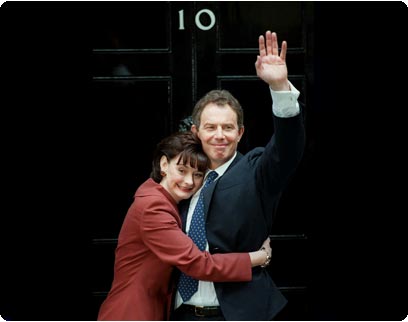
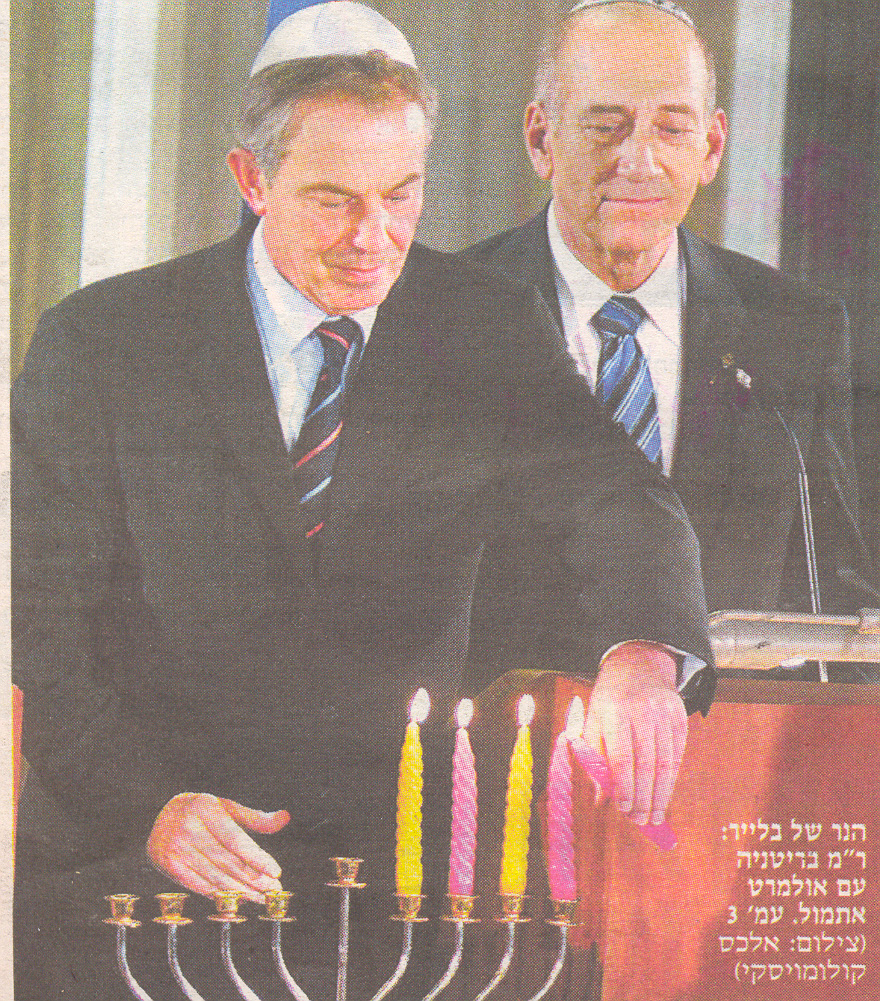
Source: Yediot Acharonot
Jerusalem News-553
Date: 5 Tevet 5767, 26 December 2006
Contents:
1, Arutz Sheva News Friday,
(5. NEW POPULATION SURVEY: 6.4 MILLION JEWS IN AMERICA
2. Archaeology: Brit-Am Version of Explorator 9.35
3. Asher Veizgan Funeral
1. Arutz Sheva News Service -
http://www.IsraelNationalNews.com
Friday, December 22, 2006, 1 Tevet 5767
(5. NEW POPULATION SURVEY: 6.4 MILLION JEWS IN AMERICA
By Nissan Ratzlav-Katz
According to a new American Jewish Year Book survey, there are
currently 6.4 million Jews in the United States - about a million more
than in Israel.
The results are significantly higher than the total of 5.2 million
American Jews identified in a 2000-2001 National Jewish Population
Survey. The researchers involved were careful to note that because
population estimates are not an "exact science," population changes
did not necessarily occur in just the last few years. "Rather," the
survey concludes, "[they] most likely occurred over a long period of
time, but [have] only recently been substantiated."
About 2.2 percent of the US population is Jewish, according to
American Jewish Year Book statistics. Published by the American Jewish
Committee and conducted by Professor Ira Sheskin of the University of
Miami and Professor Arnold Dashefsky of the University of Connecticut,
the study was based on a tally of individual Jewish communities across
the country.
New York, as in years past, was found to have the largest Jewish
population of any state, at 1,618,000. California (1,194,000),
Florida (653,000) and New Jersey (480,000) had the next largest
numbers of Jewish residents. These four states account for more than
60 percent of the entire national Jewish estimate.
Regionally, 44 percent of Jews live in the Northeast; 11 percent live
in the Midwest; 22 percent live in the South; and 24 percent live in
the West.
San Francisco, California, showed the largest single reported growth
nationally among Jewish communities, increasing from 107,900 in 2001
to 227,800 in 2006 - or 10% of the local population. Other areas
showing growth of 70,000 or more were Atlanta, Georgia (33,900 to
119,800); San Diego, California (19,000 to 89,000); Montgomery and
Price Georges County, Maryland (16,500 to 121,000); and South Palm
Beach Florida (14,500 to 107,500).
In reporting 24,000 fewer people than in 2001, Detroit, Michigan,
showed the largest single decrease nationally; Miami, Florida,
followed with a decrease of 11,700.
Data on the various communities were derived, where available, from
studies that have been conducted in those communities, many through
scientific methods such as random digit dialing (RDD) telephone
surveys. In communities where no scientific study had been completed,
information was culled from the mailing lists of local organizations
and synagogues. To ensure greater accuracy, the survey instituted a
new category of "part- time" residents, in order to eliminate "double
counting" of retirees or students in both their home communities and
in secondary communities where they lived part of the year.
According to the Israeli Central Bureau of Statistics, as of late
2006, there were 7,077,000 Israelis, including 5,368,000 Jews.
2. Archaeology: Brit-Am Version of Explorator 9.35
From: david meadows <rogueclassicist@gmail.com>
================================================================
explorator 9.35 December 24, 2006
================================================================
================================================================
ANCIENT NEAR EAST AND EGYPT
================================================================
More coverage of that Essene latrine story:
http://www.haaretz.com/hasen/spages/803283.html
Digging Khirbet al-Yahud:
http://www.haaretz.com/hasen/pages/ShArt.jhtml?itemNo=801792
Report on Beit Ha-Kerem:
http://tinyurl.com/v84be (IAA)
Somewhat vague item on the discovery of a 1500 b.p. bathing
complex in Turkey:
http://www.turkishpress.com/news.asp?id=156494
Radio show on Sean Kingsley's theory about the whereabouts of
the Temple Treasure:
http://www.abc.net.au/rn/spiritofthings/stories/2006/1809700.htm
King David was on trial:
http://tinyurl.com/vmy77 (Sun)
================================================================
EUROPE AND THE UK (+ Ireland)
================================================================
A metal detectorist has come across some medieval coinage:
http://tinyurl.com/w7ygc (This is Bradford)
Solstice at Newgrange:
http://tinyurl.com/tc63z (AFP via Yahoo)
Vikings will soon sail again to Ireland:
http://www.cphpost.dk/get/99623.html
================================================================
OTHER ITEMS OF INTEREST
================================================================
Honouring Sweden's role in Cypriot archaeology:
http://tinyurl.com/cyagb (Cyprus Weekly)
Reading Shakespeare is good for your brain:
http://www.sciencedaily.com/releases/2006/12/061218122613.htm
Review of David Christian, *How Language Works*:
http://www.nytimes.com/2006/12/18/books/18dick.html
Review of Andrew Hussey, *Paris: The Secret History*
http://www.nytimes.com/2006/12/21/books/21ridi.html
Oxford Dictionary of National Biography Lives of the Week:
http://www.oxforddnb.com/public/lotw/
================================================================
TOURISTY THINGS
================================================================
City of David:
http://tinyurl.com/u8a3h (JPost)
================================================================
GENERAL MAGAZINES AND JOURNALS
================================================================
Archaeology (Jan/Feb 2007):
http://www.archaeology.org/curiss/index.html
About.com Archaeology:
http://archaeology.about.com/
Archaeoblog:
http://archaeoblog.blogspot.com/
Archaeology Briefs:
http://archaeologybriefs.blogspot.com/
================================================================
NUMISMATICA
================================================================
On the web: Medieval Coinage:
http://www.medievalcoinage.com/
Hobbyblog:
http://hobbyblog.blogspot.com/
Ancient Coin Collecting:
http://ancientcoincollecting.blogspot.com/
Ancient Coins:
http://classicalcoins.blogspot.com/
================================================================
EXHIBITIONS, AUCTIONS, AND MUSEUM-RELATED
================================================================
A new home for some of Norway's Viking ships:
http://news.yahoo.com/s/nm/20061221/en_nm/vikingships_norway_dc
http://www.upi.com/NewsTrack/view.php?StoryID=20061220-042652-5422r
3. Asher Veizgan Funeral
Date: Sun, 24 Dec 2006 17:24:56 -0500
From: Ya'aqov Ben-Yehudah <yaaqov.ben.yehudah@gmail.com>
(1- Funeral for
Asher Veisgan
We are sorry to inform you of the sudden death of Asher Veisgan. According to the Israeli Prison Authorities, Asher committed suicide with his Tefilin, Friday, Dec. 21, 06. Asher was sentenced to 112 years in prison for killing four Arabs in Shilo "to stop the disengagement/expulsion", July 2005. Asher was influenced by the former GSS Director Avi Dichter, who had said, "It will only take one Jewish settler nut to derail the disengagement by going on a shooting spree against Arabs." At his trial, Asher said, "I was the one nut Dichter was looking for, I am shocked others did not do the same thing. I took action to try and prevent the catastrophic disengagement that will lead to many deaths of innocent Jews and Arabs."
Jerusalem News-554
Date: 5 Tevet 5767, 26 December 2006
Contents:
1. British Forces Storm Basra Detention Center
2. DNA: Genetics of eye colour unlocked
3. Guysen Israel News Extracts
4. Israel Economic Advancement
5. Drugs, Islam, and Jimmy Carter
6. Israeli Singer Calls for Transfer of Muslim Citizens
7. An A-Bomb for Saudia? Who Owns the Nukes of Pakistan?
1. British Forces Storm Basra Detention Center
http://www.nytimes.com/2006/12/26/world/middleeast/26iraq.html?th&emc=th
BAGHDAD, Dec. 25 Hundreds of British and Iraqi soldiers assaulted a police station in the southern city of Basra on Monday, killing seven gunmen, rescuing 127 prisoners from what the British said was almost certain execution and ultimately reducing the facility to rubble.
The military action was one of the most significant undertaken by British troops since the 2003 invasion, British officials said, adding that it was an essential step in any plan to re-establish security in Basra.
2. DNA: Genetics of eye colour unlocked
http://news.bbc.co.uk/2/hi/science/nature/6195091.stm
By Paul Rincon
Science reporter, BBC News
[Extracts:
Eye colour has always intrigued geneticists
Scientists have made a breakthrough in their understanding of the genetics behind human eye colour.
They found that just a few "letters" out of the six billion that make up the genetic code are responsible for most of the variation in human eye colour.
The research, by a team of scientists from Queensland, Australia, will appear in a forthcoming issue of the American Journal of Human Genetics.
The findings are based on a genetic study of nearly 4,000 individuals.
[] One of the changes is like switching the light on and off [for blue eyes], while the other is like changing the light bulb from brown to green[]
Richard Sturm, University of Queensland
The study, which focused on twins, their siblings and parents, shows - conclusively - that there is no "gene" for eye colour.
The study was a collaboration between researchers at the Queensland Institute of Medical Research and the University of Queensland, both in Brisbane.
3. Guysen Israel News Extracts
From: Guysen Israel News <webmaster@guysen.com>
[] 2006-12-24 , 3 Tevet 5767
[]Venezuela hand in hand with Iran. The Venezuelan government has announced that from now on its oil production would be priced in euros and not dollars, following Teheran, which had announced a similar move a week ago.
17:48 The eighth death in Egypt from the bird flu H5N1 virus. A thirty year old woman died on Sunday after contracting the virus. This was announced by the World Health Organization in Cairo. (Guysen.Isra l.News)
10:13 The famous journalist Uri Dan (Z'L) has just passed away following a long illness. For many years he was a close friend and advisor to Ariel Sharon. He published articles in the ''Jerusalem Post'', and he was the correspondent for the ''New York Post'' in Israel. He wrote more than ten books, one of them ''Ariel Sharon. Intimate Meetings With Uri Dan''. The funeral will take place on Tuesday in Jerusalem. The Guysen team regrets the passing of one of the greatest Israeli journalists. (Guysen.Isra l.News)
09:21 Terrorists were planning an attack under the English Channel. According to the British newspaper, The Observer, a group of Islamic terrorists were planning the attack for the Christmas holidays. (Guysen.Isra l.News)
08:22 The international coalition has confirmed that it had killed one of the most important Taliban leaders and close associate of Ossama ben Laden , mullah Akhtar Mohammad Osmani, during a surgical strike in the south of 'Afghanistan. (Guysen.Isra l.News)
4. Israel Economic Advancement
Arutz 7 Sunday
December 24, 2006, 3 Tevet 5767
(7. Globes: Israel Among Top Five Growing Markets
By Hillel Fendel
Israel has risen 12 places in an international listing to become the world 36th largest economy. So reports Globes, based on a survey by The Economist.
The survey graded nations' economies in the years 2001-05 as compared with 20 years earlier. Israel, it was found, jumped 12 slots, raising it from the worlds 48th biggest economy in 1980-84 to the 36th largest in 2001-05. Globes reported that the Economist survey ranked economies on the basis of their five-year average GDP in current dollars.
The four fastest climbing national economies are all in Asia: Singapore rose 20 places to become the 39th largest economy, still three slots behind Israel; Taiwan rose 14 places to become #18; and both South Korea and Hong Kong rose 12 places, just like Israel, to become numbers 11 and 30, respectively.
China rose four notches to slot #6, while oil-producing Venezuela fell 12 places and is now #37. Iran plunged 16 places to 33, and Saudi Arabia fell from 15th place to 22nd.
5. Drugs, Islam, and Jimmy Carter
Carter's Arab financiers
From: imra@netvision.net.il
Carter's Arab financiers
By Rachel Ehrenfeld
Op Ed in The Washington Times Published December 21, 2006
www.washtimes.com/functions/print.php?StoryID=20061220-092736-3365r
Extracts:
To understand what feeds former president Jimmy Carter's anti-Israeli
frenzy, look at his early links to Arab business.
Between 1976-1977, the Carter family peanut business received a bailout in
the form of a $4.6 million, "poorly managed" and highly irregular loan from
the National Bank of Georgia (NBG). According to a July 29, 1980 Jack
Anderson expose in The Washington Post, the bank's biggest borrower was Mr.
Carter, and its chairman at that time was Mr. Carter's confidant, and later
his director of the Office of Management and Budget, Bert Lance.
Mr. Anderson wrote: "Of course, the Saudis remained discretely silent...
kept quiet about Carter's irregularities... [and] renegotiated the loan to
Carter's advantage."
When Mr. Lance introduced Mr. Carter to Abedi, the latter gave $500,000 to
help the former president establish his center at Emory University. Later,
Abedi contributed more than $10 million to Mr. Carter's different projects.
Even after BCCI was indicted - and convicted -- for drug money laundering,
Mr. Carter accepted $1.5 million from Abedi, his "good friend."
A quick survey of the major contributors to the Carter Center reveals
hundreds of millions of dollars from Saudi and Gulf contributors. But it was
BCCI that helped Mr. Carter established his center.
BCCI's origins were primarily ideological. Abedi wanted the bank to reflect
the supra-national Muslim credo and "the best bridge to help the world of
Islam, and the best way to fight the evil influence of the Zionists."
6. Israeli Singer Calls for Transfer of Muslim Citizens.
By Ha'aretz Service
Controversial singer Ariel Zilber called Wednesday for the "transfer" of all Muslim Arab citizens of Israel, saying that they pose a direct threat to the future of the Jewish state.
Speaking on Army Radio, Zilber said that, "the leftists are planning to transfer settlers from the West Bank. That's no different from what I'm suggesting."
Zilber, who last year angered Israel's gay and lesbian community when he condemned their lifestyle, said that Muslim Arabs "will never accept our presence here. They even say that the temple was built on top of the Al-Aqsa mosque. They're crazy. For 2,000 years they just sat here doing nothing, and now they want their own state? What is that nonsense?"
Zilber cited Turkey and Kosovo, as recent examples of population transfers, saying that "Israel has to do something. We are at war, and we're going to lose the Galilee, just like we've already lost Acre, Nazareth and Jaffa."
7. An A-Bomb for Saudia? Who Owns the Nukes of Pakistan?
U.S. intelligence monitoring international links to Saudi nuclear program
http://www.geostrategy-direct.com/geostrategy%2Ddirect/
WASHINGTON The United States has questioned the need for a Saudi Arabian nuclear energy program in its first expression of concern about the Saudis' plans. In 2003, Saudi Arabia signed an agreement with Pakistan for nuclear cooperation. Officials said the intelligence community believes that Riyad financed much, if not all, of Pakistan's nuclear weapons efforts. The U.S. intelligence community has long been monitoring Saudi nuclear efforts. For more than a decade, Riyadh has been seeking ways to deter Iran's nuclear program, expected to produce atomic bombs over the next two years.
Jerusalem News-555
Date: 7 Tevet 5767, 28 December 2006
Contents:
1. Iran Oil Revenue Quickly Drying Up, Analysis Says
2. Christians Leaving Bethlehem
3. Ukrainian Babies Killed for Body Parts?
4. British Psychologists:
Abortions Cause Women Mental Health Problems
5. Joel Bainerman: "What the world can learn from Cyprus"
6. Guysen Israel News, Wednesday
7. Arutz Sheva News Wednesday
(6. JOSHUAS ALTAR LEADS TO DEEPENING NATIONAL CONSCIOUSNESS
1. Iran Oil Revenue Quickly Drying Up, Analysis Says
Associated Press
The Washington Post Tuesday, December 26, 2006; A09
www.washingtonpost.com/wp-dyn/content/article/2006/12/25/AR2006122500486_pf.html
Iran is suffering a staggering decline in revenue from its oil exports, and
if the trend continues income could virtually disappear by 2015, according
to an analysis published yesterday in a journal of the National Academy of
Sciences.
Iran's economic woes could make the country unstable and vulnerable, with
its oil industry crippled, Roger Stern, an economic geographer at Johns
Hopkins University, said in the report and in an interview.
Iran earns about $50 billion a year in oil exports. The decline is estimated
at 10 to 12 percent annually. In less than five years, exports could be
halved, and they could disappear by 2015, Stern predicted.
Stern's analysis, which appears in this week's edition of the Proceedings of
the National Academy of Sciences, supports U.S. and European suspicions that
Iran is trying to develop nuclear weapons in violation of international
understandings. But, Stern
says, there could be merit to Iran's assertion that it needs nuclear power
for civilian purposes.
He said oil production is declining and both gas and oil are being sold
domestically at highly subsidized rates. At the same time, Iran is
neglecting to reinvest in its oil production.
Iran produces about 3.7 million barrels a day, about 300,000 barrels below
the quota set for Iran by the Organization of Petroleum Exporting Countries.
The shortfall represents a loss of about $5.5 billion a year, Stern said. In
2004, Iran's oil profits were 65 percent of the government's revenue.
If the United States can "hold its breath" for a few years, it may find Iran
a much more conciliatory country, he said. And that, Stern said, is good
reason to delay any instinct to take on Iran militarily.
"What they are doing to themselves is much worse than anything we could do,"
he said.
2. Christians Leaving Bethlehem
Date: Tue, 26 Dec 2006 13:03:09 +0000
From: Guysen Israel News <webmaster@guysen.com>
[] 2006-12-25 , 4 Tevet 5767
22:38 According to Frontpage Magazine, Christians living in the PA represent less than 2% of the PA population. Their numbers have declined since the establishment of the PA, and especially since Hamas came to power at the start of 2006. WorldNetDaily said that this is on account of the deterioration in the economy, violence, discrimination and persecution by Muslims against Christians and their property: there have been attacks on the Church of the Nativity and arson attacks on their shops. In 1990, under Israeli administration, Christians were 60% of the population in the Bethlehem region. Under Arafat, this number dropped to 16%. These Christians took refuge in Europe, America and Israel. (Guysen.Isra l.News)
3. Ukrainian Babies Killed for Body Parts?
http://www.lifenews.com/bio1918.html
4. British Psychologists: Abortions Cause Women Mental Health Problems
http://www.lifenews.com/nat2697.html
5. What the world can learn from Cyprus
By Joel Bainerman December 19, 2006
http://web.israelinsider.com/Views/10103.htm
6. Guysen Israel News, Wednesday
Date: Wed, 27 Dec 2006 12:20:44 +0000
From: Guysen Israel News <webmaster@guysen.com>
[] 2006-12-26 , 5 Tevet 5767
Wednesday 12/27/2006
23:57 The conflict between Ethiopia and Somalia : Addis-Ababa, that supports the loyalist forces in Somalia, said on Tuesday that it has beaten the Islamic militias, who called their withdrawal from some positions in the center and south of the country a "tactic". Thousands of refugees have fled Somalia. The UN Security Council has met on Tuesday to consider the situation that is threatening to spread in Africa. (Guysen.Isra l.News)
21:37 The two children injured in Sderot by a kassam rocket have been taken to the Barzilai hospital in Ashkelon. One of them is suffering from severe injuries, and the second one is moderately injured. Four people are in a state of shock. (Guysen.Isra l.News)
21:04 The kassam rocket that just hit Sderot fell in the courtyard of a house and seriously injured two children aged 12 and 13 who are receiving medical care on the scene. This is the sixth rocket of the day. (Guysen.Isra l.News)
17:07 Rabbi Yuval Sherlo has said that the use of the Gregorian calendar is a sign of the loss of Jewish identity. According to him, people who celebrate the civil new year are looking for entertainment, but more worrying than the use of the Gregorian calendar is the question one often hears of "when does Pesach fall?" (Guysen.Isra l.News)
13:35 The weather forecast: strong rains are currently falling on the whole country. Snow has been falling since this morning on Mount Hermon, reaching a depth of 40 cm. (Guysen.Isra l.News)
11:18 "Israel is not as strong than we thought", King Abdallah II of Jordan said in an interview with a Japanese paper, the Daily Yomiuri. He said that in the Middle East, Israel is considered to have lost the war in Lebanon. He warned against the rise of radicalism and of three possible civil wars in 2007, in the PA, in Iraq and in Lebanon. (Guysen.Isra l.News)
10:13 A kassam was fired by Palestinian terrorists. It landed in the Rotenberg electric plant near Ashkelon. The missile hit near a fuel depot and according to the security services it was a true miracle that there was not major damage. (Guysen.Isra l.News)
7. Arutz Sheva News Wednesday
http://www.IsraelNationalNews.com
December 27, 2006, 6 Tevet 5767
(6. JOSHUAS ALTAR LEADS TO DEEPENING NATIONAL CONSCIOUSNESS
by Hillel Fendel
A reminder of the historic significance of the Jewish People's first
day in the Holy Land was provided by a trip for Russian-speaking
Israelis to Joshua's Altar on Mt. Ebal outside Shechem.
The story began just before this past Chanukah, when two busloads of
Russian-speaking Israelis - new immigrants, veteran immigrants, and
some tourists - made their first visit to the site known as Joshua's
Altar near Shechem (Nablus).
Security concerns notwithstanding, the visitors - many of whom had
never been to the area - came away greatly inspired, and some were
even moved to tears. Secular Jews found themselves reciting special
blessings and prayers appropriate to the novelty of the experience.
What was so special? "To see the actual altar that Joshua built, by
Divine command, on the day the Jewish People entered the Land of
Israel, is simply overwhelming," one participant tried to explain.
The trip was organized by the Maof organization - helping
Russian-speakers get to know the Land of Israel - and ex-MK Uzi
Landau's Machatz (Zionist Camp), whose Eretz Nehderet
(Beautiful Land) program does the same for people all over the
country. The two buses were targeted by a small bomb hurled by
Palestinian terrorists in the region, but no damage was caused.
Prof. Adam Zertal, an archaeologist from Tel Aviv University,
was the man who discovered and excavated the area and determined that
it is the remnants of Joshua's Altar. He appeared recently on
IsraelNationalRadio,
speaking with hosts Yishai
and Malkah Fleisher.
"How do you know that this was in fact Joshua's altar?" Yishai asked.
"Perhaps it was built by other peoples over the years, for instance."
Prof. Zertal, author of " A Nation is Born: The Mt. Eval Altar and the
Beginnings of the Nation of Israel," appeared not to know where to
start, given the amount of evidence he can provide. He began with the
discovery itself:
"We discovered this place, all covered with stones, in April 1980. At
that time I never dreamt that we were dealing with the altar, because
I was taught in Tel Aviv University - the center of anti-Biblical
tendencies, where I learned that Biblical theories are untrue, and
that Biblical accounts were written later, and the like. I didn't
even know of the story of the Joshua's altar. But we surveyed every
meter of the site, and in the course of nine years of excavation, we
discovered a very old structure with no parallels to anything we had
seen before. It was 9 by 7 meters, and 4 meters high, with two stone
ramps, and a kind of veranda, known as the sovev, around."
The Torah itself, in Deut. 27, 4-8, recounts the command to build the
altar on Mt. Ebal (Eval) when the Jewish People would cross the Jordan
River into the Holy Land. The command stipulates that the stones
should not be hewn by iron, and that sacrifices should be brought
there.
Joshua 8, 30 states that Joshua fulfilled the command and, in fact,
built the altar on Mt. Ebal. This occurred, according to traditional
chronology, in the year 2488 to the creation of the world, or 3,252
years before Zertal began his excavation of the site.
A very critical piece of evidence cited by Zertal in support of his
identification of the structure as Joshua's Altar appears to be the
animal bones found there:
"There were more than 1,000 burnt animal bones - exactly of the type
that were used for sacrifices. It was clear that this was not the
remnants of some village, but rather a cultic site. But the critical
turning point [in our excavation] came when a religious member of our
team showed us the Mishna describing the altar of the 2nd Temple
period - 1,200 years later than our discovery. The description was
very similar to what we had found - meaning that the Mishna was
clearly and definitely a continuation and prototype of the one on Mt.
Ebal. They both have ramps, just as the Torah stipulates, for the
High Priest to ascend to the altar without going up steps, and the
sizes matched, and more... The architecture itself was the evidence."
"We found 1,000 bones in the site, and another 2,000 around it -
representing something like 700 animals," Prof. Zertal said. "We sent
them for analysis to the zoology department of the Hebrew University
in Jerusalem, and all the males were young males around one year old -
as the Torah commands - and were of the four animals that were brought
as sacrifices: goats, sheep, cattle, and fallow deer. In addition,
most of the bones had been burnt in open-flame fires of low
temperature."
Explaining why the area around the altar is so barren, Prof. Zertal
said, "Both in Deut. 27 and in Joshua 8, the implication is that the
altar will serve for a one-time ceremony, as opposed to becoming a
permanent holy area such as the Temple in Jerusalem... Afterwards, it
was covered up with stones in order that it not be desecrated, and the
people moved southward, to Shilo, and then further south, to
Jerusalem, where the final eternal Temple was built."
The Talmud (Sotah 45b), in fact, agrees that the altar was quite
temporary, and that Joshua took it apart and moved the stones to the
Gilgal area. The Talmud states that this happened on the same day the
altar was built, and the Medrash adds that another altar was built on
Mt. Eval some 40 years later.
Asked if he had found the 12 stones on which the Book of Deuteronomy
was written there (Joshua 8, 32), Prof. Zertal said that this would be
a hard task. He explained that the exact location of the stones is
not clear from the Biblical account, and that in any event, "The words
of Torah were written on plaster that covered the stones, because iron
tools were not allowed to be used on the stones... But we did find 60
pieces of plaster near the altar; this is unusual, as usually they did
not plaster the structures. The pieces are very fragile, but we are
trying to see if we can find something."
As with many archaeological theories and findings, Zertal's has its
detractors as well. Zertal is not fazed, however. In response to
claims that the structure was a residence, he notes that "there was
neither a floor nor an entrance" and it was "obviously not regularly
lived in." Neither could it have been a watchtower, he asserts,
because all transportation routes avoided the area, nor were there any
Iron Age settlements nearby, "such that there was nothing to guard."
The Special First Day
Another local scholar, Lt.-Col. (res.) Nechemiah Perelman of Kedumim,
has a different approach. He says that whether or not the stone
structure on Mt. Eval is actually Joshua's Altar, it is more important
"for us to remember and instill in our national consciousness all of
the events that happened on that day. That was Israel's first day in
the Holy Land!"
Specifically, Perelman said, "The people of Israel miraculously
crossed the Jordan River; they took 12 stones out of the river, and
then replaced them with 12 other ones - and the significance of this
must be studied; they gave up their share in a plot of land that Jacob
had purchased in order to provide a burial spot for Joseph; Joseph was
buried; the blessings-and-curses ceremony at Mt. Gerizim and Mt. Eval
took place; and the altar was built. Each of these special events
must be studied carefully - especially by us, the generation that has
returned to the Land of Israel - in order that we understand their
full significance."
Midreshet Shomron, an institution in the nearby community of
Shavei Shomron, also organizes periodic trips to the area. However,
the trips are often thwarted by the terrorists in the area. One
ill-fated tour, in October 2000, ended with the death of Rabbi
Binyamin Herling, one of several hikers who left the main route and
were shot at by Palestinian terrorists in Shechem. The army was
widely accused of not taking offensive action to save the hikers when
the terrorists pinned
them down with long-range but accurate fire.
Another trip to the same area this past Chanukah was canceled by the
army with just two days' notice, because of intelligence warnings of
another planned terror attack. However, the people of Midreshet
Shomron, Maof and Machatz all agree that they will continue
to organize the trips and cement the bonds between the people of
Israel and their Land.
Jerusalem News-556
Date: 8 Tevet 5767, 29 December 2006
Contents:
1. U.S. blocks arms, technology to Israel
2. Arutz Sheva News Thursday
(4. CELEBRATIONS OF MODERN-DAY JUDAISM
(5. NETANYAHU BLOG: LIKUD LEADER UNEDITED
(6. WINTER WONDERLAND, TRAFFIC NIGHTMARES AND ACCIDENTS
3. Guysen Israel News Thursday
1. U.S. blocks arms, technology to Israel
http://www.israelunitycoalition.org/news/article.php?id=642
2. Arutz Sheva News Thursday
http://www.IsraelNationalNews.com
December 28, 2006, 7 Tevet 5767
Extracts
(4. CELEBRATIONS OF MODERN-DAY JUDAISM
By Hillel Fendel
Among many others, three sample events that have taken or will be
taking place in December and January show the versatility and dynamism
of contemporary Orthodox Judaism.
The Jerusalem Talmud
Two institutions - the Jerusalem Institute and the Shilo Institute -
hosted a symposium last week highlighting the "Relevance of the
Jerusalem Talmud in Modern Times." The Jerusalem Talmud, like the
more well-known Babylonian Talmud, includes the explanations and
teachings of Sages from the third to sixth centuries C.E. on the Six
Orders of the Mishna.
The Jerusalem Talmud scholars seek to bring out the wisdom thereof, in
fulfillment of the Medrashic teaching, "There is no Torah like the
Torah of the Land of Israel and no wisdom like the wisdom of the Land
of Israel."
Bnei Akiva
World Bnei Akiva will be holding its 11th International Conference in
Israel next week. Leaders of the movement and over 200 shlichim
(emissaries) from around the world will be in attendance. The themes
of the event: Pioneering and Strengthening the North.
Bnei Akiva seeks to empower and inspire Jewish youth with a deep
commitment to the Nation of Israel, the Land of Israel, and the Torah
of Israel. Its motto is Torah V'Avodah [Toran and Labor], standing for the combining of
Torah study and observance with active contribution to the Jewish
people in advancing the rebirth of the Jewish nation on its Land.
16th Annual World Conference on Monetary Matters in Jewish Law
Rabbi Ratzon Arousi, the unofficial Chief Rabbi of the Yemenite
community in Israel and the Chief Rabbi of Kiryat Ono, is the
President of this conference. Taking place in Jerusalem, this year's
edition is dealing largely with "Jewish Financial Law During War
Time."
Among the questions dealt with at the conference are the definition of
a "national calamity." Rabbi Arousi explained to Arutz-7's Uzi Baruch
two questions that arose in this context:
"A tenant paid a high rent for a store in the north this summer,
expecting a high volume of business. However, because of the war,
buyers stayed away - and the renter asked for a partial return of his
rent money. In another case, a rented apartment was damaged by a
rocket. It turns out that based on the definition of 'national
calamity' - where most of the houses or fields are affected - the
rulings in these cases are different.
"In the first case, since business in the entire area is affected, the
renter is not to be held [totally] liable, and the owner must bear his
share of the responsibility. But in the case of the specific apartment
that was damaged, since most of the apartments were not damaged, it is
fully the renter's liability and not the owner's."
"The goal is to show how the Torah of Israel is a living document,"
Rabbi Arousi said, "with a response to every situation. We are
enriching the treasure of Jewish Law, and identify with the desire to
once again make the Torah's laws the law of the land."
(5. NETANYAHU BLOG: LIKUD LEADER UNEDITED
By Hana Levi Julian
Likud Chairman Binyamin Netanyahu had harsh words for the government
in a statement Wednesday on his new Hebrew-language blog.
The former Prime Minister outlined an itemized response he demands
from the Olmert government to the incessant rocket attacks from Gaza
against Israel.
The rocket fire aimed at Sderot has become routine in the past few
weeks since the government agreed to the ceasefire, wrote Netanyahu.
More than 50 rockets have been launched at Sderot since that
imaginary truce and it has been a miracle that no one wounded until
now... The expected has finally occurred [on Tuesday night]: people
have been hurt.
Netanyahu demanded that the government carry out the following four
steps:
* Take control of the Kassam launch areas.
* Stop the smuggling by taking control of key areas.
* Set the goal of deposing Hamas and act in accordance with this goal.
* Immediately cease all negotiations and the implementation of
gestures until there is a complete end to terror.
No other country in the world would have put up with incessant
shelling of its towns and houses, he wrote.
Netanyahu's blog, only three weeks old, is intended to bypass the
media and present his messages to the public in an unadulterated
fashion. A spokesman for the Knesset opposition leader said that
Netanyahu also intends to start an English-language blog in the near
future.
(6. WINTER WONDERLAND, TRAFFIC NIGHTMARES AND ACCIDENTS
By Hana Levi Julian
Major arteries in the Golan Heights and Galilee are still sealed off
in the wake of Wednesdays stormy winter wonderland.
The first snow of the season shut down traffic and caused blackouts
that left thousands of Israelis from the north to the Negev without
heat or lights for various durations on Wednesday.
On the other hand, it marked a welcome end to the drought that had
plagued the country for the last several weeks.
Public transportation in Beitar Illit was shut down and the
communitys snow committee urged residents not to leave the town
limits. Access routes in and out of the community were blocked by the
drifting snow, according to municipal hotline director Guy Akriv, who
said the Tunnel Road and the Ein Kerem Road were both impassable.
Galilee police blocked off traffic on Route 889 between Tzfat (Safed)
and Rosh Pina due to the heavy accumulation of snow. The access road
to Tzfat between Biria Junction and Meron was also sealed off, with
drivers redirected to detour routes.
Traffic in the Upper Galilee and northern Golan Heights was moving,
but very slowly, due to the icy conditions. Snow continued to fall
overnight in the Mount Hermon area.
A 19-year-old Tiberias youth was seriously injured when he was struck
by a marble tile that flew off a building. In Akko, a woman was
lightly injured when she was trapped under a tree that was blown down
by the strong winds.
Motorists were crawling down the icy streets of Jerusalem as an
accumulation of some 8 centimeters (3 to 4 inches) of the white stuff
coated the capital.
Local travelers found themselves walking to their destinations rather
than wait endlessly for public bus service that was forced to a
standstill for several hours by the messy weather.
Heavy snowfall was also seen in Judea and Samaria, with residents in
many small communities reporting they were snowed in Wednesday
evening. More than 10 centimeters (4 inches) of snow was reported in
Kiryat Arba; a similar accumulation was seen in Beit El.
The snowstorm made its way south from Mt. Hermon, reaching as far as
the Negev desert town of Mitzpe Ramon by Wednesday afternoon. Strong
winds blew down a group of tents and shacks in a small Bedouin village
outside the city of Rahat, lightly injuring a pregnant woman and six
children.
Some 200 tent dwellers were taken to a school in Rahat to spend the
night and 30 members of the community were treated for frostbite.
The Israel Electric Company announced it had reached capacity by early
evening and that reserves were running very low. Electricity use
reached a record 9,450 megawatts as severe weather conditions and
plunging temperatures sent Israelis straight to the electric space
heaters.
Power outages were reported in a number of communities in the south,
including Yatir and Arad. The company asked consumers to refrain from
using high-consumption appliances overnight in order to relieve the
national grid. Dishwashers, washing machines, baking ovens, electric
grills, water heaters and vacuum cleaners were all on the
please-dont-use-these-tonight list.
3. Guysen Israel News Thursday
Extracts Only
From: Guysen Israel News <webmaster@guysen.com>
[] 2006-12-27 , 6 Tevet 5767
23:45 The famous Israeli singer, Sarit Haddad, is on tour in the United States. Choosing to appear only dressed in Israel's colors (blue and white), Sarit Haddad said that she would not work on Shabbat and that she only ate kosher food. (Guysen.Isra l.News)
23:21 A preliminary agreement has been reached between representatives of El Al and the ultra-orthodox community according to which the company commits to consult a rabbinic authority in the case of a need for flights on Shabbat. The contract specifies that El Al will maintain its current policy of not flying on Shabbat. (Guysen.Isra l.News)
22:28 Pope Benedict XVI received Iranian Foreign Minister Manouchehr Mottaki who gave him a message from President Mahmoud Ahmadinejad. (Guysen.Isra l.News)
21:38 Hamas condemned Israel's decision to eliminate the kassam launchers. The terrorist organization's spokesman Ghazi Hamad, denounced the "continuing aggression against the Palestinian people". "We are convinced that the cease-fire is still in force and that it must be respected by both sides", he said. (Guysen.Isra l.News)
17:13 In 2006, 35% of children were living below the poverty threshold in Israel. The National Council for Childhood presented its annual report to Ehud Olmert. At the end of 2005, there were 2.3 million children in Israel, of whom more than one third were living in poverty, as against 33% in the previous year. (Guysen.Isra l.News)
14:56 France is calling on Israel and the Palestinians to show restraint. The Foreign Minister criticized the construction of a new Jewish town in Judea and Samaria intended to house the Israeli]s expelled from the Gaza Strip, but he also criticized the firing of kassam rockets on Israeli towns. (Guysen.Isra l.News)
13:31 Israel and Turkey may face the Iranian threat together. According to the Saudi daily Al Watan, a Turkish military delegation, composed of high ranking officers, is currently in Israel to examine how to present a joint front to counter the Iranian threat. (Guysen.Isra l.News)
12:40 A new contingent of American soldiers in Kuweit. The Pentagon announced that it was going to send a contingent of 3,500 soldiers to Kuweit to support the American forces in Iraq if necessary. (Guysen.Isra l.News)
07:46 Former president Gerald Ford passed away last night at the age of 93. Ford was president of the United States from 1974 to 1977 following the Watergate affair, which led to the resignation of Richard Nixon. (Guysen.Isra l.News)
Jerusalem News-557
Date: 11 Tevet 5767, I January 2007
Contents:
1. Saudi cleric denounces Shi'ites as infidels
2. Arutz Sheva News Sunday
(2. MOMENTS BEFORE DEATH, SADDAM HUSSEIN: PALESTINE IS ARAB
(3. JEWISH CALENDAR IN ACTION
(4. SAUDI ARABIA BARS BIBLE-BEARING FLIGHT ATTENDANT
3. Guysen Israel News
4. RAYMOND HAINEY: Climate change: The crack of doom?
5. Archaeology: Brit-Am Version of Explorator 9.36
1. Saudi clericdenounces Shi'ites as infidels
The Peninsula - 30 December, 2006
www.gulfinthemedia.com/index.php?id=273548&news_type=Top&lang=en
An influential cleric of Saudi Arabia's hardline Sunni school of Islam has
denounced Shi'ite Muslims as "infidels" in a new religious edict that comes
amid rising sectarian tension in the region.
"The rejectionists (Shi'ites) in their entirety are the worst of the Islamic
nation's sects. They bear all the characteristics of infidels," Sheikh Abdel
Rahman Al Barrak said in the fatwa, or ruling, distributed on Islamist Web
sites.
"They are in truth polytheist infidels, though they hide this," it said,
citing theological differences 14 centuries after the death of the Prophet
Mohammad, such as reverence of shrines which followers of Saudi Arabia's
Wahhabi school consider abhorrent.
Concern is growing in Saudi Arabia, birthplace of Islam, over Shi'ite-Sunni
violence in Iraq which has taken the northern neighbour to the brink of
civil war. Sunni-Shi'ite tensions are also high in Lebanon, where Shi'ites
are leading efforts to bring down a Sunni-led cabinet.
"The Sunni and Shi'ites schools of Islam are opposites that can never agree,
there can be no coming together unless Sunnis give up their principles," the
fatwa said.
Barrak, an independent scholar, has come to be regarded by many as the
highest authority for Wahhabi Muslims.
Clerics of the austere Wahhabi school of Sunni Islam have long dismissed Shi'ites
as virtual heretics and Saudi Arabia's Shi'ite minority complains of second
class treatment.But Barrak's fatwa was the strongest in recent years.
The fatwa, which was published on Barrak's Web site in response to a
follower's question, also appeared to criticise efforts by some
government-backed Saudi preachers at reconciliation between Sunnis and Shi'ites.
--------------------------------------------
IMRA - Independent Media Review and Analysis
Website: www.imra.org.il
2. Arutz Sheva News Sunday
http://www.IsraelNationalNews.com
December 31, 2006, 10 Tevet 5767
(2. MOMENTS BEFORE DEATH, SADDAM HUSSEIN: PALESTINE IS ARAB
By Hana Levi Julian
Even during his final moments, Saddam Hussein made sure to shout
encouragement to Palestinian Authority terrorists.
As the noose was slipped around his neck, and the trapdoor about to
open for him to plunge to his death, Hussein called out, Allah is
great. The nation will be victorious, and Palestine is Arab.
Around the Muslim world, the festival of Eid al-Adha dawned Saturday
morning with the news that Iraqs murderous dictator was dead. The
families of the thousands of his countrymen whom he slaughtered
throughout the 35 years he ruled Iraq with an iron fist celebrated his
death, as did Kuwaitis and Iranians, who had suffered during Iraqs
invasions. This is the best Eid gift for humanity, said former
Kuwaiti Information Minister Saad bin Tafla al-Ajmi.
Al-Ajmi said the families of hundreds of people who went missing
during Iraqs seven-month occupation of Kuwait were ecstatic, saying
Husseins death was the fair punishment for the one who executed our
sons without trials.
The former Iraqi ambassador to the United Nations prior to the 2003
U.S. invasion of Iraq said, The Arab nation has lost a hero. So have
all of those who are against Iran and Israel and for Arab unity.
Mohammed al-Douri added that Husseins death was no triumph for the
U.S. They think this is a victory, the execution of President
Saddam. They have no other victory to claim. There is no new Iraq, no
democracy, no example for the region, he said.
In Israel, the death of Saddam Hussein was welcomed. Former Foreign
Minister Silvan Shalom, writing for Ynet, explained, "We have no
reason to mourn the death of Saddam... Let us not forget the dozens of
Scuds he fired at Israel with the intent of killing innocent people.
This cruel dictator did everything he could to harm the State of
Israel and the stability of the Middle East. For years he aided and
funded Palestinian terrorism in the territories and within the State
of Israel."
Not everyone agreed. MK Ahmed Tibi (Taal Raam) said the hanging was
an act of sadism, adding, Even dictators deserve to be treated
humanely.
Deputy Defense Minister Ephraim Sneh expressed concern about the
post-Saddam era in Iraq. We have to be worried about what is going
to happen now, he said, noting that Iraq has become a regional power
station for terror. He also said that Irans influence was growing
in Shiite areas of Iraq, as well as in the central government there.
Hamas official Mohammed Barghouti condemned the execution, saying that
despite the disputes between his deeply religious terror organization
and the secular leader, the Iraqi government was wrong to hang Saddam
Hussein. Barghouti, serving as Labor Minister in the Hamas-led PA
government, said that PA Arabs had bonded with Iraqis in
brotherhood.
During the first Gulf War in 1991, PA Arabs cheered Saddam's missile
attacks on Israel, chanting, "Beloved Saddam, strike Tel Aviv," as the
Scud missiles flew overhead. He later gave $25,000 to the families of
PA suicide bombers who managed to kill Jews and $10,000 for other
martyrs killed by the IDF.
Indeed, PA residents mourned their generous Iraqi backer, who had
proved his support with money and missiles.
We heard of his martyrdom, and I swear to G-d we were deeply shaken
from within. Nobody was as supportive or stood with the Palestinians
as he did, said Khadijeh Ahmad, a resident of the PA-controlled
village Qadora.
Residents in the PA town of Bethlehem opened a house of condolence,
hanging Iraqi flags and pictures of the dead dictator. Visitors to the
center drank black coffee and black strips of cloth were tied to the
antennas of vehicles in the streets.
(3. JEWISH CALENDAR IN ACTION
By Hillel Fendel
Today, the 10th of Tevet, is a day of fasting, commemorating the siege
of Jerusalem led by Nebuchadnezzar - the ancient Babylonian despot of
whom Saddam Hussein claimed to be a reincarnation.
Just a day after the hanging of Saddam Hussein, Jews around the world
remember another cruel tyrant - Saddam's self-proclaimed role model -
and his murderous plans for the Jewish People. Nebuchadnezzar was
more successful than Saddam in this regard, in that he destroyed
Jerusalem and the Holy Temple, and put hundreds of thousands of Jews,
including the nation's king and leaders, to death with unspeakable
cruelty.
On this day, the 10th of Tevet, Nebuchadnezzar instated a tight siege
on Jerusalem, setting off the chain of events that led to the
destruction of the First Holy Temple and a 70-year exile of the Jewish
People from their Holy Land.
Today, nearly 2,500 years later, Jews around the world - and
especially in the modern renewed edition of the Jewish State that
Nebuchadnezzar tried to rub out - refrain from eating and drinking
until sunset to remember the calamities that occurred at that time.
Saddam Hussein, who was hanged yesterday in Baghdad, just 90
kilometers from Nebuchadnezzar's palace in the ancient city of Babyon,
modeled himself in many ways after Nebuchadnezzar.
Much of the brickwork in the throne room of King Nebuchadnezzar's
palace, for instance, was built by Saddam Hussein's workers. Just as
the original bricks are inscribed with words praising Nebuchadnezzar,
the newer ones - 60 million of them! - state that they were fashioned
in "the era of Saddam Hussein, protector of Iraq, who rebuilt
civilization and rebuilt Babylon."
In addition, in his book "Saddam Hussein, the Stairway to Heaven and
the Return of Planet X," William Henry writes, "Saddam is saying he is
the reincarnated Nebuchadnezzar... He is attempting to recreate and
outdo the feats of the biblical king... It is well known that [he]
has connected himself with Nebuchadnezzar, spending over $500 million
during the 1980s on the reconstruction and the re-establishment of
ancient Babylon, the capitol of Nebuchadnezzar."
Nebuchadnezzar was Divinely changed into an animal for a period of
time - an event that many recalled when the once-opulent Saddam
Hussein was captured two and a half years ago living in nearly
animal-like conditions.
The Tenth of Tevet has also taken on another facet, in connection with
the Holocaust. Many bereaved Jews who do not know the date or place
of death of their loved ones recite Kaddish, the Jewish prayer for
those who have died, on this day. For this reason, some consider this
day as a Holocaust remembrance day.
Yishai Fleisher contributed to this article.
(4. SAUDI ARABIA BARS BIBLE-BEARING FLIGHT ATTENDANT
By Tzvi Ben Gedalyahu
A Bible-bearing Christian flight attendant has been barred by her
British employer from flying to Saudi Arabia, where Christianity is
illegal.
The flight attendant, who works for British Midland Airways (BMI), is
"a committed Christian [who] likes to take her Bible, which was once
her mother's, with her when she travels," according to journalist
Claire Bergen.
The British Foreign Office backed the airline. "The importation [to
Saudi Arabia] and use of narcotics, alcohol, pork products and
religious books, apart from the Quran (Koran), and artifacts are
forbidden," it stated. The London Telegraph quoted a BMI
official as saying, "We issue advice to all our staff and passengers
that these are the guidelines. She is saying she wants to carry her
Bible with her. We are saying we cannot start designing rules around
individuals when we have several hundred members of staff. To take
every personal preference into account would be impossible."
The stewardess has taken the case to an industrial (labor) court.
It is not the first time that religious practice of airline workers
has been curtailed because of Saudi rules. A flight attendant working
for British Airways (BA) was forbidden to wear her cross visibly on
the route to Saudi Arabia.
Even Christmas trees are banned in the oil-rich kingdom, which claims
to allow religious freedom. An Iowa woman wrote in the Wichita
Eagle earlier this month about her experience in 2003.
"Christianity was not allowed to be practiced," wrote Charlotte Brock
Rady. "Shopping in the back alleys of Jeddah one night, we discovered
a market that had hidden away upstairs in a dark room a small
artificial Christmas tree and lights."
Another worker in the country reported that her tree was confiscated
at the border.
Nevertheless, on a recent visit to Princeton University, Saudi Prince
Turki al-Faisal declared, "Arab tradition and Muslim tradition is
geared towards having an open mind. Muslim religion accepts
Christianity and Judaism."
Last year, a Saudi Arabian court sentenced a teacher to 40 months in
prison and 750 lashes for discussing the Bible and praising Jews.
He was charged with promoting a "dubious ideology, mocking religion,
saying the Jews were right, discussing the Gospel and preventing
students from leaving class to wash for prayer," according to a local
newspaper report.
A report in 2005 by the U.S. State Department criticized Saudi Arabia,
saying religious freedoms "are denied to all but those who adhere to
the state-sanctioned version of Sunni Islam."
3. Guysen Israel News
EXTRACTS ONLY
Date: Sun, 31 Dec 2006 11:28:06 +0000
From: Guysen Israel News <webmaster@guysen.com>
[] 2006-12-30 , 9 Tevet 5767
[]Saddam Hussein was hung at dawn, on Saturday 30th December. 69 years old, the former dictator from Baghdad had ruled over Iraq for a quarter of a century. He had been sentenced to death for crimes against humanity.
20:16 Summary of the news of the day from ... (Guysen.Isra l.News)
SATURDAY AFTERNOON
The execution of Saddam Hussein has provoked a wave of attacks in Iraq. Several car bombs have exploded throughout the country: 73 dead.
The EU condemned the crimes against humanity perpetrated by Saddam Hussein but it also disapproved of his execution. "Despite the crimes of the former dictator, the EU is opposed to the death penalty" the high representative for foreign policy of the EU, Javier Solana said.
19:48 The Palestinians are in mourning. "We have lost a leader," the PA said. Elsewhere, the Palestinians are said to have been very touched by the last words of the former dictator: "Palestine is Arab". (Guysen.Isra l.News)
19:15 Whilst many in the western world have expressed their satisfaction following the execution of former dictator Saddam Hussein, voices have been raised in condemnation of this sentence: Russia, Italy, Spain, Sweden, Norway, Denmark, Austria, Hungary, Holland and the Ukraine are amongst the countries that officially condemned the execution. (Guysen.Isra l.News)
4. Climate change: The crack of doom?
RAYMOND HAINEY
http://news.scotsman.com/index.cfm?id=1928862006
Comments
An interesting article followed by equally interesting comments giving the
pros and cons.
5. Archaeology: Brit-Am Version of Explorator 9.36
From: david meadows <rogueclassicist@gmail.com>
Subject: [Explorator] explorator 9.36
================================================================
explorator 9.36 December 31, 2006
================================================================
================================================================
AFRICA
================================================================
More coverage of that early ritual site in Botswana:
http://tinyurl.com/y994pk (NG)
================================================================
ANCIENT NEAR EAST AND EGYPT
================================================================
No evidence of Medes at Ecbatana:
http://www.chnpress.com/news/?section=2&id=6905
================================================================
ANCIENT GREECE AND ROME (AND CLASSICS)
================================================================
A piece on the early Olympics:
http://tinyurl.com/ymussn (LA Times)
Reviews of a couple of well-reviewed books on Caesar and Augustus:
http://www.nytimes.com/2006/12/31/books/review/Coates.t.html
http://www.iht.com/articles/2006/12/29/features/IDLEDE30.php
... and another:
http://tinyurl.com/ye6oe9 (LA Times)
================================================================
EUROPE AND THE UK (+ Ireland)
================================================================
That Bronze Age log boat from the River Tay is in the news again:
http://tinyurl.com/yma4al (BBC)
... while there is ongoing controversy about plans to move those
Viking ships (we mentioned last week):
http://www.nytimes.com/2006/12/25/world/europe/25viking.html
http://www.iht.com/articles/2006/12/25/news/viking.php
13th century finds from Berwick:
http://tinyurl.com/ybcd7c (Berwick Today)
Review of Stella Tillyard, *George III and his Scandalous
Siblings*:
http://www.nytimes.com/2006/12/27/books/27grim.2.html
Archaeology in Europe Blog:
http://www.archaeology.eu.com/weblog/index.html
================================================================
ASIA AND THE SOUTH PACIFIC
================================================================
Humans are being blamed for the demise of Australia's giant
kangaroos:
http://www.msnbc.msn.com/id/16359687/
http://news.yahoo.com/s/ap/20061226/ap_on_sc/australia_megafauna
Trying to identify a caucasian mummy from China:
http://www.upi.com/NewsTrack/view.php?StoryID=20061224-032826-6357r
cf.:
http://english.people.com.cn/200612/25/eng20061225_335707.html
A Mongolian fresco/mural appears to depict the funeral of Genghis Khan:
http://en.ce.cn/National/culture/200612/27/t20061227_9905492.shtml
http://tinyurl.com/ymzzlk (Washington Times)
Mysterious rings from the tomb of China's only empress:
http://english.peopledaily.com.cn/200612/21/eng20061221_334509.html
New Zealand Archaeology eNews:
http://www.nzarchaeology.org/netsubnews.htm
================================================================
NORTH AMERICA
================================================================
A 9000 b.p. spear point from New Brunswick:
http://tinyurl.com/whpus (Star Tribune)
http://tinyurl.com/y2uc2l (UPI)
http://tinyurl.com/yaj9l8 (Globe and Mail)
http://tinyurl.com/ymjxj7 (CBC)
And piles of stuff from beneath a Halifax hotel:
http://thechronicleherald.ca/Front/550002.html
Toronto's heritage is in danger from development:
http://tinyurl.com/ycmrx6 (National Post)
================================================================
OTHER ITEMS OF INTEREST
================================================================
A nice sort of 'overview' of what DNA studies are telling us
about our past:
http://observer.guardian.co.uk/uk_news/story/0,,1980639,00.html
The mystery of the deaths of Francesco I Medici and his wife
appears to have been solved (very interesting):
http://www.guardian.co.uk/italy/story/0,,1979151,00.html
The secret of Stradivarius violins' distinctive sound has
been solved:
http://www.sciencedaily.com/releases/2006/11/061129151126.htm
Interesting item on painters' fingerprints:
http://www.nytimes.com/2006/12/31/arts/design/31cole.html
Piece on pomegranates has a nice overview of their history:
http://www.csmonitor.com/2006/1227/p13s02-lifo.html?s=hns
Oxford Dictionary of National Biography Lives of the Week:
http://www.oxforddnb.com/public/lotw/
================================================================
CRIME BEAT
================================================================
Interesting piece on some of the folks who recovered Nazi-looted
art at the end of WWII:
http://www.timesonline.co.uk/article/0,,2089-2524245,00.html
================================================================
NUMISMATICA
================================================================
Big bucks for a coin of Henry VIII at auction:
http://news.bbc.co.uk/2/hi/uk_news/england/cumbria/6220490.stm
Review of a book on Cumberland Mining Tokens:
http://www.whitehaven-news.co.uk/leisure/viewarticle.aspx?id=447775
================================================================
EXHIBITIONS, AUCTIONS, AND MUSEUM-RELATED
================================================================
Athens-Sparta:
http://www.nytimes.com/2006/12/29/arts/design/29onas.html
Jerusalem News-558
Date: 14 Tevet 5767, 4 January 2007
Contents:
1. Quotation
2. Israel Security Maps
3. Kicking is more dangerous than fists or weapons
4. Why are Danes the world's happiest nation?
5. Moslems in England
1. Quotation
From: dailyquote@thequoteboard.com
Subject: yair, your daily quote from the Quote Board
Hi yair,
----
It costs five times more to obtain a new customer than to retain an existing one.
Hugh Mackay.
2. IsraelSecurity Maps
http://www.iris.org.il/security_maps.htm
3. Kicking is more dangerous than fists or weapons
http://dienekes.blogspot.com/2006/12/kicking-is-more-dangerous-than-fists-or.html
Researchers at Cardiff University in Wales examined the medical records of nearly 25,000 people treated in a local hospital between 1999 and 2005 (related photos: the new Wales).
The researchers tallied the victims' injuries according to a five-point triage scale based on the urgency of treatment needed.
Reporting in a recent issue of the journal Injury Prevention, lead study author Jonathan Shepherd and colleagues found that while kicks were less common, such assaults caused greater damage than either punches or attacks with weapons.
4. Why are Danes the world's happiest nation?
http://www.eurekalert.org/pub_releases/2006-12/bmj-wad122106.php
44-020-738-36529
BMJ-British Medical Journal
Comparative study of life satisfaction in the European Union
Earlier this year, Denmark came top in a world map of happiness (the UK ranked 41st out of 178 nations). And for more than 30 years it has ranked first in European satisfaction surveys. So what makes Danes so content?
Researchers in this week's Christmas issue of the BMJ decided to find out why life satisfaction in Denmark substantially exceeds that in Sweden and Finland, the two countries most similar to Denmark.
Their hypotheses range from the unlikely (hair colour, genes, food and language) to the more plausible, such as family life, health and a prosperous economy.
However, their analysis points to two explanatory factors. Firstly, winning the 1992 European Football Championship put Danes in such a state of euphoria that the country has not been the same since. This may explain the high level of life satisfaction in Denmark after 1992, they write.
Secondly, while Danes are very satisfied, their expectations for the coming year are rather low. In contrast, Italy and Greece, which rank low on life satisfaction, rank high on expectations for the year to come, together with Swedes and Finns.
The causes of the stolid depth of Danish wellbeing are undoubtedly multifactorial, they say. The Danish football triumph of 1992 has had a lasting impact, but the satisfaction of the Danes began well before 1992, albeit at a more moderate level. The key factor that explains this, and that differentiates Danes from Swedes and Finns, seems to be that Danes have consistently low (and realistic) expectations for the year to come.
5. Moslems in England
From: eidelberg@foundation1.org
Ponder this from England:
http://www.jihadwatch.org/dhimmiwatch/archives/014639.php
Extracts
Yes, of course, Moslems are an alien body in our midst.
Every day in London - on the tube, in shops, in parks,
whilst shopping, whilst going about the 101 tasks that make
up an average life - this is borne in on me.
In London today Moslems dress differently, are rude to
locals, jump queues, shout at us, wave their fists at us,
call us 'worthless infidel' in public and in loud voices. I
have, just four days ago, been elbowed aside by a moslem
couple, with sidekicks, whilst trying to top up my Oyster
card at a tube station at the automatic machine. Apparently,
I had taken longer than the ten seconds that they were
prepared to wait and so three burly males forced me aside
and, when I objected, pushed me to the floor and - quite
literally - and took over the machine which I was attempting
to use.
Not, in a crowded and impatient city like London that this
was a surprise, but that in this instance that I was
insulted by these people was a surprise. The eldest male in
the group, dressed in the usual and ridiculous garb of
mohammedans everywhere, looked directly at me amd said, in
quite clear English, (and I quote verbatim) "Get out of our
way infidel slave".
You may imagine how I felt at that moment. To be so insulted
in my own capital city was stunning. It took all my
self-control not to do something rash at that moment.
Knowing that CCTV cameras would have captured this incident
I complained, some three hours later (after having completed
my journey and return), to the British Transport Police on
the Broadway. I need not have bothered. Not only would
no-one there take my complaint of 'technical assault and
insult' seriously but no-one to whom I spoke was even
prepared to initiate any paperwork whatsoever nor were they
remotely prepared to find and look at the video recordings.
Indeed, one Officer even said to me that I 'should swallow
my pride' and live with it because - and, once again, I
quote verbatim 'you are just being racist and you have to
remember that it's cultural with them'.
Jerusalem News-559
Date: 15 Tevet 5767, 5 January 2007
Contents:
1. How Israel Helps Saudi Arabias Rulers Control their Working Class
2. The Nazi Loving Saddam
3. In Britain, 70 percent support anti-Israel disinvestment
1. How Israel Helps Saudi Arabia's Rulers Control their Working Class
http://americanwars.blogspot.com/2007/01/how-israel-helps-saudi-arabias-rulers.html
[Note: This is a Neo-Nazi Site but what have they got against Saudi Arabia?]
2. The Nazi Loving Saddam
Date: Tue, 02 Jan 2007 18:05:59 -0500
From: rgriff9243@aol.com
Subject: Saddam and the Third Reich
The History Channel has an episode on the connections between Saddam and the Nazis
Saddam and the Third Reich -
Few people realize that the Baath party was actually
formed upon the principles and organizational
structure of the Nazi party. Iraq, because of its oil
and hatred of Jews, was an important battleground
between the Axis and Allied powers in World War II.
Nazi propaganda was broadcast throughout Baghdad, and
Iraqis often went on rampages against Jews throughout
the war. One of the most ardent Nazi supporters during
WWII was named Khairallah Talfah. Talfah was Saddam's
uncle. After the war, many of the key Iraqi Nazi
supporters, all of whom evaded prosecution, wound up
involved in Saddam's rise to power. This special
examines the key individuals of the Iraqi-Nazi
connection, the little-known battle for Iraq in WWII,
and the strange link to Saddam Hussein.
3. In Britain, 70 percent support anti-Israel disinvestment
http://www.jnewswire.com/article/1532
Source: TotallyJewish.com
January 04, 2007
British Jews reacted in shock to a survey which showed that nearly 70 percent of Britons support uprooting Jews from Judea, Samaria and Gaza.
According to Totallyjewish.com , the poll "pointed to the wide-spread existence of anti-Israel sentiment among the respondents and a suspicion of the Jewish state's actions."
No suprise there really. The British press has long been at the forefront of western media's campaign to demonize Israel, poisoning the minds of the British people with lies and skewed reporting that sympathizes with the Arab side.
Jerusalem News-560
Date: 18 Tevet 5767, 7 January 2007
Contents:
1. Escape from US racist Christian Identity cult
2. Solar Energy in California
3. Steven Shamrak:
(a) Religious Forgery of Islam
(b) U.S. Catholics for Disinvestment
4. Golda Meir: Quotation
5. Winston Churchill and Israel and on assuming his post in WW11
6. Dona Gracia
7. Jerusalem Post: El Al Now More than Just Kosher
1. Escape from US racist Christian Identity cult
http://dearkitty.blogsome.com/2007/01/02/escape-from-us-racist-christian-identity-cult/
2. Solar Energy in California
http://www.israelunitycoalition.org/news/article.php?id=685
3. Steven Shamrak:
Date: Sun, 07 Jan 2007 12:51:17 +1100
From: Steven Shamrak <stevenshamrak.e@gmail.com>
(a) Religious Forgery of Islam.
by Steven Shamrak.
One of the most widely accepted ideas about Islam is the belief that "Allah" is one and the same as the God of Israel. Is it really true? Let put political correctness a-side and take a brief look at the history and facts.
Mohammed was born in A.D. 570 into the Arabian tribe of Quraysh (sounds very much like the root of the word Quaran). The tribe was in control of the city of Mecca, the town where pagan tribes would come to worship at the Kabaah stone, a pantheon where they kept all their gods and idols in the cube-like construction.
Mohammed proclaimed Allah, the widely worshipped moon god throughout ancient Mesopotamia, as the only true god. He chose a powerful god Allah from the many pagan celestial gods in order to accommodate the pagan population in Arabia ... Allah was the prominent moon god, who was married to the sun goddess. The word "Allah" is a contraction of al-llah, an old Kaaba god. he was the top God of the pantheon of 360 pagan gods.
It is not surprising that Islam retained many aspects of paganism. It is heathenism discussed in monotheistic form. Muslims still make an annual pilgrimage Hajj - to the black Kaaba structure, like the one where gods of the Arabian tribes were stored. Therefore, Islam is actually nothing more than the Arabic cult of a pagan self-professed prophet and the moon God of the Kabaah named Allah.
(b) U.S. Catholics for Disinvestment.
U.S. Roman Catholics have come out squarely against Israel. In a recent survey 68.5 per cent agreed that they "would disinvest from companies whose products are used by the Israeli government. in the occupied territories", while 75 per cent called for the "removal of Jewish West Bank settlements". http://www.shamrak.com/
4. Golda Meir: Quotation
This country exists as the fulfillment of a promise made by God Himself. It would be ridiculous to ask it to account for its legitimacy.
Golda Meir, Le Monde, 15 October 1971
5. Winston Churchill and Israel and on assuming his post in WW11
http://www.jewishpost.com/jewishpost/jpn201b.html
Churchill considered the establishment of the State of Israel "as one of the most hopeful and encouraging adventures of the 20th century." Only eight months subsequent to the proclamation of the State Churchill suggested to the House of Commons that "The coming into being of a Jewish State in Palestine is an event in world history to be viewed in the perspective not of a generation or a century, but in the perspective of a thousand, two thousand or even three thousand years."
<<I have nothing to offer you but blood, tears, and sweat. You ask, What is our policy? I say it is to wage war, by sea, land and air. With all our might and with all the strength that God can give us to wage war against a monstrous tyranny, never surpassed in the dark, lamentable catalog of human crime. That is our policy.
<<You ask, What is our aim? I answer in one word - victory. Victory at all costs. Victory in spite of all terror. Victory however long and hard the road may be. For without victory for us, there is no survival, let that be realized, no survival. I feel sure that our cause will not be subject to failure and I feel entitled to claim the aid of all.>>
Winston Churchill
<<I still take the book out from time to time to look at that handwriting and to reflect that this was a man who sent our armies to Gallipoli, who shook hands with Michael Collins, who stood alone against Adolf Hitler, who campaigned for Zionism in Palestine and sent King Faisal to Iraq as a consolation prize for losing Syria to the French.>>
Malcolm Macdonald on Winston Churchill
http://www.irandaily.ir/1383/2114/html/dotcoms.htm
6. Dona Gracia
http://israelnationalnews.com/news.php3?id=118908
16th Century Female Philanthropist Land-Builder's Untold Story
16:26 Jan 07, '07 / 17 Tevet 5767
by Hillel Fendel
Excerpts
The life of Dona Gracia Nasi - a former Maranno, the richest woman in the world, and a Baron de Rothschild-type supporter of Jewish settlement in the Holy Land in the 1500's - was a story very sparsely-told - until the Dona Gracia Hotel-Museum was built in Tiberias in recent years.
Tzvi Schaik (pronounced S-kha'ik, from the word Yitzchak), the curator of the unique museum, told the story to IsraelNationalRadio's Yishai and Malkah Fleisher. He said that about eight years ago, he came to know the amazing personage Dona Gracia, and also met a wealthy Israeli man named Yaakov Amsalem. "Wealth, in this case, was not enough, however," Schaik said; "he also had a very Zionist, Jewish heart. I told him the story of Dona Gracia, and of my dream to create a living monument dedicated to her special life. He was barely able to believe the story, and I told him that I had barely told him 10% of it... At the end of the evening, he said, 'Here it is - a 5,000-square meter building for you to build your dream' - a beautiful building in the heart of Tiberias, which Dona Gracia began to build up from its ruins 350 years ago."
A short recap of the woman's life includes the following: Born to a secretly-Jewish family that had been expelled from Spain and then Portugal in the 1490's... Fiercely dedicated to her Jewish faith... Married into a wealthy Jewish banking family, assuming control of the business at the age of 32 after her husband and his brother died... Running through Europe, pursued both by Inquisition elements and those who wanted her fortune, yet emerging all the stronger and wealthier after each encounter... Ended up finally in Turkey, where she was admired by Sultan Suleimon the Magnificent, who acceded to her request - for which she paid a high yearly fee - to build up the city of Tiberias for persecuted Jews from all over the world.
Schaik also noted that Amsalem, fittingly, is a descendant of Rabbi Chaim Abulafia, who helped rebuild Tiberias in 1740 after 1,600 years of ruin.
Schaik said that Dona Gracia helped Jewish causes all over the world, including the Land of Israel: "Unfortunately, most of the time in Jewish history, we hear about men and not women. Dona Gracia is a special case; she was born 400 years before Theodore Herzl, and was the only woman who after 1,500 years of exile and destruction came to the Sultan - essentially, the leader of the world at the time - and said, 'We are the richest family in the empire. May I have some land for my people?' The Sultan Suleimon the Magnificent said, 'Of course, how about Hungary?' She said no thanks; she wanted Tiberias."
"And so," Schaik said, "Suleimon agreed that Tiberias would be the capital of a new Jewish state following the expulsion from Spain and Portugal. He signed this into law, in the year 1562. She immediately sent workers to Tiberias to build the [city's southern] wall and houses, and she wrote a letter to European Jews, offering land, a house, sheep and mulberry trees for silk to whoever comes to Tiberias. Some Jews did come, in fact, but one day in 1569, [after she had been ill,] she was found dead in her palace in Constantinople..."
The story does not end there, as Dona Gracia's son-in-law, the famous Don Yosef Nasi, took over her endeavors.
Among the projects Dona Gracia supported was a Kabbalah-study program initiated in the Galilee city of Tzfat by the saintly Rabbi Yosef Karo, the author of the Shulchan Arukh - the Jewish People's classic Law Code. Rabbi Karo visited her in Constantinople; he and other leading rabbis of the day praised her generosity and courage in standing up for Jewish causes.
7. Jerusalem Post: El Al Now More than Just Kosher
http://www.jpost.com/servlet/Satellite?cid=1167467668260&pagename=JPost%2FJPArticle%2FShowFull
Haredi leaders end 'boycott' of El Al
Extracts
Matthew Wagner, THE JERUSALEM POST Jan. 5, 2007
El Al promised to refrain from flying on Shabbat while rabbinic leaders removed a boycott threat against the national carrier in an agreement signed between the two Friday.
El Al's management acquiesced to a demand by religious leaders to give Chief Sephardi Rabbi Shlomo Amar the final say on emergency flights on Shabbat.
El Al maintained in the agreement that it is and has been bound by a cabinet decision dating back to August 1982 that kept El Al out of the sky on Shabbat even though the carrier was privatized over a year ago. According to the new agreement, Amar is responsible for determining whether a specific case warrants the desecration of the Shabbat. According to Jewish law, desecration of Shabbat is permitted to save lives.
In return for the El Al undertaking, rabbinic authorities of all walks of Orthodox Jewish life - from religious Zionists to Sephardim to Hassidim to Lithuanians - agreed to lift a boycott threat leveled at El Al for over a month. Lifting of the boycott and the unequivocal rabbinic support for the agreement is likely to encourage religious fliers to prefer El Al to other airlines.
Aryeh Frankel, of Gal Advertising, a haredi ad agency, said Saturday night that El Al was supplying a service to customers that were responsible for between 18% and 22% of El Al's revenues.
"El Al offers services to the haredi market that no other airline can offer, including special food, entertainment and seating arrangements," said Frankel.
Frankel was referring to "ALAS" an abbreviation for "area without movies" [ezor lelo sratim] which is offered on El Al's 777 planes. On these planes El Al offers special haredi movies directed and produced by a Gerrer Hassid named Moshe Levi who runs Chalom Film Productions, which are broadcast on personal movie screens and a special haredi music channel.
El Al also provides special seating arrangements on all its planes that enables separation of men and women. In addition, all passengers eat kosher food.
"You won't ever have a situation on an El Al plane where one passenger is eating a Glatt Kosher [Extremely Kosher] dinner while the guy next to him is eating a 100% bona fide pork delicacy," said Frankel.
Jerusalem News-561
Date: 19 Tevet 5767, 9 January 2007
Contents:
1. Brit-Am Version of Explorator 9.37
2. Thomas Jefferson Fights Islam
3. Excerpts from Guysen Israel News
4. Palestinian Waste of Aid Funds
5. Paul Sheehan: A sovereign Palestine? No chance
1. Brit-Am Version of Explorator 9.37
From: david meadows <rogueclassicist@gmail.com>
Subject: [Explorator] explorator 9.37
================================================================
explorator 9.37 January 7, 2006
================================================================
================================================================
ANCIENT NEAR EAST AND EGYPT
================================================================
The ancient Egyptians and global warming:
http://scotlandonsunday.scotsman.com/index.cfm?id=33182007
Also in Egypt, they're restoring the oldes mud brick wall:
http://tinyurl.com/yjdl6o (SIS)
More warnings of impending ramp collapses at the Western Wall:
http://www.haaretz.com/hasen/pages/ShArt.jhtml?itemNo=808569
http://www.ynetnews.com/articles/0,7340,L-3347606,00.html
More coverage of the lack of Median evidence at Ecbatana:
http://www.payvand.com/news/07/jan/1003.html
More on those Qumran latrines:
http://news.yahoo.com/s/ap/20070103/ap_on_sc/israel_essene_latrine_5
http://tinyurl.com/y4tned (USA Today)
http://www.azstarnet.com/sn/news/162931.php
http://www.physorg.com/news87054286.html
================================================================
ANCIENT GREECE AND ROME (AND CLASSICS)
================================================================
Plenty of discovery of a chunk of Roman Road in the Netherlands:
http://deseretnews.com/dn/view/0,1249,650220885,00.html
http://tinyurl.com/y9frs4 (USA Today)
http://tinyurl.com/yzakle (AP via Yahoo)
http://www.physorg.com/news87273256.html
http://www.nctimes.com/articles/2007/01/06/science/15_04_181_5_07.txt
http://tinyurl.com/szx33 (Seattle Times)
http://www.msnbc.msn.com/id/16489022/
================================================================
EUROPE AND THE UK (+ Ireland)
================================================================
A follow-up piece to that discovery of a Psalter in an Irish
bog last summer:
http://www.timesonline.co.uk/article/0,,13509-2526932,00.html
I think we've covered this medieval image of Stonehenge before:
http://www.timesonline.co.uk/article/0,,61-2526389,00.html
Nice feature on the Vikings:
http://www.historysociety.ca/bea.asp?subsection=fea
================================================================
OTHER ITEMS OF INTEREST
================================================================
Was there a world wide drought which contributed to the downfall
of the Tang Dynasty and Mayan civilizations?:
http://www.newkerala.com/news4.php?action=fullnews&id=74310
http://www.breitbart.com/news/2007/01/03/070103192513.agkxud01.html
http://tinyurl.com/txrxs (New Scientist)
http://www.nytimes.com/2007/01/04/theater/04shak.html
Another Indiana Jones movie is on the way:
http://in.news.yahoo.com/061231/139/6apsk.html
Interesting excavation of a 1991 van (no really ... it is
interesting):
http://www.guardian.co.uk/cars/story/0,,1980901,00.html
The Biblical Archaeology Society has launched findadig.com:
http://www.findadig.com/
Drinking some very old wine:
http://www.nytimes.com/2007/01/03/dining/03pour.html
================================================================
TOURISTY THINGS
================================================================
Sailing down/up the Nile:
http://tinyurl.com/yykjte (Courier Mail)
2. Thomas Jefferson Fights Islam
What Thomas Jefferson learned
from the Muslim book of jihad
http://www.usvetdsp.com/jan07/jeff_quran.htm
By Ted Sampley
U.S. Veteran Dispatch
January 2007
Democrat Keith Ellison is now officially the first Muslim United States congressman. True to his pledge, he placed his hand on the Quran, the Muslim book of jihad and pledged his allegiance to the United States during his ceremonial swearing-in.
Capitol Hill staff said Ellison's swearing-in photo opportunity drew more media than they had ever seen in the history of the U.S. House. Ellison represents the 5th Congressional District of Minnesota.
The Quran Ellison used was no ordinary book. It once belonged to Thomas Jefferson, third president of the United States and one of America's founding fathers. Ellison borrowed it from the Rare Book Section of the Library of Congress. It was one of the 6,500 Jefferson books archived in the library.
Ellison, who was born in Detroit and converted to Islam while in college, said he chose to use Jefferson's Quran because it showed that "a visionary like Jefferson" believed that wisdom could be gleaned from many sources.
There is no doubt Ellison was right about Jefferson believing wisdom could be "gleaned" from the Muslim Quran. At the time Jefferson owned the book, he needed to know everything possible about Muslims because he was about to advocate war against the Islamic "Barbary" states of Morocco, Algeria, Tunisia and Tripoli.
Ellison's use of Jefferson's Quran as a prop illuminates a subject once well-known in the history of the United States, but, which today, is mostly forgotten - the Muslim pirate slavers who over many centuries enslaved millions of Africans and tens of thousands of Christian Europeans and Americans in the Islamic "Barbary" states.
Over the course of 10 centuries, Muslim pirates cruised the African and Mediterranean coastline, pillaging villages and seizing slaves.
The taking of slaves in pre-dawn raids on unsuspecting coastal villages had a high casualty rate. It was typical of Muslim raiders to kill off as many of the "non-Muslim" older men and women as possible so the preferred "booty" of only young women and children could be collected.
Young non-Muslim women were targeted because of their value as concubines in Islamic markets. Islamic law provides for the sexual interests of Muslim men by allowing them to take as many as four wives at one time and to have as many concubines as their fortunes allow.
Boys, as young as 9 or 10 years old, were often mutilated to create eunuchs who would bring higher prices in the slave markets of the Middle East. Muslim slave traders created "eunuch stations" along major African slave routes so the necessary surgery could be performed. It was estimated that only a small number of the boys subjected to the mutilation survived after the surgery.
When American colonists rebelled against British rule in 1776, American merchant ships lost Royal Navy protection. With no American Navy for protection, American ships were attacked and their Christian crews enslaved by Muslim pirates operating under the control of the "Dey of Algiers"--an Islamist warlord ruling Algeria.
Because American commerce in the Mediterranean was being destroyed by the pirates, the Continental Congress agreed in 1784 to negotiate treaties with the four Barbary States. Congress appointed a special commission consisting of John Adams, Thomas Jefferson, and Benjamin Franklin, to oversee the negotiations.
Lacking the ability to protect its merchant ships in the Mediterranean, the new America government tried to appease the Muslim slavers by agreeing to pay tribute and ransoms in order to retrieve seized American ships and buy the freedom of enslaved sailors.
Adams argued in favor of paying tribute as the cheapest way to get American commerce in the Mediterranean moving again. Jefferson was opposed. He believed there would be no end to the demands for tribute and wanted matters settled "through the medium of war." He proposed a league of trading nations to force an end to Muslim piracy.
In 1786, Jefferson, then the American ambassador to France, and Adams, then the American ambassador to Britain, met in London with Sidi Haji Abdul Rahman Adja, the "Dey of Algiers" ambassador to Britain.
The Americans wanted to negotiate a peace treaty based on Congress' vote to appease.
During the meeting Jefferson and Adams asked the Dey's ambassador why Muslims held so much hostility towards America, a nation with which they had no previous contacts.
In a later meeting with the American Congress, the two future presidents reported that Ambassador Sidi Haji Abdul Rahman Adja had answered that Islam "was founded on the Laws of their Prophet, that it was written in their Quran, that all nations who should not have acknowledged their authority were sinners, that it was their right and duty to make war upon them wherever they could be found, and to make slaves of all they could take as Prisoners, and that every Musselman (Muslim) who should be slain in Battle was sure to go to Paradise."
For the following 15 years, the American government paid the Muslims millions of dollars for the safe passage of American ships or the return of American hostages. The payments in ransom and tribute amounted to 20 percent of United States government annual revenues in 1800.
Not long after Jefferson's inauguration as president in 1801, he dispatched a group of frigates to defend American interests in the Mediterranean, and informed Congress.
Declaring that America was going to spend "millions for defense but not one cent for tribute," Jefferson pressed the issue by deploying American Marines and many of America's best warships to the Muslim Barbary Coast.
The USS Constitution, USS Constellation, USS Philadelphia, USS Chesapeake, USS Argus, USS Syren and USS Intrepid all saw action.
In 1805, American Marines marched across the dessert from Egypt into Tripolitania, forcing the surrender of Tripoli and the freeing of all American slaves.
During the Jefferson administration, the Muslim Barbary States, crumbling as a result of intense American naval bombardment and on shore raids by Marines, finally officially agreed to abandon slavery and piracy.
Jefferson's victory over the Muslims lives on today in the Marine Hymn, with the line, "From the halls of Montezuma to the shores of Tripoli, we will fight our country's battles on the land as on the sea."
It wasn't until 1815 that the problem was fully settled by the total defeat of all the Muslim slave trading pirates.
Jefferson had been right. The "medium of war" was the only way to put and end to the Muslim problem. Mr. Ellison was right about Jefferson. He was a "visionary" wise enough to read and learn about the enemy from their own Muslim book of jihad.
3. Excerpts from Guysen Israel News
(Excerpts Only)
From: Guysen Israel News <webmaster@guysen.com>
[] 2007-01-07 , 17 Tevet 5767
23:59 After investigating on Sunday, ''Guysen'' has exposed the authors of the false reports in the ''Sunday Times'' regarding "Israel's tactical nuclear attack on Iran" and reveals the truth of a sinister media manipulation. (Guysen.Isra l.News)
22:58 Border guards dismantled a clandestine Palestine transportation network in Israel. This network was transporting between 250-350 Palestinians in the center of the country, daily. Each one was paying 200 shekels per month. This information has just been authorized for publication. (Guysen.Isra l.News)
17:09 Two Israelis narrowly escaped being kidnapped. These two men who entered the Arab village of Halhoul, near Hevron, apparently to look for a car that had been stolen from them, were attacked by Palestinians. One of them managed to flee and alerted the security forces. A few minutes later the second man escaped. The police questioned the two men and opened an inquiry. Israelis are forbidden from entering Palestinian territory. (Guysen.Isra l.News)
16:18 The cold is one of the main preoccupations of elderly people. According to a poll carried out by the Friendship Foundation (Hakeren Leyedidut), 41% of people in the third age said that they suffered from the cold in winter. 16.4% of people questioned said that they did not heat their apartment enough in order to meet their needs for food and medications. The Friendship Foundation has started an operation during which 34,000 elderly people will each receive a budget of 250 shekels to finance their heating costs. (Guysen.Isra l.News)
13:56 Terrorist activity has shown a noticeable rise in the last few months in Judea and Samaria. An official of the central region military command said that 187 terrorists about to carry out suicide attacks in Israel were arrested in 2006. (Guysen.Isra l.News)
12:58 A "brain drain" from Israel. The Jewish state recorded a startling increase in the departure for foreign lands amongst professors and researchers, mainly attracted the United States, from 2002 to 2004. According to the Shalem Center, Jerusalem, Israel is the number one exporter of "brains" to the United States, proportional to its population, more than India, Pakistan, Canada and European countries. (Guysen.Isra l.News)
11:36 The dollar will continue to weaken against the shekel in the long term. The governor of the Bank of Israel, Stanley Fischer, caused surprise with these comments on Saturday evening. "We do no know what will happen in the short term, but in the long term, on account of the significant American balance of payments, the dollar will weaken", he explained. (Guysen.Isra l.News)
10:27 Iran is threatening Israel with an attack if its nuclear installations are attacked. Teheran made this warning to Jerusalem following the publication by the Sunday Times of a report according to which the Jewish state would not hesitate to strike the Iranian plants. "Israel will quickly regret its actions", the Iranian Foreign Minister said. (Guysen.Isra l.News)
08:11 The level of the Kinneret (the Sea of Galilee) rose by 5 cm at the end of the week and is now at 212.13m below sea level. The lowest danger level of the lake is set at -213m and the upper limit at -208.8m. If the lake falls below its danger level, there is a risk of it drying up and above its higher level, it could flood. (Guysen.Isra l.News)
07:48 According to the British newspaper, the Sunday Times, Israel intends to strike at the Iranian nuclear installations with tactical atomic weapons. The airforce is already trained for long distance flight as far as the Gibraltar Straits. The newspaper said that this plan was intentionally revealed by Israel to put pressure on Teheran. (Guysen.Isra l.News)
4. Palestinian Waste of Aid Funds
From: imra@netvision.net.il
Sender: imra-owner@imra.org.il
What Did the Palestinians Do with Their "Marshall Plan"?
Ben-Dror Yamini Maariv-Hebrew, 5 Jan 06
[Provided by Daily Alert - January 8, 2007 - Jerusalem Center for Public
Affairs]
The Palestinians have bought themselves a place of honor on the list of
unfortunates in the world. A well-oiled public relations campaign has turned
them into a nation of victims. Misery pays. One of the countries hated by
the Palestinians the most, the United States, has since 1993 helped them
more than any other nation in the world, according to World Bank figures.
From 1994 to 2004, the U.S. provided the Palestinians with $1.3 billion, the
EU $1.1 billion, and Japan $530 million. In addition to direct aid, the U.S.
is also the largest contributor to UNRWA, the UN agency for Palestinian
refugees.
In 1992, the Palestinian per capita GDP was $2,683 per person. If there had
not been terror, the Palestinian economy could have grown during the 1990s
into one of the leaders in the Middle East. The money was used for three
major purposes: perpetuation of the refugees as victims, purchase of weapons
and explosives, and corruption. Opportunities to achieve independence and
prosperity were rejected for the ultimate goal: the removal of Israel from
the map.
In relation to their numbers, the Palestinians have received more aid than
provided by the Marshall Plan after World War II. Since the Oslo agreements,
the Palestinians in the territories have received $5.5 billion, or $1,300
per person. By comparison, in the Marshall plan, each European enjoyed only
$273 (in today's numbers). Above all, the guilt lies with those who gave
these huge sums without having the Palestinians undergo a period of recovery
from their futile dreams of the destruction of Israel. The result is,
primarily, the continued destruction of Palestinian society.
5. Paul Sheehan: A sovereign Palestine? No chance
From: Shield of David List Moderator <magen_david_1948@yahoo.com>
Subject: [shieldofdavid] A sovereign Palestine? No chance
http://www.smh.com.au/news/opinion/a-sovereign-palestine-no-chance/2006/12/31/1167500013390.html
January 1, 2007
Paul Sheehan puts away prejudices and preconceptions to consider the viability of a Palestinian state.
Three young brothers, Salam, 4, Ahmed, 7, and Osama, 9, were gunned down outside their school on the morning of December 11. They had just arrived by car when they and the driver died in a wild spray of gunfire. Four other schoolboys who happened to be nearby were wounded.
It was an assassination attempt, and it failed. The target was the boys' father, Bala Ba'lousheh, but he wasn't in the car. He was a senior Fatah official with the Palestinian Authority's intelligence service in Gaza City, and his would-be assassins were almost certainly from Hamas, the rival Palestinian political party which won power in last year's election. After the shootings, demonstrations erupted in the West Bank and Gaza. Within 48 hours, a prominent Hamas leader was shot to death in the Gaza Strip.
The level of conflict between the Palestinian parties simmers just below the level of civil war, even as the spoils keep shrinking. The open wound inspires strong reactions among millions of people around the world with no direct stake in the problem.
For the sake of reality, let's put aside whatever views and prejudices you may hold on the Palestinian question. Put aside any animosity about grasping Jews or murderous Arabs. Put aside the Holocaust, and Muslim anti-Semitism. Put aside hopes and judgements. Simply look at what has happened on the ground. Stripped of all emotion and prejudice, right and wrong, one reality becomes clear: there is no chance of a sovereign, autonomous Palestinian state. Not within our lifetimes. No chance. None.
Not only won't there be a sovereign Palestinian state, there can't be.
It's no longer viable. At every historic juncture since Israel was created in 1948, rhetoric has taken precedence over pragmatism in the Arab world. As a result, every one of these historic junctions has resulted, without exception, in material defeat for the Palestinians.
In 1948, roughly 700,000 Palestinian Arabs - the number remains contested and inexact - heeded calls from the Arab world and fled their homes in the newly proclaimed Israel. The result? The Palestinian position of 1948 now looks infinitely superior to the Palestinian position of today.
In 1967, Israel was invaded by its Arab neighbours in the Six Day War. The result? The Arabs lost control of the holy city of Jerusalem and the Palestinians went from Arab rule to Israeli control.
In 1982, after the Palestinians sparked a civil war in Lebanon, Israel invaded Lebanon and Jordan's army attacked the Palestine Liberation Organisation. The result? The Palestinians were crushed in Lebanon and Jordan and Israel fortified its position in the West Bank.
In 1987, the first Palestinian intifada began at the instigation of PLO leader Yasser Arafat, and suicide bombings came to Israeli life. It lasted almost five years. The result? Israel again fortified and expanded its positions and the West Bank was divided into military-controlled subdivisions.
In 2000, Arafat launched the second intifada, his response to Israel's final offer in the Oslo peace accords. It lasted six years. The result? What the Palestinians were offered in 2000 is now impossible today, because Israel has since encircled Jerusalem with settlements housing 100,000 Jewish settlers. And Israel began building the Wall.
In 2006, Hezbollah attacked Israel, in the cause of Palestine, and Hamas and other militant elements fired rockets into Israel from the Gaza Strip, as political opposition was Islamicised. The result? Some 175 Israelis were killed by Hezbollah, for which Lebanon paid with more than 1500 dead, and Hezbollah lost its military control of southern Lebanon. It thus lost its strategic forward position for no strategic gain.
In the West Bank, the dividing fence and wall became a reality, effectively halting suicide bombings but also annexing more sections of the West Bank. Israeli military control became more intense. According to B'Tselem, the Israeli Information Centre for Human Rights in the Occupied Territories, 1065 Palestinians were killed by Israeli security forces in 2006, while 23 Israelis were killed by Palestinians.
Everyone I spoke to while visiting Israel recently hates the wall. One prominent Palestinian moderate, Khaled Abu Toameh, who once worked for the PLO and now writes for The Jerusalem Post, told me in Jerusalem: "The wall is a tragedy. The wall is bad. It is the direct result of Yasser Arafat's intifada. It will become the wailing wall for both sides. I'm not optimistic. Not at all."
A conspicuous critic of the wall is the former US president Jimmy Carter, who, in his new book, Palestine: Peace Not Apartheid, writes: "An enormous imprisonment wall is now under construction, snaking through what is left of Palestine to encompass more and more land for Israeli settlers. In many ways, it is more oppressive than what blacks lived under in South Africa during apartheid."
Compare this fenced-off community of today with 20 years ago, before the intifadas. The Palestinian workforce was integrated into the Israeli economy, with relatively free movement into Israel. Education and health systems were built, universities opened, local governments were functioning, corruption was minimal, and life expectancy had soared from 47 under Arab rule to 68. Then came Yasser Arafat and Fatah.
"Fatah is the mafia," Abu Toameh told me. "It is responsible for most of the anarchy on the West Bank. Fatah is a monster." Nor does he think much of Hamas, though he thinks it is much less corrupt, much more competent, and more pragmatic. He believes the West erred shockingly in trusting and subsiding Fatah and has now mishandled the transition to Hamas.
"But on the Muslim side, the message has always been 'No', and 'No', and 'No'. They quote the Koran: God is on the side of the patient . . .
"And what is the West Bank now? It is six Arab cities, two refugee camps, 150 villages. A series of cantons, with no economic base. And Gaza? An awful place."
And Israel? Through all the wars, terrorist bombings and threats of annihilation, and despite intense internal divisions, Israel has grown into a muscular economy of almost 7 million, with a per capita gross domestic product far higher than any Arab neighbours, including Saudi Arabia. The Jewish population has grown from 600,000 to 5.3 million, with a birthrate higher than those in Western Europe. Per capita, Israel has the most engineers and the most high-tech economy in the world.
Untold damage would be done to this economy if one anti-aircraft missile, fired from the West Bank, brought down an airliner flying out of the futuristic new Ben Gurion International Airport. Israel can't afford to let this happen.
Sixty years of years of "No" has put an end to a sovereign Palestinian state, indefinitely. This pawn has been sacrificed in a much larger game.
Jerusalem News-562
Date: 20 Tevet 5767, 10 January 2007
Contents:
1. Psalms 62 and Barry Chamish
2. Arutz Sheva News Tuesday,-
(8. ISRAEL SOON TO LAUNCH NEW ANTI-MISSILE DRONE
3. Jewish Population of Judea and Samaria Growing
1. Psalms 62 and Barry Chamish
G wrote:
Boker Tov [Good Morning],
After reading
Psalm 62,
I took a tour of your site.
You delivered such a clear and interesting commentary to Psalm 62!! So why the need for all that mud throwing; why do you have to besmirch yourself, your site and all that you stand for here?? Even if you are only quoting, it is repulsive to say the least that you put this filthy yellow pages story about wombs and testicles, together in one pot with the Psalms and Prophets. AND it is adding insult to the injury, hurt and pain that those youngsters have gone through in Amona that day.
Let Barry Chamish be and dont drug your readers into that slander.
With Love of the Land of Israel
Graciela Kittel
Answer:
Shalom,
The offending quotation from Chamish has been removed and replaced with words of
explanation.
http://www.britam.org/Questions/QuesChamish.html
Chamish however remains as an unpurged blot that still manages to mislead
others.
He slanders Jewish and Israelite entities and influences in the wrong way people who otherwise
are sympathetic towards our beliefs. We therefore shall continue to expose his nefarious
mendaciousness.
2. Arutz Sheva News Tuesday,-
http://www.IsraelNationalNews.com
January 09, 2007, 19 Tevet 5767
(8. ISRAEL SOON TO LAUNCH NEW ANTI-MISSILE DRONE
Israel Soon to Launch New Anti-Missile Drone
By Hana Levi Julian
A new drone designed to identify, intercept and destroy ballistic missiles as they are launched from the ground will soon make its debut.
The drone, designed and produced by the Israel Aircraft Industries, is the largest unmanned aircraft in the world.
It is a huge aircraft, almost the same size as a Boeing 737 passenger airliner with a wing span of 110 feet (35 meters), said a security official quoted in the daily newspaper Yediot Ahronot.
The aircraft is designed to fly at high altitudes and is equipped with cameras which identify the missiles as they are launched. It is also armed with missiles, which are used to intercept and destroy those which are fired by the enemy.
Named the Eitan, the unmanned aircraft will be used for long-range operations and is expected to make its first flight within the near future.
The development of the new anti-missile system comes as the Jewish State eyes with concern the increasing threat to its existence by sabre-rattling calls from Iranian President Mahmoud Ahmadinejad to wipe Israel off the map.
Hizbullah terrorists in southern Lebanon fired Iranian-made long-range missiles at Israel during the war last summer, hitting an Israeli naval vessel in Mediterranean waters and killing four sailors.
Syria and Iran have also broadened military cooperation in recent months. Iran agreed last June to sell missiles and establish weapons production plants in Syria. Defense ministers of the two Muslim countries said the agreement was intended as a move against Israel and the United States.
Earlier in the year, Iran conducted a successful test launch of its Shehab-3 surface-to-air (SAM) ballistic missile. The weapon is designed to carry a non-conventional weapon, such as an atomic warhead, according to a report that was published in the British Telegraph.
Russia has also been arming the Islamic Republic. Iran received the first of 29 surface-to- air missile systems from Russia in November, according to the Tass news agency. Iranian crews were trained by Russia to man the weapons.
3. Jewish Population of Judea and Samaria Growing
W. Bank settlement population grew 5.8% in 2006
Associated Press, THE JERUSALEM POST Jan. 9, 2007
www.jpost.com/servlet/Satellite?cid=1167467695158&pagename=JPost%2FJPArticle%2FShowFull
The population of Israel's settlements in the West Bank grew by 5.8 percent
to 268,379 in 2006, the Interior Ministry said Tuesday.
One portion of the growth in the West Bank was an influx from Gaza. Israel
withdrew from the Gaza Strip and dismantled its 21 settlements there in
2005, and most of the 8,500 settlers moved to the West Bank, according to
settler leaders.
Jerusalem News-563
Date: 22 Tevet 5767, 12 January 2007
Contents:
1. Arutz-7 Broadcast on Harps
2. Arutz Sheva News Thursday,
(5. PIPELINE MAY CONNECT BLACK SEA, RED SEA
(7. NEW TORAH ARK DEDICATED AT HEBRONS TOMB OF THE PATRIARCHS
3. Arabs Have Other Problems Apart from Israel
1. Arutz-7 Broadcast on Harps
Go to
http://israelnationalnews.com/
Find the column headed
"Israel National Radio"
scroll down to the entry:
<<Jan 8 - Israeli harps makers re-create ancient Jewish instruments>>
click
I found a few technical glitches with the broadcast (for all I know it came from my computer)
with breaks in the transmission at first but after that it went smoothly. The subject matter was interesting.
2. Arutz Sheva News Thursday,
http://www.IsraelNationalNews.com
January 11, 2007, 21 Tevet 5767
(5. PIPELINE MAY CONNECT BLACK SEA, RED SEA
Turkey and Israel have agreed in principle to build a water and gas
pipeline system connecting the Black Sea to the port Eilat on the Red
Sea. It might even carry water to help back up the Kinneret.
Turkish Energy Minister Hilmi Guler said that Turkey and Israel have
provisionally agreed to build a pipeline system connecting the Black
Sea to the Red Sea .
The ambitious project involves the building of oil, gas and water
pipelines, as well as electricity and fiber optic cables, as part of a
seabed pipeline system in the Eastern Mediterranean. Passing through
Turkey and bypassing Syria and Lebanon countries which are hostile
to Israel the pipeline will reach the Israeli port of Ashdod, from
where an existing pipeline reaches the port of Eilat in the Red Sea .
A feasibility study is expected to be completed before the end of 2007
and will determine whether the proposed pipeline system will be an
extension of the Baku-Tbilisi-Ceyhan pipeline or of the proposed
Samsun-Ceyhan pipeline. Turkey 's Calik Energy and Italy's Eni are
currently carrying out a detailed study on the subject.
The Turkish-Israeli pipeline could convey Russian crude or Azeri Light
oil to East Asian markets. The natural gas conduit would be an
extension of the Blue Stream Pipeline, which runs beneath the Black
Sea .
The system could also be used to bring Turkish water to parched
Israel. Recent rains have raised the Kineret Sea, Israel's largest
reservoir, 9.5 centimeters. The lake now stands at just over 212.1
meters below sea level - 2.3 meters (7.5 feet) - below the optimal
level.
(7. NEW TORAH ARK DEDICATED AT HEBRONS TOMB OF THE PATRIARCHS
By Alex Traiman
A Torah Ark was installed this week in the holy city of Hevron
(Hebron) at the Cave of the Patriarchs, the ancient monument housing
the graves of the Jewish Patriarchs and Matriarchs.
The Ark strengthens the Jewish presence at the holy site called
Me'arat HaMachpela, a double cave which the Torah (Genesis 23)
records Abraham purchased from the Hittites for 400 silver shekels to
use as a burial cave for his wife Sarah.
Donated by New York financier and philanthropist Ira Rennert, the new
Holy Ark was designed by Avraham Avargel - the same architect who
constructed the large Ark at the Western Wall plaza.
Standing more than four meters tall and three meters wide, the Ark
will house handwritten Torah scrolls read on Monday, Thursday, Sabbath
and holiday services.
The ark, featuring an etched wooden facade flanked by stone, stands in
the large open courtyard that connects the smaller Jewish prayer
rooms, each built in memory of one of the holy couples Abraham and
Sarah, Isaac and Rebecca, and Jacob and Leah. (Rachel's Tomb is
located in Bethlehem, between Jerusalem and Hebron.)
The addition of the Ark is one of a series of uniquely Jewish
improvements made to the site in recent years. Worshippers have
noticed the additions of numerous prayer and study books and
libraries, as well as several framed wall pieces with prayers for
recitation at the site.
This coming summer, a roof will be constructed over the courtyard
where Jewish worshippers come to pray, rain or shine.
Hevron spokesman David Wilder believes it is important to beautify the
site, which is one of the holiest in Jewish history.
Every day when we pray to the G-d of Abraham, the G-d of Isaac, and
the G-d of Jacob, " he said, "we have to understand that this is where these people have been for almost 4,000 years."
The monumental Cave of the Patriarchs complex was built over the caves
2,000 years ago by Herod the Great, then King of Judea. Since then,
both Christians and Muslims have added onto the structure, at many
points claiming the site belonged to them.
Arabs kept Jews from entering the holy site for 700 years between 1267
and 1967, when the IDF liberated Hevron together with the rest of
Judea and Samaria during the Six Day War.
Today both Jewish and Muslim worshippers pray regularly at the site,
entering through separate gates, and praying in separate areas.
Except for special days, neither Jews nor Arabs are allowed full
access to the entire site.
Muslims pray in the large room memorializing the Jewish forefather
Isaac. The room bears the only entrances to the actual burial caves,
and can house more than 1,000 worshippers. Jews are relegated to an
outdoor courtyard, and the much smaller adjacent rooms.
Relations between Jews and Muslims at the site remain tense.
They continue to claim that the site belongs to them, said Wilder.
If they controlled the site they would again declare it off limits."
One of the ways to maintain our possession of the site," he said,
"and to show how important it is to us, is to bring such beautiful
objects of sanctity into the building such as this beautiful aron
kodesh (Holy Ark). Originally, when we came back to the site in
1967, we werent allowed to bring in anything that showed any
permanence. Everything had to be movable because the Arabs claimed
that it didnt belong to us, it belonged to them, and they wanted to
expel us at any given moment."
By bringing in such beautiful works of art, such holy objects, we
show both the Jewish people and people around the world that this is
the second holiest site in the world for the Jewish people and we have
no intentions of [leaving it].
Wilder and the Hebron community are grateful that members of the
Jewish community worldwide are aiding in the efforts to help build-up
Jewish presence at the holy site.
I think that it is very noteworthy that people from all over the
world have taken part in trying to beautify such a site because
Me'arat HaMachpela doesnt belong to me any more than it belongs to
any other Jew in the world, Wilder says.
It belongs to all the Jewish people from throughout all of the
generations in the past to the present and in the future, and I am
very happy that people around the world take such interest and want to
partake in honoring such an important and significant site.
3. Arab Have Other Problems Apart from Israel
From: imra@netvision.net.il
Who's Your First?
BY YOUSSEF IBRAHIM
The New York Sun January 11, 2007
www.nysun.com/article/46500
A maxim in Middle East affairs to Europeans and many American advocates of
convoluted solutions is that settling the 100-year-old dispute between
Israelis and Palestinian Arabs is a sine qua non to resolving other Middle
East catastrophes.
Indeed Secretary of State Rice is reinvigorating this view with a new round
of diplomacy in the Greater Middle East, which means inevitably putting
pressure on Israel to accommodate Palestinian Arabs and Syrians with
withdrawals from the West Bank and the Golan Heights.
But something doesn't click here, like the whole argument. It is a red
herring from start to finish. The catastrophes in the Middle East lie in
five areas:
. Internecine conflicts in Iraq, Lebanon and among Palestinian Arabs;
. Absence of representative governments for 350 million Arabs;
. Uneven distribution of wealth and corruption;
. Widespread illiteracy, poverty, and illness;
. Disenfranchisement of women.
Why does resolving any of these depend on good will in the Palestinian Arab
areas?
Ever since they achieved independence in the past century, cliques of
families and army officers have ruled Arabs, be they Al Sauds in Saudi
Arabia, Al Qaddafis in Libya, Al Mubaraks in Egypt, Al Sabahs in Kuwait,
etc. They will neither share power nor are willing to pass it along. These
elites have robbed, generated corruption, instituted police states, and
observed fitful development and great injustice - all ingredients of failed
governments. Their actions have produced violent reactions including
fundamentalist jihadis that now target them and the West, which supports
them. The logical action here is to force them to reform and end repression
at home.
But the "advocates" advance the view that once America "pressures" Israel to
settle with Palestinian Arabs, enough goodwill will be generated to resolve
other matters. Manifestly, this is nonsense. Arab dictators corner the
market on power because
they want it, not out of compassion for Palestinian Arabs.
The second catastrophe is growing sectarian divides, not only between
Muslims - as in Shiites vs. Sunnis - but between Arabs of different ethnic,
tribal, and religious backgrounds as with the Druze, Kurds, North African
Berbers, and among tribal clans in Somalia, Yemen, and Saudi Arabia. These
frictions have turned into gun battles and genocide in the Sudan, Lebanon,
Iraq, Algeria, among others. Here, again, it would be quite a stretch to
argue that Arabs and Muslims will stop killing each other once Israelis and
Palestinian Arabs kiss and make up.
Indeed, the Arabs themselves never awaited Palestinian Arab accord before
striking peace with Israel. Egypt and Jordan formalized peace treaties with
Jerusalem that still hold, regardless.
Another canard is that the Palestinian Arabs themselves are ready for
anything in the way of peace. As this is being written the only thing that
Palestinian Arabs are gearing up for is a civil war of their own. Should
Israel unilaterally return to the 1967 demarcation lines, leaving much of
the West Bank, the follow up will be a Palestinian Arab blood bath. Gaza,
evacuated by Israeli occupation troops more than a year ago, stands as a
vivid example a mess of armed factions, extortion, corruption, and Islamic
fundamentalism. Palestinian Arabs need rule of law before a settlement with
Israel.
What of massive illiteracy among Arabs who, the United Nations reports, have
left 25% of their populations with no education - neither able to read nor
to write. That ranks as major problem without Israeli-Palestinian Arab
ingredients behind it.
Weapons accumulated by Arab regimes, including Egypt, which has been at
peace with Israel since 1979, serve only two purposes: fighting other
Muslims and generating billions of dollars in commissions for ruling
families.
One has to be a die-hard conspiracy theorist to argue that any of these
issues is related to the Israeli-Palestinian Arab conflict.
--------------------------------------------
IMRA - Independent Media Review and Analysis
Website: www.imra.org.il
The Lifestyle Doctor
http://www.thelifestyledoctor.net/
RC Decorative Painting
in Israel
http://rcdesign.co.il/
The best there is.
Hebrew Workmanship
Reasonable Prices
Considerate, Polite, and Professional
Jerusalem News-564
Date: 25 Tevet 5767, 15 January 2007
Contents:
1. IDF keeps a wary eye on Egypt
2. Richard Baehr: Why Europe Abandoned Israel
3. Archaeology: Brit-Am Version of Explorator 9:38
1. IDF keeps a wary eye on Egypt
From: imra@netvision.net.il
Subject: IDF keeps a wary eye on Egypt
He wondered out loud why Egypt needed such a strong military when, except
for Israel, its neighbors - Libya and Sudan - barely had functioning
militaries.
IDF keeps a wary eye on Egypt
Yaakov Katz, THE JERUSALEM POST Jan. 11, 2007
www.jpost.com/servlet/Satellite?cid=1167467715152&pagename=JPost%2FJPArticle%2FShowFull
While the IDF's main concerns for 2007 focus on Lebanon, Syria and Iran,
there is growing anxiety within the defense establishment regarding the
stability of Egyptian President Hosni Mubarak's regime and the possibility
that an Islamic takeover there could lead to war with Israel.
The IDF's work plan for the coming year includes a section dedicated to
"finding answers to counter Western military equipment in the region."
While refraining from directly mentioning Egypt, but strongly hinting to it,
high-ranking officers warned this week that while certain countries in the
region might appear to be stable, they could easily collapse.
What is most troubling for Israel is that Egypt, the recipient - like
Israel - of $1.3 billion in annual US military aid, has in recent years
built up a powerful and massive, Westernized military force.
Egypt recently increased its defense expenditures by some 30 percent and has
ballistic missiles from North Korea and missile patrol boats from Germany,
as well as F-16 combat jets, Abrams tanks and Apache helicopters. Egypt has
450,000 regular troops as compared to Israel's tens of thousands.
"What is going on in Egypt is certainly a point of concern," said a defense
official, who asked to remain unnamed due to the sensitivity of the issue.
He wondered out loud why Egypt needed such a strong military when, except
for Israel, its neighbors - Libya and Sudan - barely had functioning
militaries.
As long as Mubarak remains in power, the official said, Israel doesn't need
to worry. "But the moment he falls and the Muslim Brotherhood takes over we
could find ourselves facing a new front," he warned.
--------------------------------------------
IMRA - Independent Media Review and Analysis
Website: www.imra.org.il
For free regular subscription:
Subscribe at no charge: imra-subscribe@imra.org.il
Unsubscribe: imra-unsubscribe@imra.org.il
For free daily digest subscription:
Subscribe at no charge: imra-subscribe-digest@imra.org.il
Unsubscribe: imra-unsubscribe@imra.org.il
For a copy of all reports distributed for a given day please send a
message to:
monday@imra.org.il tuesday@imra.org.il wednesday@imra.org.il
thursday@imra.org.il friday@imra.org.il
saturday@imra.org.il sunday@imra.org.il
--------------------------------------------
2. Richard Baehr: Why Europe Abandoned Israel
From: rgriff9243@aol.com
Subject: Important article: Why Europe Abandoned Israel
http://www.realclearpolitics.com/printpage/?url=http://www.realclearpolitics.com/articles/2007/01/why_europe_abandoned_israel.html
January 14, 2007
Why Europe Abandoned Israel
By Richard Baehr
[Extracts ONLY]
Why is Israel viewed so differently in Europe than in the United States? To argue as the title of this article does, that Europe has abandoned Israel, is to suggest that it was once in its corner. And in fact, this is true.
Prior to the Six Day War in 1967, it was France which was Israel's primary military supplier, not the United States. In the War of Independence in 1948-49, it was arms smuggled from Czechoslovakia that enabled the Zionists to fight on. Most European nations, including some Soviet satellites, supported the partition resolution in the General Assembly in November 1947. European nations supported Israel at the UN through the late 1960s and in some cases well beyond then.
Clearly, some of this support in the post World War 2 period-was a reflection of European guilt over the murder of six million Jews in their midst from 1939 to 1945. As Raul Hilberg has written, most Europeans and most European nations fell into one of two categories during the Holocaust: perpetrators, or bystanders. Few nations distinguished themselves (Denmark, Bulgaria, and maybe Italy, were better than average).
Today 40 years later, that residue of sympathy for the plucky underdog nation of Israel has disappeared.
When I refer to Europe I mean for the most part the EU (which includes all of western Europe except Norway Switzerland, and Iceland and an increasing number of eastern European countries: Romania and Bulgaria the most recently admitted, joining Slovenia, Hungary, Poland, the Czech Republic, Slovakia, Latvia, Lithuania, and Estonia).
As an alumnus of the Bronx High School of Science and MIT, I have an attachment to numbers. So I will start with some important ones that emphasize my major point: modern Europe, as a result of consolidation through the EU, is experiencing a certain schizophrenia in terms of its role in the world.
Size versus military might
1. Europe is a growing economic powerhouse due to creation of a collective economy.
2. But Europe is a declining military power with a diminished role versus the United States' power and role, and this gap is more pronounced with George W. Bush as President than before, given his inclination to defend and promote what he believes are American interests despite substantial international resistance.
Let us look at some numbers: The EU now has 27 countries with a GDP over $13 trillion. The EU countries have almost 500 million people. The United States with 300 million people, also has a GDP of about $13 trillion, so obviously per capita GDP is much higher in the US than in Europe (60% higher per capita in fact). Europeans claim that the greater income disparity among Americans means the real gap in per capita income is narrower between most citizens of the US and Europe.
Add Turkey and the non-EU Eastern European nations, Croatia, Bosnia, Serbia, Macedonia, Montenegro (reuniting Yugoslavia within the EU!), and the EU could soon be well over 500 million people. Russia has another 150 million people, Ukraine 40 million, though these countries are not currently considered potential members.
But there is little or no population growth within Europe, and with the exception of some of the Eastern European economies, Ireland and Scandinavia, relatively slow economic growth overall. In the US, the 1950 population of 150 million has doubled 55 years later. In the US, we have replacement population growth from the birth rate, plus immigration, mostly from Mexico and East Asia. Europe's population, which grew only 20% the past 55 years, is now stagnant, and headed downward sharply, given today's low birth rates.
Defense budgets in Europe are dropping. The US defense budget is larger than the next 20 largest defense budgets in the world combined. The European solution is to solve problems multilaterally, and not by military means. Why? If a military solution is required, then Europe must follow the American lead and be in America's shadow. This is a dignity issue. If international problems are addressed multilaterally, then Europe has 27 EU nations, and in international forums like the UN, Europe has more than 30 votes, and the US just one.
Lifestyle issues
But there is also an attitude or life style issue at play between Europe and America.
Western Europeans want to believe that all international disputes can be resolved amicably, or as they call it, diplomatically, and multilaterally. ...The only intolerance that is allowed is towards Christianity, America, and Israel...
Look at lifestyle issues. In the US, average hours worked per year is close to 1900. In Germany it is now below 1400. Europeans work less, retire earlier, and are better secured cradle to grave through an extensive and expensive social net than we are here. But this social system is paid for with much higher taxes than I believe would be accepted in the United States. And the high cost to business to pay its share for this rich safety net means few workers are hired, hence close to 10% unemployment is a near constant level for some countries on the continent. The population in Europe is aging almost as quickly as Japan's. Europeans have the lowest birth rates in the world. All countries in Europe except Ireland, have below-replacement fertility rates. Catholic countries such as Italy and Spain have an average of 1.1 or 1.2 births per female of child bearing age. In Northern Italy, the fertility rate (number of children per woman of child bearing age) has fallen below 1, a first in world history.
Population decline
The most up to date demographic forecasts project that every single European country will have a smaller population in the year 2050 than today with the possible exception of Ireland and France. Ireland has a high birth rate by European standards. France still has sufficient immigration to counter declining fertility rates. Some of the former Soviet states already have declining population. In Russia the death rate is now 1/3 greater than the birth rate. Russia may be half its current size in 50 years, as might some of the Baltic States. Italy is projected to be 1/4 smaller. Every minute on average, there are 3 births and 4 deaths in Russia....
Crime is way up in center cities. European cities still have lower murder rates than American cities but higher overall crime rates in many cases. London's crime rate is twice as high as New York's. The new immigrants, especially the Muslim immigrants, have not mixed well with the native population. Entire immigrant communities have taken over sections in major cities, particularly in France, Britain, Germany, the Netherlands, Denmark, Sweden and Belgium. Half the babies born in Brussels are Muslim. The city of Malmo, Sweden, has become so dangerous that the fire department will not come for an emergency call in certain neighborhoods without police protection...
Current estimates are that at least 20 million Muslims now live in Western Europe. A few years back, I met with a French consul general to complain about French anti-Semitism, which of course he denied. When I told him that the French were kowtowing to the Muslim minority because it was ten times the size of its Jewish community, he cut me off to say there were only 4 million Muslims in France, not 6 million as I was implying. A year later, 6 million is the official estimate the French accept. There are also 3 million Muslims in Germany (mainly Turks), 2 million in Britain (mainly Pakistanis), and a million each in Italy and the Netherlands (both mostly from North Africa). A recent article I read says the real Muslim population in France may be between 8 and 9 million, as illegal immigration, aided and abetted by Europe's new open borders, has brought more and more Arabs to the country in Europe where they were most numerous already: France.
One forecast I read suggests that France may be half Muslim by 2050 given continued immigration and the much higher birth rate for Muslims than other French..
Hostility to Israel as the product
So why are the Europeans so hostile to Israel, and so sympathetic to the Palestinians?
There are a number of factors that explain European behavior towards Israel. I have identified seven of them:
1. Europe's dependence on Middle East oil
2. Europe's rivalry with the US
3. The growing number of Muslims and their militancy
4. The small number of Jews, and their passivity
5. The role of elites in Europe's politics
6. Europe's long term disease of anti-Semitism, and
7. The decline of Christianity in Europe.
Oil
The US obtains almost 40% its oil from domestic sources, and much of the rest from Venezuela, Nigeria, and other non-Arab or Middle East countries. Europe is much more dependent on foreign oil, and especially Middle East oil. If OPEC , and Middle Eastern nations use the oil weapon to punish the US for its policies with Israel and the Palestinians, or for war against Iraq, Europe will suffer more than we will.
Rivalry with the US
Taking a slap at Israel is a cheap and easy way to annoy the US, and insert Europe in a competing power role. The US is too pro-Israel, so Europe will be more balanced and nuanced, more multilateral, more understanding of the Palestinian side. The old argument was that only the US could pressure Israel, so Arabs needed to work with the US as well. Now the European argument is that only Europe can work with the PA given America's tilt towards Israel. We have seen a similar logic in the French and German approach in the period leading up to the war with Iraq. Part of the resistance to American efforts may have been honest disagreement about the results of continued inspections, and hence the wisdom of going to war over WMDs. But a far greater part, especially in the case of France was designed to spite the US, and interfere with America's projection of power abroad. A final factor of course was money- the spoils for France, and Russia and Germany from the oil for food scandal, the largest financial scandal in the world's history, but reported in this country almost entirely on just one channel (FNC), and in one newspaper - the Wall Street Journal.
Fear of the Muslim population
Europe is afraid of its Muslims...
There is also little intermarriage by immigrants in Europe. In the US 10 % of blacks marry whites, 5% of Asians marry non-Asians, and as we know, about half of Jews marry non-Jews.
Few Jews left in Europe
Other than France and Britain, there are not many Jews around in Europe today. The total Jewish population is a little over a million in Western Europe, and merely a handful in Eastern Europe other than the former Soviet republics. There has been a little Jewish revival in Germany caused by immigration from the Soviet Union. So we see declining numbers everywhere else; aging population, low birth rate, high intermarriage rate. Does this sound familiar?
But unlike the US, the Jewish communities in Europe are in many cases remnants of once larger communities, and are not politically assertive. There is no European equivalent of AIPAC, and Jews lack a meaningful political voice. Most European Jews before 1939 lived in Eastern Europe, not Western Europe. France has twice as many Jews today as it did in 1939 as a result of getting a sizable share of the Sephardic Jews expelled from Arab countries after the creation of the state of Israel, particularly from Tunisia, Algeria, and Morocco. Western Europe may have lost a million Jews in the Holocaust, while Eastern Europe lost 5 million.
Interestingly, in Eastern Europe (other than in the countries that were part of the former Soviet Union), being Jewish is now becoming a bit trendy, even "hot" in some cases. In Slovenia, my wife's native country, with perhaps 500 Jews, a major magazine had a ten page story on the Jews of Slovenia (that's 50 Jews per page), the President lit Chanukah candles, and the first synagogue in almost 500 years has just been opened in the capital of Ljubljana. There is a sort of philo-Semitism in some other Eastern European countries as well, including Bulgaria, the Czech Republic, Hungary and amazingly enough, even in Poland. Jews or partial Jews are coming out of the woodwork. While this is better than the situation that existed in these countries for decades or centuries in some cases, the Jews who remain are in some respect museum pieces or curiosities, and the communities belong to history.
In Western Europe, however, Jews are looking for cover. Wear a yamulka in a public places, and you could become a target. Eat at a Jewish cafeteria, go to synagogue, go to a Jewish day school, and you might become a target. You are even a target after you are buried. The worst anti Semitism is in France, but it is also terrible in Belgium and Germany, and bad in other countries as well. The more critical the governments and media are of Israeli behavior in a particular country, the more the violence seems to spread, almost as if it were given a license. Were European government policy to become more supportive of Israel, the fear is that the attacks would then be directed against European institutions, rather than Europe's Jews.
Role of the Elites
In Europe the elites have a far different role than they do in the United States. The elites of Europe are the coffee shop philosophers: leftists who romanticize the violence of Che Guevara, Yassar Arafat, and the Sunni killers fighting our forces in Iraq. They fancy themselves revolutionaries fighting western hegemony, colonialism, militarism, imperialism, etc. In the US we have such people too. They make up the humanities faculties of most colleges and universities, particularly at elite schools.
In America the leftist academics prepare petitions and write their drivel for academic conferences, but they really do not much affect public policy...
Europe is very different. The elites are public intellectuals and have a major role in making government policy. This is why the mindless anti-Americanism of the German minister with her Hitler analogy to George Bush can be voiced. It is why major media in Britain and France and Italy, and to a lesser extent Germany, are full of biting anti American, and anti Israel commentary. That "shitty little country" comment by the French ambassador to Britain reflects the worldview of the European elites. Israel is the imperialist colonialist power. There is nothing noble about its struggle against terrorism. The Palestinians are the oppressed - the new South Africans fighting the Israeli apartheid...
Romanticism
In Europe, these views are not just a reflection of government policy caused by fear of domestic Muslim terrorism, but a romanticism for the presumed helpless victim, and admiration for the revolutionary gunmen fighting for their freedom. In Europe the elites believe this garbage. The anger against Israel among the elites is very strong. The coverage of the conflict by the leftist European media, the bibles of the elites - The Guardian, Le Monde, the BBC, Reuters - feed this anger with their reporting...
The Greens, a far left movement that started as an environmental movement, are now pro-Palestinian, anti-American, anti-capitalist and anti-war, and growing in strength throughout the continent. There is pitifully little common ground between the major American policy consensus and Europe's Greens.
America's greens (represented by Ralph Nader and Israel-hating film director Michael Moore) have similar views as Europe's Greens, but here, thankfully, the Greens are only a 1%- 2% phenomenon. In Europe they are ten percent of the voters in many countries, and part of many governing coalitions. They influence all the other parties on the left and make them less sympathetic to America and by extension to Israel.
How bad has it gotten for Israel in Europe?
Public opinion surveys up through the end of 2003 showed huge majorities favoring the Palestinians over Israel, by 2 to 1 or 3 to 1 in the large countries and by 10 to 1 in some smaller ones. In the US, surveys showed 3 to 1 to 4 to 1 support for Israel over the Palestinians in the same period...In a survey last year, Europeans named Israel the most dangerous country in the world, with the US and Iran tied for second! The media is least hostile to Israel in Germany (with greater care taken to not cross the line to anti-Semitism given the Germans' ignoble history), and most hostile in Britain, France, and Spain.
The public is also very hostile to Israel in Belgium, and in Scandinavia, which has no Jews to speak of. Norway took great pride in the Oslo Agreement. Foreign Minister Terje Larsen facilitated this agreement. Norway awarded a Nobel Peace Prize to Yassar Arafat (and Jimmy Carter). No one subsequently questioned whether Arafat was still deserving, but some questioned Shimon Peres' award because of his complicity in the "massacre" in Jenin, which of course never happened. Larsen is very hard on Israel and his attacks on Ariel Sharon were slanderous. In Jenin he knowingly lied about war crimes. There is a total unwillingness to accept that Oslo was a disaster for Israel. Sweden prides itself on its moral superiority and has condemned Israel in unusually strong language even for Europe. Let us not forget, however, that Sweden was neutral in World War 2 and grew wealthy selling war materiel to Hitler. Somehow they could not come around to choosing sides between the allies and the Nazis.
The international criminal court and the war crimes tribunals against Sharon in Belgium, and the International Court of Justice's advisory ruling on the security barrier in the West Bank, were other ways for Europeans to annoy America, badger Israel, and try to force a European role in American foreign policy and military decisions. But it also demonstrates the problem of moral equivalence (or in reality, the absence of any grounded morality) which is an endemic problem for Europeans...
Anti-Semitism lives on in Europe
Europeans have a Jewish problem. In fact with the exception of a few decades after World War 2, they always have had a problem with their Jews. But charges of anti Semitism are hurtful to Europeans. They want to put the past in the trunk and lock it for good. The centuries of discrimination, the pogroms, the ghettos, the Holocaust, are all ancient history, crimes of an older Europe. Anti-Israel attitudes are everywhere in Europe, - in many cases official government policy, and are all over the media, from the BBC and Reuters to the tabloid rags.
But anti Semitism is more problematic, since it violates Europeans' notion of human rights, and their more ordered higher quality societies. So the rejection of the charge is immediate and fierce. There is no more guilt about past behavior but defensiveness about current charges of Jew-hatred. Even Amnesty International has been forced to condemn suicide bombings as crimes against humanity because of the charge that by ignoring these atrocities, and concentrating instead on Israel's counter measures, it was anti Semitic, since murder of Jews did not concern them, only what happened to Arabs.
The decline of Christianity
Here one can see perhaps the biggest difference between Europe and America, and a difference that is very favorable to support for Israel in the US. Jews are now less than 2% of America's population, down from 4% in 1950, and our numbers have declined from six to just over five million, according to one population survey, and held steady at six million according to a more recent survey. Muslims and Arabs may together be 3 to 4 million, certainly not the 6 to 7 million they claim, but their numbers are rapidly growing.
The decline in church membership in America is in the liberal Protestant churches - the Episcopalians, Lutherans, Presbyterians - the groups least sympathetic to Israel. Their members, of course, behave like most liberal Jews: they read the New York Times, listen to NPR, vote Democratic, and attend Michael Moore movies.
Evangelical Christians and practicing Catholics, on the other hand, are growing in numbers. And especially among evangelical Christians, support for Israel is very strong. This community, which has an above average number of births, is growing as a share of the population. That is good for political support for Israel here.
...Europeans now have the lowest church attendance in the western world. In Britain, of those who attend Anglican church services, more than half are African or Caribbean blacks. There are exceptions of course - Ireland and Poland are countries where many white Europeans still go to church. Current estimates are that 10% of Europe's population are practicing Christians, about double the number of Muslims on the continent. What is left - the vast majority of Europeans - are secular humanists or anti-religious right wingers, and Israel has no biblical or moral significance for either group...
Europe will react better to an Israel run by someone from the left, and an Israel that shrinks. The withdrawal from Lebanon was applauded, as was the disengagement from Gaza. A Barak or a Peres, or an Olmert, in fact most anyone other than a Sharon or a Netanyahu, makes Europe happier. But Europeans, thankfully, do not get to vote in Israel's elections, or ours. Israelis will pick their leaders, just as we pick our own.
Ariel Sharon had no hope of ever getting a fair hearing in Europe. From the beginning, the Europeans viewed him as a war criminal....
The Europeans demand that if negotiations are to begin again between Israel and the Palestinians, that Israel go back to where it left off at Camp David or Taba in early 2001 and forget its 1500 dead, the terror attacks, the vicious hate rhetoric and de-legitimization campaign that the Palestinians and their Arab allies have broadcast relentlessly in venues all around the world. The Israelis know that the Islamic terror groups, as well as the secular terror groups, are still armed to the teeth and remain aggressive in their intentions.
In Southern Lebanon, the UNIFIL and Lebanese army forces merely looked on as Hezb'allah rearmed after the war...
The American-led war with Iraq was revealing for the divisions that it revealed within Europe, though on Israel the negative sentiment remained close to universal. Britain, Spain (under Aznar), Italy, and a few Eastern European countries provided troops and material support in the war effort. The French, Germans, Belgians, Greeks, and many other Europeans opposed the war for a variety of reasons. Certainly, there were legitimate strategic arguments that could be developed to explain why some might have been opposed to the war, just as in America. But in Europe, there were additional issues:
1. The instability it might cause among their own Muslim populations which would need to be controlled.
2. The potential loss of business investments and opportunities since Europeans willingly filled the gap left by America's boycott of business activity with Iraq.
3. Because the war demonstrated America's military power, and Europe's weakness, military action meant the UN and diplomacy and multilateralism had not worked. Since these are the holy trinity of European international politics, the resistance to American action was deeply felt, and resented.
The Americans have learned that a country that only responds to attacks against it will continue to be attacked. Sometimes you have to take the battle to the enemy, as Israel did after the Passover massacre in Netanya, and the Americans did to Al Qaeda and the Taliban after 9/11 (and as FDR did by going after Germany first after Pearl Harbor, though we had been attacked by Japan, and not Germany, a piece of history that seems to have been largely forgotten). The best defense is often a good offense. As in football, keep the other side's offense off the field.
Other than Tony Blair, this doctrine is foreign to the Europeans...
In Europe, the fear of military conflict is so strong, that the illusionists reign supreme. Think of how pathetic was the European response to the savagery in the former Yugoslavia in the early 1990s. In this country, the ties with Israel remain strong. Certainly, the support of evangelicals, the bipartisan support in Congress (thanks in large part to AIPAC and Jews' political activism), and the different sizes of the Jewish and Muslim communities here versus in Europe, all matter to the equation. But we should never under-estimate leaders, and the messages they send. George Bush seems to understand, that in the conflict with radical Islam in which we are now engaged, Israel is on the same page as we are.
[A version of this article was delivered as a talk at Temple B'Nai Israel, Aurora, Jan. 7, 2007.]
Richard Baehr is the chief political correspondent of The American Thinker.
Page Printed from: http://www.realclearpolitics.com/articles/2007/01/why_europe_abandoned_israel.html at January 14, 2007 - 10:10:58 AM CST
3. Archaeology: Brit-Am Version of Explorator 9:38
From: david meadows <rogueclassicist@gmail.com>
================================================================
explorator 9.38 January 14, 2006
================================================================
================================================================
AFRICA
================================================================
Maps of Africa from various periods are now available on the
web:
http://news.bbc.co.uk/2/hi/africa/6250225.stm
================================================================
ANCIENT NEAR EAST AND EGYPT
================================================================
A pile of sites from various periods from Iran's Lorestan
province:
http://tinyurl.com/uezqs (Iranmania)
Did the Egyptians reach Malta?:
http://www.timesofmalta.com/core/article.php?id=248628
The Qumran latrine story is still making the rounds:
http://www.chron.com/disp/story.mpl/bizarre/4439936.html
================================================================
EUROPE AND THE UK (+ Ireland)
================================================================
A television show thing about a very interesting Morayshire
cave with strange infant burials from 3000 b.p.:
http://www.theherald.co.uk/news/other/display.var.1118440.0.0.php
A couple of Viking boat burials from Norway:
http://metimes.com/storyview.php?StoryID=20070109-035301-3064r
possibly related:
http://www.aftenposten.no/english/local/article1592947.ece
A Council has purchased a gold torq found by an 'amateur
treasure hunter' (that seems a bit more accurate) a couple
years ago:
http://news.bbc.co.uk/2/hi/uk_news/england/nottinghamshire/6244811.stm
... while the British Museum has purchased a Saxon Sword which
had been declared treasure a while ago:
http://tinyurl.com/stmx5
... oh, and just in case you have a claim to the British throne:
http://www.english-heritage.org.uk/server/show/nav.10807
... or were planning on purchasing Dracula's castle:
http://tercera.cl/medio/articulo/0,0,3255_5700_246081285,00.html
Archaeology in Europe Blog:
http://www.archaeology.eu.com/weblog/index.html
================================================================
ASIA AND THE SOUTH PACIFIC
================================================================
Another frozen warrior from the Altai region:
http://www.news.com.au/story/0,10117,21042599-13762,00.html
http://tinyurl.com/y89x2w (Australian)
The locals are pondering the big heads on Easter Island:
http://www.nytimes.com/2007/01/09/world/americas/09easter.html
Aboriginal graffiti is showing up in urban settings (not really
ancient, but interesting):
http://news.independent.co.uk/world/australasia/article2137661.ece
New Zealand Archaeology eNews:
http://www.nzarchaeology.org/netsubnews.htm
================================================================
CENTRAL AND SOUTH AMERICA
================================================================
Maybe the conquistadores didn't bring all those diseases:
http://news.yahoo.com/s/ap/20070107/ap_on_sc/mexico_ancient_plague
================================================================
OTHER ITEMS OF INTEREST
================================================================
Latest video on the Archaeology Channel documents an experiment
to show how megaliths could be moved:
http://www.archaeologychannel.org/
Interesting item on the history of human skin:
http://www.nytimes.com/2007/01/09/science/09conv.html
Jerusalem News-565
Date: 27 Tevet 5767, 15 January 2007
Contents:
1. Reformed Neo-Nazi
2. Guysen Israel News Monday
3. Trial of Moslem Terrorists in London
4. IRAN: A THREAT TO ISRAEL AND THE WORLD
5. The Variegated Origins of Australian Aborigines
1. Reformed Neo-Nazi
Reformed Neo-Nazi Skinhead Activist to Speak at Alfred State College
http://www.alfredstate.edu/alfred/NewsBot.asp?MODE=VIEW&ID=1492&SnID=370194323
Extract:
<<Something happened that caused a profound, life-changing realization.
One day, I heard my son use the word nigger and saw him give the Nazi salute, Leyden says. He was only three, and I knew he wasnt going to grow up to find the cure for cancer or serve on the Supreme Court. He was going to be a mindless bum beating people for kicks.>>
2. Guysen Israel News Monday
Extracts
Date: Mon, 15 Jan 2007 11:36:57 +0000
From: Guysen Israel News <webmaster@guysen.com>
[] 2007-01-14 , 24 Tevet 5767
14:36 Dan Halutz said that no conflict is expected next summer. Joining his voice to that of the Defense Minister Amir Peretz, the chief of staff said that a war with Syria is not expected to break out in the next 6 months. "But we are always ready for every eventuality", he added. (Guysen.Isra l.News)
14:09 Important archeological discoveries near the Kotel: during excavations on the west side of the Kotel plaza, archeologists found the end of an underground water channel which enabled water to be brought to the Solomon's basins on the Temple Mount, a mikveh (ritual bath) carved out of the stone and covered with plaster, dating from the Second Temple, as well as remains of a street lined with columns from the Roman-Byzantine period. (Guysen.Isra l.News)
11:36 The symbol of the Red Crystal officially used by the Red Cross and the Red Crescent: from this Sunday, the red diamond on a white background will be seen on the uniforms of aid workers with this humanitarian organization. This emblem was created last year, after more than half a century of Israeli pressure, in the framework of an agreement that allows the Magen David Adom to join the international movement. (Guysen.Isra l.News)
10:27 Three ministers are calling for a large-scale operation in Gaza. Amongst them, two deputy Prime Ministers, Eli Ishai and Avigdor Lieberman. The head of Shas in particular emphasized the necessity of a "structured and organized" intervention "in order to reduce the attacks on Jewish towns near the Gaza Strip". The head of the Shabak (General Security Services) Yuval Diskin and the chief of staff Dan Halutz will brief the government on the situation in Gaza, during the Council of Ministers. (Guysen.Isra l.News)
09:12 Fourteen members of the Carter Center have resigned in protest at the "anti-Israel views" expressed by former president Jimmy Carter in his latest book, "Palestine: Peace Not Apartheid" describing the peace process between Israel and the Palestinians during his term in office. The lawyer Alan Dershowitz said: "'Carter claims that Jewish money buys the silence of politicians, but he denies that his own silence was bought by Arab money". The Carter Center is a human rights organization. (Guysen.Isra l.News)
08:40 Not less than 5787 driving tickets were handed out this week-end. 1381 police and 911 volunteers were deployed in the north of the country, for a large operation intended to enforce road laws. 262 driving licenses and 132 vehicles were confiscated and 549 other vehicles were declared unfit for use. (Guysen.Isra l.News)
07:29 Venezuela and Iran against the United States: Venezuelan president Hugo Chavez and his Iranian counterpart Mahmoud Ahmadinejad agreed to give financial support to countries "trying to break free from American imperialism". President Chavez concluded by declaring "Death to American Imperialism". (Guysen.Isra l.News)
3. Trial of Moslem Terrorists in London
NYT
Britain Tries 6 in Bomb Plot That Fizzled
By ALAN COWELL
Published: January 16, 2007
Excerpts Only:
LONDON, Jan. 15 The city was still edgy, two weeks after the London bombings of July 2005, when suddenly on a summers day the horror seemed to return. On three subway cars and a bus, young men boarded with backpacks stuffed full of explosives, but there was an all-important difference: this time the explosives failed to detonate.
On Monday, in a courthouse here close to the high-security Belmarsh prison, six men appeared on trial, charged with conspiracy to murder and cause explosions on July 21, 2005. They are accused of attempting an attack that seemed to mimic the one on July 7 in which four bombers killed themselves and 52 bus and subway travelers in Londons bloodiest peacetime attack.
The bombs failed to explode because the concentration of one ingredient in the explosive, hydrogen peroxide, was too low, the prosecutor said, so the detonators went off but did not ignite the main charge.
Outlining the prosecution case, he painted a picture of young Muslims, one of them alleged to have been trained in Sudan and Pakistan, preparing homemade explosives in a bomb factory in a north London housing project and setting out to create carnage with bombs wrapped in shrapnel, hidden in backpacks.
He said two of the men had at one time prayed at the Finsbury Park mosque run by Abu Hamza al-Masri, a radical Egyptian-born cleric currently serving a prison term for incitement to murder.
Even after the failure of the alleged attack, the drama did not cease. One man fled north on a bus to Birmingham clad in a loose-fitting Muslim womans gown called a burqa, which conceals the face and body. Another used a brothers passport to slip by the police and board a train to Paris before heading to Rome. Both were arrested soon after fleeing.
In his statement to the court, Mr. Sweeney provided what he said was a detailed description of the six mens preparation for the attack, some of them attending fitness camps in Scotland and in the Lake District of England, where the police had kept a group of men under surveillance in May 2004, including five of the accused.
The preparations began with the purchase of chemicals in April or May 2005, Mr. Sweeney said, adding that one of the men had told witnesses he had trained in Sudan in 2003 and Pakistan a year later.
Pakistan has frequently been accused in British terrorism cases of providing training bases in plots ascribed to descendants of Pakistani immigrants, including three of the four July 7 bombers.
Mr. Sweeney said Mr. Ibrahim had been trained for jihad in Sudan in 2003 and had gone to Pakistan in December of 2004 in order to take part in jihad or to train for it.
At that time, according to the prosecution, the suspects began assembling material to fashion an explosive made of hydrogen peroxide mixed with flour. The detonators were made of a high explosive called triacetone triperoxide, or TATP, and would be set off by an electrical current from a nine-volt battery.
The main explosives were to be packed in plastic containers surrounded with screws, tacks, washers or nuts, Mr. Sweeney said, adding that when the attempts took place, one of the men, Mr. Asiedu, lost his nerve and dumped his bomb in a wooded area.
But Mr. Ibrahim, Mr. Osman, Mr. Omar and Mr. Mohamed set off with bombs on July 21, three of them on subway trains and one on a bus, the prosecutor said, a configuration of targets similar to that of July 7.
Mr. Mohamed, he said, wore a distinctive New York top, the words New York across his chest, no doubt connected with the events of 9/11.
In all four cases, the detonators exploded but the main charges did not, because the hydrogen peroxide was not sufficiently concentrated, Mr. Sweeney said. The men bought 284 bottles of hydrogen peroxide sold in a diluted form and sought to make it more concentrated by warming it or boiling it over a stove at Mr. Omars apartment using two saucepans and a frying pan on an electric cooker, the prosecutor said.
The men purchased the peroxide using a cover story that they needed it for stripping wallpaper or bleaching wood, Mr. Sweeney said. He said they also made a suicide video at Mr. Mohameds home in West London.
The trial is expected to last four months. Eleven more defendants, including Mr. Osmans wife and sisterin-law, are to be tried on charges of assisting the suspects or failing to give information about them to the authorities.
At one point on Monday, the jury was shown a video of a similar explosive made by government scientists being detonated successfully. The video was shown in slow motion.
It is going so slowly, it takes its time, but you can now see that the metal plate with the wooden surround in front of the bomb is starting to be affected by it, Mr. Sweeney said. Now imagine that on a tube train or a bus.
4. IRAN: A THREAT TO ISRAEL AND THE WORLD
From: HonestReporting <action@honestreporting.com>
http://www.honestreporting.com/
[Extracts Only]
IRANIAN POLICY -- NO MORE ISRAEL
Time and time again, Iranian President Mahmoud Ahmadinejad has stated that Israel should not exist. Moreover, he has done so with no significant domestic dissent. When the leader of a sovereign nation makes unequivocal statements without domestic opposition, those statements serve as the basis of national policy. It is critical to note that Ahmadinejad's statements go beyond opposition to Israeli policies, he is speaking of Israel's very existence.
In 2005, much of the media reported his call for Israel (actually the "Zionist regime" since Iran refuses to use the word "Israel") to be "wiped off the face of the map" in a keynote address to the Iranian-government sponsored "World without Zionism" conference. Such sponsorship is, in itself, incitement to genocide. Neither the United States, Israel, or any other nation has ever sponsored a conference themed on the destruction of another country.
There are those who say that Ahmadinejad was misquoted. Yet in a June 11, 2006 analysis, New York Times deputy foreign editor Ethan Bronner concluded that:
translators in Tehran who work for the president's office and the (Iranian) foreign ministry disagree with (those who say he was misquoted). All official translations of Mr. Ahmadinejad's statement refer to wiping Israel away.
At other times, Ahmadinejad has said:
"The real cure for the conflict is elimination of the Zionist regime."
"The way to peace in the Middle East is the destruction of Israel."
"Like it or not, the Zionist regime is heading toward annihilation."
"The Zionist regime is a rotten, dried tree that will be eliminated by one storm." (For sources of these quotes and more, see The Israel Project, Iran's Leaders: In their own words.")
In addition, almost all senior leaders of Iran have made similar statements. What is especially alarming is that these statements are not aimed at Israeli policies, but rather at the nation of Israel as a whole. As the Jerusalem Center for Public Affairs has pointed out in its "Referral of Iranian President Ahmadinejad on the Charge of Incitement to Commit Genocide" (worth reading in it's entirety):
It is essential to distinguish between freedom to oppose a government and incitement to genocide. Verbal barrages (against a government) pose no existential threat to ordinary people in the street. Ahmadinejads reckless anti-Semitic tirades that the Jews are very filthy people,[the Jews have] inflicted the most damage on the human race, [the Jews are] a bunch of bloodthirsty barbarians, they should know that they are nearing the last days of their lives, and as the Imam said, Israel must be wiped off the map should have aroused trepidation. His apocalyptic utterances are not mere rhetoric. Ahmadinejads declaration that the Holocaust was a fairy tale, and his enabling of Hamas and Hizbullah, demonstrate that there is simply no way for his ambitions to be realized without perpetrating a new genocide.
IRAN'S POLICY -- DEVELOPMENT OF LONG RANGE MISSILES
According to Uzi Rubin, a prominent military analyst:
The Iranians are pursuing the most intensive missile program in the Third World, with constantly increasing ranges.
The Iranian Shahab 3 missile (domestically produced within Iran) can threaten either Tel Aviv or Riyadh from the same launch point. The newer Shahab 3ER, with its 2,000 km range, can reach Ankara in Turkey, Alexandria in Egypt, or Sanaa in Yemen from one single launch point deep within Iran. Thus, Iran does not have to move its launchers to project power, making its missile arsenal more survivable.
Yet even this missile does not appear to be enough for Iran. According to the Washington Times:
In January (2006), the German magazine Bild reported that Iran purchased 18 BM-25 land-mobile missiles from North Korea. The BM-25 is a variation of the SS-N-6, a Soviet-made submarine-launched ballistic missile, with a range of up to 1,800 miles. The BM-25, according to Mr. Rubin, "is a nuclear missile...There is no other warhead for this other than a nuclear warhead." The Iranian missile threat is clearly growing.
Finally, Iran's ultimate goal seems to be the ability to strike anywhere, including the United States. The Center for Strategic and International Studies took a look at Iranian research plans. They noted that:
...Iran is attempting to create a Shahab-5 and a Shahab-6, with a 3,000-5,000 kilometer range. These missiles would be three-stage rockets. If completed, the Shahab-5 and the Shahab-6 would take Iran into the realm of limited range ICBMs, and enable Iran to target the US eastern seaboard.
We are being asked to believe that Iran is building uranium enrichment capacity to make fuel for reactors that do not exist from uranium Iran does not have.
THINKING THE UNTHINKABLE
[]While even the "smallest" nuclear attack anywhere is an unimaginable horror, because of its size and population, it would be almost impossible for the country of Israel to survive a single nuclear attack.
The following is an account of the atomic bomb dropped on Hiroshima, considered primitive and tiny compared to modern nuclear weapons.
The bomb exploded about 600 meters (2,000 ft) above the city with a blast equivalent to about 13 kilotons of TNT (the U-235 weapon was considered very inefficient, with only 1.38% of its material fissioning), instantly killing at least an estimated 90,000 people. The radius of total destruction was about 1.6 km (1 mile), with resulting fires across 11.4 square km (4.4 square miles). Infrastructure damage was estimated at 90% of Hiroshima's buildings being either damaged or completely destroyed.
[]Such an attack, again using one of the smallest and least effective nuclear weapons... could result in the deaths of most of the 1,190,000 people who live within the Tel Aviv metropolitan district.
Furthermore, radioactive fall-out would spread rapidly not only to all parts of Israel, but across the Middle East and even to Europe with certain wind conditions. The world's economies would be devastated and millions of people would become instant refugees.
5. The Variegated Origins of Australian Aborigines
The extinction of the Australian pygmies
Keith Windschuttle and Tim Gillin
http://www.sydneyline.com/Pygmies%20Extinction.htm
This is a long detailed but interesting article.
It deals not just with the possibility of "Pygmies"
in Australia (as its title suggests) but rather with the origins of
all the Australian Aboriginal Populations.
Jerusalem News-566
Date: 29 Tevet 5767, 19 January 2007
Contents:
1. Finland: Editors Fined For Printing Anti-Semitic Letter
2. Jimmy Carter Interceded on Behalf of Nazi SS Guard
3. Hillel Fendel: The Modern Version of the Torah Commandment 'Gleanings'
1. Finland: Editors Fined For Printing Anti-Semitic Letter
By Associated Press
January 10, 2007
HELSINKI, FINLAND Jan 10, 2007.
Two newspaper editors were fined for publishing a letter that said violence against Jews was justified and that the Holocaust was acceptable.
State Prosecutor Mika Illman said Uusimaa, a regional newspaper, and the Kansan Uutisetpaper broke the law in July by publishing the letter by Usko Takkumaki, which criticized Jews and Israel.
A regional court found the editors guilty of inciting racial hatred. The editor of Uusimaa was fined $1,300 on Monday, and the editor of Kansan Uutiset was fined $500. Mr. Takkumaki also was fined $740.
2. Jimmy Carter Interceded on Behalf of Nazi SS Guard
09:14 Jan 18, '07 / 28 Tevet 5767
by Ezra HaLevi Israel National News
www.israelnationalnews.com/news.php3?id=119732
A former U.S. Justice Department official disclosed to Arutz-7 that former
U.S. President Jimmy Carter's advocacy extended beyond the PA Arabs, when he
interceded on behalf of a Nazi SS man.
Neil Sher, a veteran of the U.S. Justice Department's Office of Special
Investigation, described a letter he received from Carter in 1987 in an
interview with Israel National Radio's Tovia Singer. The letter, written and
signed by Carter, asked that Sher show "special consideration" for a man
proven to have murdered Jews in the Mauthausen death camp in Austria.
"In 1987, Carter had been out of office for seven years or so," Sher
recalled. "It was a very active period for my office. We had just barred
Kurt Waldheim - he was then president of Austria and former head of the
United Nations - from entering the U.S. because of his Nazi past and his
involvement in the persecution of civilians during the war. We had just
deported an Estonian Nazi Commandant back to the Soviet Union after a
bruising battle after which we were attacked by Reagan White House
Communications Director Patrick Buchanan.
"Also around that time, in the spring of 1987, we deported a series of SS
guards from concentration camps, whose names nobody would know. One such
character we sent back to Austria was a man named Martin Bartesch."
Bartesch, who had immigrated to the U.S. and lived in Chicago, admitted to
Sher's office and the court that he had voluntarily joined the Waffen SS and
had served in the notorious SS Death's Head Division at the Mauthausen
concentration camp where, at the hands of Bartesch and his cohorts, many
thousands of prisoners were gassed, shot, starved and worked to death. He
also confessed to having concealed his service at the infamous camp from
U.S. immigration officials.
"We had an extraordinary piece of evidence against him - a book that was
kept by the SS and captured by the American armed forces when they liberated
Mauthausen," Sher said. "We called it the death book. It was a roster that
the Germans required them to keep that identified SS guards as they extended
weapons to murder the inmates and prisoners."
An entry in the book for October 10, 1943 registered the shooting death of
Max Oschorn, a French Jewish prisoner. His murderer was also recorded: SS
guard Martin Bartesch. "It was a most chilling document," Sher recalled.
The same evidence was used by the U.S. military in postwar trials as the
basis for execution or long prison sentences for many identified SS guards.
"We kicked him out and he went back to Austria. In the meantime, his
family - he had adult kids - went on a campaign, also supported by his
church, to try to get special treatment. In so doing they attacked the
activities of our office and me personally. They claimed we used phony
evidence from the Soviet Union - which was nonsense. They claimed he was a
young man of only 17 or 18 when he joined the Nazi forces, asking for some
sympathetic treatment and defense from our office, which they claimed was
just after vengeance."
The family approached several members of Congress. "The congressmen would,
very understandably, forward their claims over to our office and when they
learned the facts they would invariably drop the case," Sher recalled.
But there was one politician who accepted the claims without asking for any
further information.
"One day, in the fall of '87, my secretary walks in and gives me a letter
with a Georgia return address reading 'Jimmy Carter.' I assumed it was a
prank from some old college buddies, but it wasn't. It was the original copy
of the letter Bartesch's daughter sent to Carter, after Bartesch had already
been deported.
"In the letter, she claimed we were un-American, only after vengeance, and
persecuting a man for what he did when he was only 17 and 18 years old.
"I couldn't help thinking of my own father who returned home with shrapnel
wounds after he joined the U.S. Army as a teenager to fight the Nazis and
hit the beaches at Normandy at that same age on D-day.
"On the upper corner of the letter was a note signed by Jimmy Carter saying
that in cases such as this, he wanted 'special consideration for the family
for humanitarian reasons.'
"I didn't respond to the letter - the case was already over and he was out
of the country - but it always stuck in my craw. A former president who didn't
do what I would expect him to do - with a full staff at his disposal - to
find out the facts before he took up the side of this person. But I wasn't
going to pick a fight with a former president. We had enough on our plate."
Now, following Carter's book, Palestine: Peace Not Apartheid, Sher has
decided to go public with the hope that a public made aware of Carter's
support and defense of a Nazi SS man will help illustrate why the arbiter of
the Camp David Accords came out with a book defending the Palestinians after
the landslide election of the Islamist Hamas terror group.
"It always bothered me, but I didn't go public with it until recently, when
he wrote this book and let it spill out where his sentiments really lie,"
Sher said. "Here was Jimmy Carter jumping in on behalf of someone who did
not deserve in any way, shape or form special consideration. And the things
he has now said about the Jewish lobby really exposes where his heart really
lies."
3. Hillel Fendel: The Modern Version of the Torah Commandment 'Gleanings'
http://www.israelnationalnews.com/news.php3?id=119800
Leket is a new initiative that seeks to save and distribute much of the 25% of Israel's food and agricultural produce that would otherwise go to waste.
The name Leket is the Hebrew word for the Biblical commandment to allow the poor and needy to gather the "gleanings of your harvest" (Lev. 23,22)." Leket is also the newest project of the Table to Table organization, which was created to fulfill the commandment of Leket in its most efficient form.
Every year in Israel, the organizers say, millions of pounds of excess prepared and perishable food are thrown in the garbage. Serving as Israel's umbrella organization for "food-rescue", Table to Table collects excess and unsold food from catered events, corporate cafeterias, army bases, food manufacturers, grocers, farms, and packing houses all over the country, and delivers the food to non-profit agencies serving those in need.
Since its inception in 2003, Table to Table has grown from a one-person campaign to an operation with 700 part-time volunteers and eight full-time employees. Every week, it collects over 10,000 meals, 40 tons of fruits and vegetables, and tens of thousands of fresh products.
According to official statistics, 24% of Israel's population, including 738,000 children, lives under the poverty line.
The new Leket project seeks to rescue food even before it starts to be food. With the permission of farmers, the Leket volunteers enter fields and orchards at the end of the harvest to gather produce that, for whatever reason, has not been picked. The volunteers spend several hours in the fields, and their bounty is delivered by Table to Table to various charity organizations around the country.
Avi Akuni, one of the project's initiators, says, "The farmers themselves don't like to see their produce, whether it be of lesser quality or surplus, thrown out and destroyed, and they have responded to our project in an exceptionally positive manner."
Some 1,000 volunteers take part in the Leket project each week. Among them are school students, IDF units, policemen, hi-tech employees, volunteers from abroad, and others. "They all consider it a privilege to be involved in this mission," Akuni says.
Comment: The above heading "Gleanings" is derived from the following verses in which Israelites are commanded to leave something of their produce in the field for the poor to gather up or "glean".
[Leviticus 19:9] AND WHEN YE REAP THE HARVEST OF YOUR LAND, THOU SHALT NOT WHOLLY REAP THE CORNERS OF THY FIELD, NEITHER SHALT THOU GATHER THE GLEANINGS OF THY HARVEST.
[Leviticus 19:10] AND THOU SHALT NOT GLEAN THY VINEYARD, NEITHER SHALT THOU GATHER EVERY GRAPE OF THY VINEYARD; THOU SHALT LEAVE THEM FOR THE POOR AND STRANGER: I AM THE LORD YOUR GOD.
[Leviticus 23:22] AND WHEN YE REAP THE HARVEST OF YOUR LAND, THOU SHALT NOT MAKE CLEAN RIDDANCE O THE CORNERS OF THY FIELD WHEN THOU REAPEST, NEITHER SHALT THOU GATHER ANY GLEANING OF THY HARVEST: THOU SHALT LEAVE THEM UNTO THE POOR, AND TO THE STRANGER: I AM THE LORD YOUR GOD.
Jerusalem News-567
Date: 3 Shevet 5767, 22 January 2007
Contents:
1. Holocaust: The Clothes
2. Arab Convert Returns to Islam and Becomes Terrorist
3. Archaeology: The Brit-Am Version of Explorator 9:39
1. Holocaust: The Clothes
[Psalms 22:17] I MAY TELL ALL MY BONES: THEY LOOK AND STARE UPON ME.
Remember the opictures of concentration camp victims with tall their ribs protruding?
[Psalms 22:18] THEY PART MY GARMENTS AMONG THEM, AND CAST LOTS UPON MY VESTURE.
"THEY PART MY GARMENTS AMONG THEM": Piles and piles of clothes neatly sorted and packed away for the benefit of the German "Home" population during the Holocaust. The property of the Jewish people was taken from them and distributed among the local population who competed with each other for their share. There was not always enough to go around. After WW2 Germany paid reparations to some Jewish families but they say that if the German Government had actually attempted to restore Jewish property to its rightful owners it would have caused a Civil War.
Not only the Nazis but also other peoples (mainly in Eastern Europe) enjoyued ditribution the meager possessions of the Jews amongsat them, down to their un derclothes, as this account of events in Lithuania testifies:
Extract from
"The Nazis. A Warning from History" by Lawrence Rees, 1997
p.209
Within days of the German occupation, all the Jewish young men of the village were rounded up and taken away. The remaining Jewish villagers were told that the young men had been taken to the nearby town of Alytus, where they had been put to work for the Germans. Riva's father was among those taken after the initial arrests. Days later some locals called on her and her mother and said they had good news. `These "nice" people with whom we had been on such friendly terms all our life came to us,' says Riva, `and told us, "We've seen your father, don't cry!" It was Vaitkevicius [a local who has since died], who came to tell us, "Here is a letter we got from him. We'll read it to you and then I'll take
p.210
a parcel back for him." He had been very friendly with my father. I went to see my neighbours to tell them that everyone was still alive. "Why the tears? My father is still alive and I'm sending him clothes and food via Vaitkevicius." My neighbours said, "Riva, you have such nice friends. Can we pay him to take parcels to our husbands and fathers too?" So we got our parcels ready and gave them to Vaitkevicius who took them all. Other people were collecting up parcels in all the other streets too.' But it was a trick, breathtaking in its callousness. Just before they were killed by the Lithuanian police acting on German orders, the Jewish men had been made to write letters to their families asking for money, clothes and food to be sent to them. Then locals had been given these letters by the police so that they could steal from the victims' families. By the time Riva was told by her neighbours, `We've seen your father,' he was already dead.
p.308
In the weeks after the killings at Butrimonys, Riva became increasingly sickened by the behaviour of her fellow villagers, whom she saw profiting from the disappearance of the Jews. She recalls that as soon as she and the other Jews had been marched along to the pits, many of the remaining villagers rushed to the victims' houses to plunder them. `Even the wives of two priests were fighting with each other,' she says, `arguing over who was to have what.' Riva learnt that one local woman helped undress the Jews at the execution site and then kept their clothes for herself. `She didn't even leave their knickers on, their clothes were so precious to her,' says Riva. `When the Russians came, her children used to go to the cinema wearing those same clothes, sometimes even wearing the Rabbi's clothes.'
2. Arab Convert Returns to Islam and Becomes Terrorist
Arutz Sheva News Friday
http://www.IsraelNationalNews.com
January 19, 2007, 29 Tevet 5767
(5. Arab Convert Arrested For Aiding Jihad Brother
By Ezra HaLevi
An Arab who converted to Judaism and moved from the PA to Haifa was indicted Thursday for conspiring with the enemy and contacting a foreign agent his brother, an Islamic Jihad terrorist.
Assaf Ben-David, born Hussam Hafez Mahmoud Suafta, converted to Judaism and left the PA-controlled village of Tubas, near Shechem once he received Israeli citizenship.
He recently returned to Islam after living for years as a Hareidi-religious Jew and is accused of trying to pass materials for manufacturing explosives to his brother Salah, a member of the Islamic Jihad terrorist group.
Salah was killed on December 20th during an IDF arrest operation in Tubas before he could receive the nitric acid from his brother, according to the indictment.
Hussam, 39, was arrested a number of times for taking part in riots and anti-Israel attacks during the Intifada of the late 80s. He worked in Israel illegally and in 1993 began the conversion process, even enrolling in a Jerusalem yeshiva. Three years later he received Israeli citizenship and changed his name to Assaf Ben-David. He later married a Jewish woman, adopted her children from a previous marriage, had two more children with her and enjoyed the status of an oleh chadash, a new immigrant to Israel.
Hussam was in touch with Salah by telephone in recent months and met with him in Jenin in October, when he agreed to procure a large amount of nitric acid. The two developed codes in order to evade detection and Salah gave Hussam several SIM cards to be used to evade Israeli surveillance.
Salah was killed resisting arrest on December 20th and Hussam converted to Islam anew just before he was apprehended on December 26. His lawyer told Radio Kol Chai that Hussam's contact with his brother was an attempt to steer him away from terrorism, due to his concern that the IDF was going to arrest Salah.
Two of Suaftas brothers are also in Israeli prisons after taking part in plans to carry out a suicide bombing in Israel recently.
3. Archaeology: The Brit-Am Version of Explorator 9:39
From: david meadows <rogueclassicist@gmail.com>
Subject: [Explorator] explorator 9.39
================================================================
explorator 9.39 January 21, 2006
================================================================
... another slow week.
================================================================
ANCIENT NEAR EAST AND EGYPT
================================================================
Archaeological evidence of the Exodus?:
http://tinyurl.com/3xndub (Jewish Chronicle)
They've found a huge cliff near Temple Mount which might account
for the Romans' difficulty in storming the city:
http://tinyurl.com/yjuvv4 (JPost)
cf: recent finds from Jerusalem:
http://tinyurl.com/yhkccm (IAA)
... and finds from around the Western Wall:
http://www.antiquities.org.il/Dig_Item_eng.asp?id=604
http://www.ajn.com.au/news/news.asp?pgID=2415
http://www.israelnationalnews.com/news.php3?id=119451
================================================================
ANCIENT GREECE AND ROME (AND CLASSICS)
================================================================
Thera's civilization was shaped by its response to natural
disasters:
http://www.ekathimerini.com/4dcgi/news/content.asp?aid=78930
Railway construction in Germany has revealed some Roman stuff:
http://tinyurl.com/2cjrlv (Boston Globe)
Mediterranean Archaeology:
http://medarch.blogspot.com/
================================================================
EUROPE AND THE UK (+ Ireland)
================================================================
Stonehenge was probably part of a much larger 'complex':
http://in.news.yahoo.com/070115/139/6b54r.html
A major study of battlefields in Ireland:
http://tinyurl.com/33fcsj (AFP via Yahoo)
The Online Historical Populations project has launched:
http://www.theregister.co.uk/2007/01/14/19th_century_uk_online/
Archaeology in Europe Blog:
http://www.archaeology.eu.com/weblog/index.html
================================================================
ASIA AND THE SOUTH PACIFIC
================================================================
Using radar photography at a site in India:
http://in.news.yahoo.com/070117/43/6b85n.html
New Zealand Archaeology eNews:
http://www.nzarchaeology.org/netsubnews.htm
================================================================
NORTH AMERICA
================================================================
The Bering Land Bridge/Clovis theories are back in the news:
http://tinyurl.com/26uf5m
Another early English settlement has been found:
http://tinyurl.com/28qx84 (Daily Press)
A possible Civil War site in Knoxville:
http://tinyurl.com/2rv3b6 (KnoxNews)
================================================================
OTHER ITEMS OF INTEREST
================================================================
Nice piece on Thomas Hardy:
http://www.newyorker.com/critics/books/articles/070115crbo_books
They've figured out why Napoleon died (again):
http://www.utsouthwestern.edu/utsw/cda/dept37389/files/338470.html
http://tinyurl.com/2o5uf4 (LiveScience via Yahoo)
http://www.msnbc.msn.com/id/16710732/from/id/16656433/
http://www.physorg.com/news88192255.html
Recent floods in the UK washed some potentially strange/horrifying
items into the rivers:
http://news.bbc.co.uk/2/hi/uk_news/england/north_yorkshire/6267531.stm
The ten most expensive books of 2006:
http://tinyurl.com/2fhg6o (Forbes)
In case you're wondering what's happening with that 'New Seven
Wonders' campaign:
http://tinyurl.com/3ajejf (AP via Yahoo)
http://news.bbc.co.uk/2/hi/middle_east/6269207.stm
http://www.msnbc.msn.com/id/16659208/
================================================================
EXHIBITIONS, AUCTIONS, AND MUSEUM-RELATED
================================================================
Monet's Drawings:
http://www.nytimes.com/2007/01/17/arts/design/17mone.html
Fraunces Tavern Museum:
http://www.frauncestavernmuseum.org/
Islamic Art:
http://www.qc.cuny.edu/nis/Releases/viewNews.php?id=234
Winter Antiques show coverage:
http://www.nytimes.com/2007/01/19/arts/design/19wint.html
American Antiques Show coverage:
http://www.nytimes.com/2007/01/19/arts/design/19taas.html
================================================================
ON THE WEB
================================================================
Godchecker: Your Guide to the Gods:
http://www.godchecker.com/
================================================================
PODCASTS
================================================================
Stone Pages Archaeology News:
http://news.stonepages.com/
Brit-Am Recommendations
The Lifestyle Doctor
http://www.thelifestyledoctor.net/
RC Decorative Painting
in Israel
http://rcdesign.co.il/
The best there is.
Hebrew Workmanship
Reasonable Prices
Considerate, Polite, and Professional
Jerusalem News-568
Date: 5 Shevet 5767, 23 January 2007
Contents:
1. Why A Palestinian State Means the End of Israel
2. Yemenite Jews flee their homes following threats by extremists
3. Quotation: Theodor Herzl
4. Palestinians Continue to Hold Israeli Soldier Captive
5. Palestinians Arrest Arab who Saved Jewish Lives
1. Why A Palestinian State Means the End of Israel
From: Israel Resource News Agency <media@actcom.co.il>
Subject: Questions that citizens can ask about the wisdom of a sovereign
Palestinian state
From: Israel Resource News Agency
Sent: Monday, January 22, 2007
David Bedein, Bureau Chief
ISRAEL RESOURCE NEWS AGENCY
Beit Agron Press Center
37 Hillel St., Jerusalem 94581
054-7222-661 t media@actcom.co.il
January, 2007: Consequences of a sovereign Palestinian Arab state
At a time when a Palestinian Arab sovereign state is so widely discussed, very few have taken the time to consider the consequences of establishing such an entity. Here are questions that every citizen can bring to the attention of the US government which conceptualizes the idea and to the Israeli Ministry of Foreign Affairs, which seems ready to swallow such an idea:
Encirclement. Will a proposed sovereign Palestine not swallow up Jordan,
most of whose population is Palestinian, leaving Israel with a hostile state from the Iraqi border to the Mediterranean Sea, with a corridor across the Negev between Gaza to Hebron?
Israeli Arabs: Will the Arabs of the Galilee and the Triangle not sue
for "autonomy," and then l demand the fulfillment of UN Resolution 181-an
Israeli withdrawal to the 1947 borders (evacuation of Nahariya, Acre,
Nazareth, Jaffa, Ashdod, Ashkelon, Kiryat Gat and Beer Sheva)?
Terror. Why will a new Palestinian entity disband terrorist organizations? After all, Machmud Abbas has so far refused to dismantle or disband the Al Aksa Brigades of the Fateh which continue to fire missiles into the Western Negev.
Armament. Why should there be any expectation that a sovereign Palestine will uphold any commitment for demilitarization, since the Palestinian Authority never upheld any such commitment since the Oslo accords?
Refugees. Based on Israels surprising agreement to view the Saudi plan as a basis for a state, does that not mean that Israel will have to absorb descendents of refugees and displace thousands of Israelis from places like Haifa, Tfzat and Jaffa and 80 kibbutzim which rest on Arab neighborhoods or villages from where Arabs fled in 1948?
Air space. Will the Israel Air Force be forbidden from flying over the "West Bank," just as it was banned from the Lebanese skies?
Alliances. Based on diplomatic experience with the Palestinian Authority, will a Palestine not violate every prohibition on signing military agreements with countries hostile to Israel, placing the Iranian Revolutionary Guard on Israels borders?
Water. Like the Palestinian Authority before it, will a sovereign Palestine not
carry out pirate drillings, and threaten the mountain aquifer of Judea and Samaria?.
Jewish sovereignty. Will the momentum of a Palestine not erase the right of the Jews to the land of Israel in international consciousness?
Loss of independence. Will Israel not become a protectorate that is subject to the Quartet the US, the EU, the US and the UN?
2. Yemenite Jews flee their homes following threats by extremists
By Yoav Stern, Haaretz Correspondent
http://www.haaretz.com/hasen/spages/816387.html
January 22, 2007
Some 45 Jews of Sa'ada county in Yemen left their homes after being threatened by radical Muslims, the Saudi daily Al Wattan reported on Monday.
According to the report, the extremists told the Jews to leave their homes within ten days, after which time they will be exposed to abductions and looting.
The Jews moved into a hotel in the town of Sa'ada, north of the Yemenite capital Sana. A formal complaint was submitted to the Yemenite President Abdullah Salah, the report said.
The threat message - attributed to disciples of Shiite-inclined religious leader Hossein Bader a-Din al-Khouty - said that the Jews are acting in a manner that "primarily serves global Zionism, which is acting persistently to disseminate decay amongst the people and to cut them off from their principles, values, their morals and religion."
The message also said that the threats are based on surveillance conducted on the Jews, and that "Islam calls upon us to fight against the disseminators of decay."
Israel Radio on Monday interviewed a recently-arrived immigrant from Yemen, who identified himself only as Masoud, who managed to contact one of the women forced out of their homes.
The man was told that the Jewish community received letters last Friday, saying "whoever remains at his home, will be killed or his children will be taken away."
According to Masoud, the Jews who fled their homes told him "their condition has worsened, they are staying in a hotel, and they are scared." He said that the members of the Jewish community are not interested in immigrating to Israel, and wish to keep living in Yemen.
They blame their strife on the oblivious Yemenite government, which refuses to offer them assistance. The Jewish community, say its members, does not have efficient communication channels with the regime that would allow it to influence its actions.
The Jews under threat contacted local authorities and demanded fair treatment as ordinary Yemenite citizens. They told the authorities among other things that Islam imposes taxes on Jews in return for protection and security.
The Al Watan report said also that last week four masked men approached Yehie Moussa Merhavi, member of the Jewish community, to emphasize the will act on their threats. Merhavi said he was told that if the Jews do not leave their homes in two days, "they will only have themselves to blame" for the consequences, which will include abductions and looting.
Following the incident, the community was forced to evacuate the homes in which they lived for generations, and leave their home town under the protection of tolerant local sheikhs.
"We have been taken out of our homes, our money is lost, we cannot provide for our children. We came to the county's capital (Sada) to plea before the president and the government to treat us fairly, because we are Yemenites," Merhavi told Al Watan.
The Jewish community in Yemen consists of several hundred members, who are not interested in leaving it. The Jews maintain a community life, including a cheder for children's torah instruction and regularly pray.
3. Quotation: Theodor Herzl
"If you will, it is no legend." Theodor Herzl, "Altneuland," 1902.
4. Palestinians Continue to Hold Israeli Soldier Captive
From: imra@netvision.net.il
PRC: The fate of the captured Israeli soldier is a Palestinian concern, not
open to factional bargaining
Date: 22 / 01 / 2007 Time: 18:59
www.maannews.net/en/index.php?opr=ShowDetails&ID=18867
Gaza - Ma'an - The Popular Resistance Committees (PRC) have, on Monday,
rejected any bargaining over the issue of the captured Israeli soldier,
Corporal Gil'ad Shalit, assuring that all factions who captured the soldier
"are in complete harmony on the issue".
In a press conference to mark their new information bureau, the PRC
threatened to abduct more Israeli soldiers, to exchange them with the
corpses of Palestinians which remain held in Israel.
The spokesperson of the PRC, Abu Mujahid, declared "the issue of the
captured soldier is a purely Palestinian issue, which doesn't belong to any
political [factional] calculations. The issue is to be dealt with only by
the three factions who captured of the soldier."
He also stated that the "misunderstanding" between the Hamas movement and
the "Jaysh Al-Islam" [army of Islam] has now been settled.
The head of the new PRC bureau, Awni Zannoun, told reporters that practical
measures will be taken to free the Palestinian corpses held by Israel. He
further implied that, if the issue remains unresolved, the PRC may kill
Israeli soldiers and take their bodies to exchange them with the Palestinian
bodies.
--------------------------------------------
IMRA - Independent Media Review and Analysis
Website: www.imra.org.il
5. Palestinians Arrest Arab who Saved Jewish Lives
From: imra@netvision.net.il
Palestinian security arrest a man guilty of collaborating with Israel
Date: 22 / 01 / 2007 Time: 14:48
www.maannews.net/en/index.php?opr=ShowDetails&ID=18859
Gaza - Ma'an - The Palestinian preventive security on Monday revealed that a
collaborator with the Israeli intelligence force 'shabak,' was apprehended.
He was transferred to the general prosecution following his confession.
In a statement which Ma'an received, the preventive security said "the 33
year old worked in Israel for several years during which he was assigned by
the Israeli Mafia to steel containers of goods belonging to Palestinians
from the Ashdood terminal in Israel. The stolen goods included frozen meats
and electric tools. He used forged ID cards to commit the robberies."
The agent had joined the Israeli intelligence in June 2006 and was given
money and a mobile phone simcard so as to monitor those launching homemade
projectiles and resistance fighters in general.
According to preventive security, the collaborator was caught while he was
in contact via mobile phone with an Israeli officer; he was giving him
significant information about resistance fighters. Two other agents were
also caught in recent months.
--------------------------------------------
IMRA - Independent Media Review and Analysis
Website: www.imra.org.il
Jerusalem News-569
Date: 6 Shevet 5767, 25 January 2007
Contents:
1. Pilgrims' road to Temple unearthed in City of David dig
2. Moshe Yaalon: The problem can be solved and Israel is not the Problem
3. The Chinese Threat to USA Control of the Sea and Space Gateways
4. DNA: World Populations Maps and Explanations
5. USA Seeks More Gateways in Eastern Europe
1. Pilgrims' road to Temple unearthed in City of David dig
By Nadav Shragai, Haaretz Correspondent Last update - 04:58 24/01/2007
www.haaretz.com/hasen/spages/817265.html
At the end of the 19th century, the archaeologists Bliss and Dickey
discovered a short piece of road dating back to the Herodian period in
Jerusalem's City of David. The road ascended from south to north in the
direction of the Temple Mount. Many years later, in 1963, the archaeologist
Kathleen Kenyon found another piece of the road, a little closer to the
Temple Mount. When, a little over a year ago, Israel Antiquities Authority
(IAA) archaeologists found yet another section of it, they believed they had
solved a puzzle, and that they could now sketch the course of the main road
by which many pilgrims of Second Temple times made their way up to the
Temple after immersing themselves in the Siloam Spring. It turned out they
were wrong. That road was apparently secondary.
The road that IAA archaeologists Ronny Reich and Eli Shukron have now found,
which is much grander, wider and more central, is parallel to the one Bliss
and Dickey discovered. Reich believes that at a certain point further to the
north, these two roads converged.
The City of David excavations are funded by the Elad Association, which buys
houses in the City of David area and populates them with Jews. The dig also
enjoys government backing, and funding from the Tourism Ministry; the Israel
Nature and Parks Protection Authority and the Jerusalem Municipality are
involved as well. About 20 laborers, mostly Arab residents of Silwan (the
Arab neighborhood where the City of David is located) are employed by the
IAA in the dig.
Not far from there, at a lower point, the IAA has continued to unearth the
Pool of Siloam, which is much bigger than previously thought. But this dig
has been halted for the time being, until talks are resumed with one of the
churches, which owns the area believed to cover the rest of the pool.
2. Moshe Yaalon: The problem can be solved and Israel is not the Problem
Ex-chief of staff Moshe Yaalon: There is nothing intrinsically wrong with the Israeli army that the current change in top command cannot remedy
http://www.debka.com/section.php?cid=2
January 22, 2007, 11:38 PM (GMT+02:00)
Addressing the Herzliya Conference Monday, Lt. Gen Moshe Yaalon stressed that the difficulties of the Lebanon War were the outcome of high-level political and military mismanagement on the part of the prime minister and defense minister.
He devoted a large part of his lecture to challenging as fallacious the proposition that the Israel-Arab dispute was caused by the Israeli occupation, or that Israeli concessions for creating a Palestinian state would end the dispute. On the contrary, he argued, this concept thwarts fresh thinking for a solution.
Yaalon said the confrontation with radical Islam has become a clash of civilizations which did not spring from the Arab-Israeli conflict. Al Qaeda was not the product of this conflict and solving the Palestinian-Israeli dispute will not bring stability to the Middle East. The search for a solution now must stop and make way for far-thinking strategic concepts and vision. We have to win this struggle, he said, but there is a long way to go.
Regarding the threat from Iran, Gen. Yaalon is of the opinion that a confrontation with the Islamic regime is unavoidable. Iraq, Lebanon, the Palestinian Authority and other nations will never achieve stability unless the Iranian regime is crushed. It is now riding how, convinced of victory, because it has never had to pay the price for its rogue behavior. I see no regime change in Iran without a serious shock being administered by an external force, he concluded.
3. The Chinese Threat to USA Control of the Sea and Space Gateways
Subject: Stratfor Geopolitical Intelligence Report
Strategic Forecasting, Inc. at www.stratfor.com
Space and Sea-Lane Control in Chinese Strategy
By George Friedman
[Extracts Only]
Aviation Week & Space Technology magazine, citing U.S. intelligence sources, has reported that China has successfully tested an anti-satellite (ASAT) system. According to the report, which U.S. officials later confirmed, a satellite was launched, intercepted and destroyed a Feng Yun 1C weather satellite, also belonging to China, on Jan. 11. The weather satellite was launched into polar orbit in 1999. The precise means of destruction is not clear, but it appears to have been a kinetic strike (meaning physical intercept, not laser) that broke the satellite into many pieces. The U.S. government wants to reveal as much information as possible about this event in order to show its concern -- and to show the Chinese how closely the Americans are monitoring their actions.
The Jan. 17 magazine report was not the first U.S. intelligence leak about Chinese ASAT capabilities. In August 2006, the usual sources reported China had directed lasers against U.S. satellites. It has become clear that China is in the process of acquiring the technology needed to destroy or blind satellites in at least low-Earth orbit, which is where intelligence-gathering satellites tend to operate.
Two things about this are noteworthy. The first is that China is moving toward a space warfare capability. The second is that it is not the Chinese who are announcing these moves (they maintained official silence until Jan. 23, when they confirmed the ASAT test), but Washington that is aggressively publicizing Chinese actions. These leaks are not accidental: The Bush administration wants it known that China is doing these things, and the Chinese are quite content with that. China is not hiding its efforts, and U.S. officials are using them to create a sense of urgency within the United States about Chinese military capabilities (something that, in budgetary debates in Washington, ultimately benefits the U.S. Air Force).
China has multiple space projects under way, but the one it is currently showcasing -- and on which the United States is focusing -- involves space-denial capabilities. That makes sense, given China's geopolitical position. It does not face a significant land threat: With natural barriers like the Himalayas or the Siberian wastes on its borders, foreign aggression into Chinese territory is unlikely. However, China's ability to project force is equally limited by these barriers. The Chinese have interests in Central Asia, where they might find power projection an enticing consideration, but this inevitably would bring them into conflict with the Russians. China and Russia have an interest in containing the only superpower, the United States, and fighting among themselves would play directly into American hands. Therefore, China will project its power subtly in Central Asia; it will not project overt military force there. Its army is better utilized in guaranteeing China's internal cohesiveness and security than in engaging in warfare.
Geopolitics and Naval Power
Its major geopolitical problem is, instead, maritime power. China -- which published a defense white paper shortly before the ASAT test -- has become a great trading nation, with the bulk of its trade moving by sea. And not only does it export an enormous quantity of goods, but it also increasingly imports raw materials. The sea-lanes on which it depends are all controlled by the U.S. Navy, right up to China's brown water. Additionally, Beijing retains an interest in Taiwan, which it claims as a part of China. But whatever threats China makes against Taiwan ring hollow: The Chinese navy is incapable of forcing its way across the Taiwan Strait, incapable of landing a multidivisional force on Taiwan and, even if it were capable of that, it could not sustain that force over time. That is because the U.S. Navy -- using airpower, missiles, submarines and surface vessels -- could readily cut the lines of supply and communication between China and Taiwan.
The threat to China is the U.S. Navy. If the United States wanted to break China, its means of doing so would be naval interdiction. This would not have to be a close-in interdiction. The Chinese import oil from around the world and ship their goods around the world. U.S. forces could choose to stand off, far out of the range of Chinese missiles -- or reconnaissance platforms that would locate U.S. ships -- and interdict the flow of supplies there, at a chokepoint such as the Strait of Malacca. This strategy would have far-reaching implications, of course: the Malacca Strait is essential not only to China, but also to the United States and the rest of the world. But the point is that the U.S. Navy could interdict China's movement of goods far more readily than China could interdict American movement of goods.
For China, freedom of the seas has become a fundamental national interest. Right now, China's access to the sea-lanes depends on U.S. acquiescence. The United States has shown no interest whatsoever in cutting off that access -- quite the contrary. But China, like any great power, does not want its national security held hostage to the goodwill of another power -- particularly not one it regards as unpredictable and as having interests quite different from its own. To put it simply, the United States currently dominates the world's oceans. This is a source of enormous power, and the United States will not give up that domination voluntarily. China, for its part, cannot live with that state of affairs indefinitely. China may not be able to control the sea itself, but it cannot live forever with U.S. control. Therefore, it requires a sea-lane-denial strategy.
Quite naturally, China has placed increased emphasis on naval development. But the construction of a traditional navy -- consisting of aircraft carriers, nuclear attack submarines and blue-water surface systems, which are capable of operating over great distances -- is not only enormously expensive, but also will take decades to construct. It is not just a matter of shipbuilding. It is also a matter of training and maturing a generation of naval officers, developing viable naval tactics and doctrine, and leapfrogging generations of technology -- all while trying to surpass a United States that already has done all of these things. Pursuing a conventional naval strategy will not provide a strategic solution for China within a reasonable timeframe. The United States behaves in unexpected ways, from the Chinese point of view, and the Chinese will need a solution within five years -- or certainly within a decade.
They cannot launch a competitive, traditional navy in that period of time. However, the U.S. Navy has a general dependency on -- and, therefore, a vulnerability related to -- space-based systems. Within the U.S. military, this is not unique to the Navy, but given that the Navy operates at vast distances and has sea-lane-control missions -- as well as the mission of launching aircraft and missiles against land-based targets -- it has a particular dependency on space. The service relies on space-based systems for intelligence-gathering, communications, navigation and tactical reconnaissance. This is true not only for naval platforms, but also for everything from cruise missile guidance to general situational awareness.
Take out the space-based systems and the efficiency of the Navy plummets dramatically. Imagine an American carrier strike group moving into interdiction position in the Taiwan Strait without satellite reconnaissance, targeting information for anti-ship missiles, satellite communications for coordination and so on. Certainly, ship-board systems could substitute, but not without creating substantial vulnerabilities -- particularly if Chinese engineers could develop effective jamming systems against them.
If the Chinese were able to combine kinetic ASAT systems for low-Earth orbit, high-energy systems for communications and other systems in geostationary orbit and tools for effectively denying the electromagnetic spectrum to the United States, they would have moved a long way toward challenging U.S. dominance of space and limiting the Navy's ability to deny sea-lanes to Chinese ships. From the Chinese point of view, the denial of space to the United States would undermine American denial of the seas to China.
4. DNA: World Populations Maps and Explanations
http://dnatribes.com/sample-results/dnatribes-global-survey-regional-affinities.pdf
5. USA Seeks More Gateways in Eastern Europe
Czechs give go-ahead for US 'son of star wars' base
http://www.guardian.co.uk/frontpage/story/0,,1995893,00.html
Guardian [Extracts Only]
The Czech government has announced that it wants to host a large
US military site for the Pentagon's much-criticised missile
shield system, confirming for the first time that Washington had
asked Prague for permission to build a radar site for the
national missile defence programme.
Russia had warned earlier this month that any extension of the US
missile project to eastern Europe would force it to review its
military planning.
In one of his first acts as the new Czech prime minister, Mirek
Topolanek said that building the facilities in the Czech
Republic, the first extension of the "son of star wars" project
beyond the US, would boost European security.
Mr Topolanek referred only to a radar site, a strong indication
that the Pentagon is hoping to locate the bigger part of the
European project - a large missile interceptor silo that would
theoretically fire off rockets to destroy incoming missiles - in
neighbouring Poland.
Russia warned earlier this month that any US extension of its
missile defence project to eastern Europe would force it to
review its military planning to counter the perceived threat.
The US has been quietly negotiating with the Czechs and the Poles
for four years, while scouting Poland and areas east of the Czech
capital, Prague, for suitable missile defence sites. Both
centre-right governments in Prague and Warsaw are pro-American.
If the US plan gets a green light, the spending on the Polish and
Czech projects is likely to total $1.6bn ( 810m) with the
bases built by 2011.
The Americans have already built two missile interceptor sites,
in California and Alaska, but the proposed project in the Czech
Republic is the first in Europe. It has alarmed Russia, which
claims it and not "rogue states" in the Middle East or Asia is
the target of the missile shield. The US says the installations
are aimed at thwarting potential North Korean long-range
missiles, while the European sites guard against long-range
missiles from Iran or other regional foes.
Up to two-thirds of Poles and Czechs are against taking part in
the missile shield, according to opinion surveys, and the
government in Warsaw, while in favour, has opposed the US terms.
The Pentagon insists both would-be sovereign US bases with the
staff stationed there, some 500 in total, not subject to Polish
or Czech law.
Nikolai Solovtsov, the officer in charge of Russia's strategic
missile command, said this month that a US extension of its
missile defence project to eastern Europe would affect Russia's
military planning.
"Russia will have to take additional measures to counter missile
defence systems to prevent its strategic deterrent potential
being downgraded," he said.
The Russian top brass dismiss assertions that the scheme is aimed
purely at countries such as North Korea and Iran, pointing out
that the project deals with intercontinental ballistic missiles,
which neither North Korea nor Iran possesses.
Brit-Am Recommendations
The Lifestyle Doctor
http://www.thelifestyledoctor.net/
RC Decorative Painting
in Israel
http://rcdesign.co.il/
The best there is.
Hebrew Workmanship
Reasonable Prices
Considerate, Polite, and Professional
Jerusalem News-570
Date: 7 Shevet 5767, 26 January 2007
Contents:
1. Winston Churchill on Islam, 1895
2. Israel May 'Stand Alone' in Years to Come, Professor Says
3. Remember Billy Carter
1. Winston Churchill on Islam, 1895
"How dreadful are the curses which Mohammedanism lays on its votaries!
Besides the fanatical frenzy, which is as dangerous in a man as
hydrophobia in a dog, there is this fearful fatalistic apathy. The
effects are apparent in many countries, improvident habits, slovenly
systems of agriculture, sluggish methods of commerce, and insecurity of
property exist wherever the followers of the Prophet rule or live. A
degraded sensualism deprives this life of its grace and refinement the
next of its dignity and sanctity. The fact that in Mohammedan law every
woman must belong to some man as his absolute property, either as a
child, a wife, or a concubine, must delay the final extinction of
slavery until the faith of Islam has ceased to be a great power among
men. Individual Moslems may show splendid qualities, but the influence
of the religion paralyses the social development of those who follow
it. No stronger retrograde force exists in the world. Far from being
moribund, Mohammedanism is a militant and proselytizing faith. It has
already spread throughout Central Africa, raising fearless warriors at
every step; and were it not that Christianity is sheltered in the
strong arms of science, the science against which it had vainly
struggled, the civilization of modern Europe might fall, as fell the
civilization of ancient Rome."
Sir Winston Churchill; (The River War, first edition, Vol. II, pages 248-50 London)
2. Israel May Be Left Alone
From: shieldofdavid@yahoogroups.com
Subject: [shieldofdavid] Digest Number 80
(3. Israel May 'Stand Alone' in Years to Come, Professor Says
Posted by: "Shield of David List Moderator" magen_david_1948@yahoo.com magen_david_1948
Wed Jan 24, 2007 4:48 pm (PST)
http://www.cnsnews.com/ViewForeignBureaus.asp?Page=/ForeignBureau\
s/archive/200701/INT20070123a.html
<http://www.cnsnews.com/ViewForeignBureaus.asp?Page=/ForeignBurea\
us/archive/200701/INT20070123a.html>
(2. Israel May 'Stand Alone' in Years to Come, Professor Says
By Julie Stahl
CNSNews.com Jerusalem Bureau Chief
January 23, 2007
Jerusalem (CNSNews.com) - Despite America's current strong
support for Israel, the Jewish State should be prepared to "go it
alone" in the years ahead, an American professor warned.
Harvard Law Professor Alan Dershowitz mentioned several events as
reasons to be concerned. They could create "the conditions for a
perfect storm," he said, with Israel at the center.
The first event is the recent publication of former President
Jimmy Carter's book on the Israeli-Palestinian conflict.
Dershowitz, addressing a recent national security conference in
Herzliya, Israel, called Carter's book a "watershed event" in
U.S.-Israeli and U.S.-Jewish relations.
Carter's book asserts the "old canard" that Jews control the
media and because they do, it prevents fair coverage of the
Palestinians' plight, said Dershowitz, who addressed the
gathering by satellite.
Carter's book also promotes the idea that Jewish control of
American politics makes it "suicidal" for any American politician
to present a "balanced view" of the Israeli-Palestinian conflict.
Carter gave legitimacy to arguments that undermine Israel,
Dershowitz said. Until now, such arguments have only been heard
from the extreme right and left, he added.
The professor also mentioned college campuses where "junk
academics" have created a debate on the proper role of "Jewish
influence" on American foreign policy. This is instilling
questions about Israel's right to exist in the next generation,
he said.
Then there's the "media war" against Israel, where terror groups
such as Hizballah and Hamas attack Israelis, using civilians as
cover -- then reap public relations benefits when Israel
retaliates and kills the civilians, Dershowitz said.
Finally, there are comments from prominent Americans such as
retired General Wesley Clark, a former Democratic presidential
hopeful and Supreme Allied NATO commander, who recently hinted
that there is too much Jewish involvement in U.S. foreign policy.
"New York 'money people' are pushing the U.S. into war with
Iran," Dershowitz quoted Clark as saying.
"Israel must be prepared for the possibility of losing American
support over the coming years, diplomatically, economically,
militarily and morally," said Dershowitz. But Israel should not
allow "these stereotypes to weaken its resolve but it must be
prepared to go it alone."
Robert Satloff, executive director of the Washington Institute
for Near East Policy, said that on a "popular level," Americans
deeply support Israel. But on the "elite level," there is a
"weakening" of that support.
Satloff said the only people who took Carter to task over his
book were Jews. (Fourteen members of the Carter Center's advisory
board resigned in protest on Jan. 11.) Twenty years ago, he said,
Americans like Scoop Jackson, Jean Kirkpatrick and Dan Moynihan
would have stood up against him.
"I am concerned about the weakness in support for Israel among
the non-Jewish, non-Evangelical foreign policy elite that
remained silent," Satloff said at the same Herzliya conference.
"It is not a crisis, but in my view, it is a point of deep
concern."
Calev Ben-David of The Israel Project, told Cybercast News
Service there is a "troubling" trend in the U.S. of
delegitimizing supporters of Israel. But he said that's because
Israel's supporters have been successful in transmitting the
truth about the Israeli-Palestinian conflict.
Some of the people that are against Israel feel that they have
"lost the argument," Ben-David said. So instead of attacking
Israel, they have now focused their criticism on those who
support Israel.
This is a "deliberate strategy," because according to polls
conducted by The Israel Project, support for Israel is at an
all-time high in regards to the Israeli-Palestinian issue, said
Ben-David.
Raising the idea of "dual loyalty" of Americans who support
Israel is like saying that Spanish-speaking American citizens
shouldn't participate in the debate on immigration laws, he said.
Israel has both Jewish and non-Jewish supporters, said Ben-David.
It's a "smear tactic" to question their right to make an argument
in favor of Israel, he said.
Israel, the only democracy in the Middle East, is considered
America's closest ally in the region. The U.S. is Israel's closet
ally by far in the international community.
Israel is considered to have strong bi-partisan support in
Congress, and visiting U.S. diplomats and politicians always make
it a point to emphasize the strong U.S.-Israel ties and American
commitment to Israeli security.
On a religious level, American Jews and Evangelical Christians
alike regard Israel's existence as having Biblical importance.
The U.S. also is the main broker in the Israeli-Palestinian
negotiating process and is leading the fight against terrorism
worldwide -- a war that Israel has been waging for decades.
3. Remember Billy Carter
Nobody can be blamed if they have "black sheep" in the family.
When however your own opinions turn out to be quite similar to those of your
brother from which in the past you dissociated
then associations can be made.
Extracts about "Billy":
http://www.pbs.org/wgbh/amex/carter/peopleevents/p_bcarter.html
In September 1978 Billy made a highly publicized trip to Libya with a group of Georgia legislators and businessmen eager to make deals. Several months later, he hosted a delegation of Libyans in Atlanta, as they looked for a place to locate a permanent trade mission. When asked why he was involved, Billy said, "The only thing I can say is there is a hell of a lot more Arabians than there is Jews." He also argued that the "Jewish media [tore] up the Arab countries full-time," and defended Libya against charges of state-sponsored terrorism by saying that a "heap of governments support terrorists and [Libya] at least admitted it."
A Dubious "Loan"
Once sober, Billy was no longer in demand on the talk-show circuit, so he turned again to his Libyan friends for financial help. In July 1980 he belatedly registered as a foreign agent of the Libyan government and admitted to receiving a $220,000 "loan" for oil sales he was supposed to facilitate.
http://www.time.com/time/magazine/article/0,9171,922114,00.html
In nine hours of testimony over two days, the Senators learned little that was new about either matter. Billy confirmed that he had visited Libya in 1978 and again the following year; he had played host, in turn, to a Libyan delegation to Georgia in January 1979; he had tried to arrange, without success, for the Charter Crude Oil Co. of Jacksonville to obtain Libyan crude oil; and he had received one check from the Libyans for $20,000 in December 1979 and another for $200,000 the following April 1.
Brit-Am Recommendations
The Lifestyle Doctor
http://www.thelifestyledoctor.net/
RC Decorative Painting
in Israel
http://rcdesign.co.il/
The best there is.
Hebrew Workmanship
Reasonable Prices
Considerate, Polite, and Professional
Main Page
To contribute to Brit-Am or to order our publications
go to:
PayPal
http://www.britam.org/order.html
Or send an offering to:
Brit-Am
Yair Davidiy
POB 595
Jerusalem 91004
Israel
List of Articles
on the Brit-Am Web-Site.
"And I will bless them that bless you" (Genesis 12:3).