Contents:
Ephraimite Forum Issues 21 to 40
Ephraimite Forum-21
Date: 18/Oct/07 6 Cheshvan 5768
Contents:
 1. Archaeology: Brit-Am Version of
Explorator
10.25
1. Archaeology: Brit-Am Version of
Explorator
10.25
2. Holocaust: Review of Book by Saul Friedlander
3. Samaritans bring in new blood to save their sect
1. Archaeology: Brit-Am Version of
Explorator
10.25
From: david meadows <rogueclassicist@gmail.com>
=====================================
explorator 10.25 October 14, 2007
===================================
=================================
ANCIENT NEAR EAST AND EGYPT
=================================
Jezebel's seal (?):
http://www.haaretz.com/hasen/spages/911612.html
Nice article on some Yemeni mummies:
http://yementimes.com/article.shtml?i=1090&p=report&a=1
An Israeli archaeologist was "stoned" near Temple Mount this week:
http://tinyurl.com/38d3uo
(JPost)
... and the legal wranglings continue:
http://www.imra.org.il/story.php3?id=36375
... but the digs will resume:
http://www.haaretz.com/hasen/pages/ShArt.jhtml?itemNo=912425
... the Hebrew version of the above has an interesting photo:
http://www.haaretz.co.il/hasite/pages/ShArtPE.jhtml?itemNo=912577
Press coverage of a Dead Sea Scrolls conference:
http://canadianpress.google.com/article/ALeqM5jqPK11wcmD_xUrnTqYdTw_Z9n7tQ
More coverage of that tunnel found in Jerusalem:
http://tinyurl.com/3yoc8y
(DT)
================================
ANCIENT GREECE AND ROME (AND CLASSICS)
================================
Hmmmmm ... "Roman" burials in Copenhagen:
http://tinyurl.com/33xacl
(IHT)
http://tinyurl.com/32mnjc
(Globe)
http://ap.google.com/article/ALeqM5jcPHO2Lh8biprvT2SKanzJ6bAHmwD8S6K3VG0
========================
EUROPE AND THE UK (+ Ireland)
============================
Is Cadiz Europe's oldest city?:
http://news.independent.co.uk/europe/article3041063.ece
========================
OTHER ITEMS OF INTEREST
==============================
Searching for Columbus via DNA:
http://www.nytimes.com/2007/10/08/us/08columbus.html
On comets and Ice Ages:
http://www.georgehoward.net/cbays.htm
http://www.youtube.com/view_play_list?p=741568C2D58A9793
======================
TOURISTY THINGS
==========================
Almost every week for the past year there has been something on
Libyan tourism ... so here's the latest:
http://www.mercurynews.com/travel/ci_7118920?nclick_check=1
Delphi:
http://www.sanluisobispo.com/living/travel/story/160194.html
2. Holocaust: Review of Book by Saul
Friedlander
http://www.telegraph.co.uk/arts/main.jhtml?xml=/arts/2007/10/11/bofri107.xml
3. Samaritans bring in new blood to
save their sect
http://www.theglobeandmail.com/servlet/story/RTGAM.20071015.wxsamaritans15/BNStory/Front/home/?&pageRequested=all&print=true
The practice of marrying their own has reduced the biblical community to
only 701 members; now they are accepting foreign brides
MARK MACKINNON
Extracts:
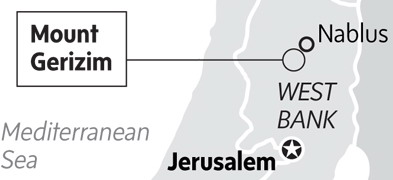 MOUNT GERIZIM, West Bank. There are two ways to look at the journey Wada Cohen
took to the south of Ukraine a few years ago. Both are told in this remote
hilltop village that is one of the last outposts of the biblical sect known as
the Samaritans.
MOUNT GERIZIM, West Bank. There are two ways to look at the journey Wada Cohen
took to the south of Ukraine a few years ago. Both are told in this remote
hilltop village that is one of the last outposts of the biblical sect known as
the Samaritans.
In one version, whispered among the women who gather on street corners to gossip
the afternoon away, Mr. Cohen was a lonely man who couldn't find a local woman,
forced to look for companionship at a faraway marriage agency. In the other,
told by his approving father and some of the other village elders, Mr. Cohen's
journey to meet and bring back a bride named Alexandra Krasyuk may just save the
Samaritans from extinction.
For millennia, the Samaritans - descendants of the ancient Israelites who
practise their own religion based on the Torah - have been slowly dying away,
their numbers diminishing to exactly 701 today. Half of them live here on the
rocky foothills of Mount Gerizim, a craggy outcrop that looms over the chaotic
West Bank town of Nablus.
The Samaritans' numbers have dwindled because of an ancient tradition of
marrying only within the community, a strictly observed rule that led to a
dwindling gene pool and a rising number of birth defects. The streets of this
village are filled with dark-haired young men and women with malformed limbs,
twisted faces and speechless tongues.
"There are a lot of cases of birth defects, because our genes are so close,"
said Rym Samiri, a 33-year-old health worker. She said she has two healthy
daughters despite being married to her cousin, but she knows she is lucky.
"I have two sisters who are mute because my father is married to my cousin.
Eighty per cent of the people are handicapped."
Into this sick and dying community have stepped two Slavic women who may as well
have arrived from a different planet, Alexandra from Ukraine, and Lena, an
Israeli citizen born in Omsk, on the plains of faraway Siberia.
Their admittance into the previously closed society of the Samaritans is nothing
short of a revolution, one that was launched by the sect's high priest, Elazar
Ben Tzadaka. Shortly after he rose to the position five years ago as a result of
the death of his more conservative predecessor, he decreed that generations of
intermarrying had left the Samaritans with too small a gene pool to survive.
Marriages to outsiders - which once meant expulsion from the Samaritan faith -
are now encouraged in an effort to reduce the birth defects that plague the
community. The only condition he set was that outsiders be made to spend six
months living in the community before the marriage so that there would be no
misunderstandings about what the newcomer was getting into.
Today, they still keep to themselves as much as possible. Neither fully
Palestinian nor Israeli, they are Arabic speakers who live in the West Bank but
celebrate Passover. Approximately 350 live in Gerizim, at the foot of the
mountain Samaritans believe to be the holiest place in the world. They believe
it is here, not Jerusalem, that God's holy temple will be built.
The Samaritans
Origins
The Samaritans are a strict sect who believe that their form of ancient
Israelite religion is the true one, going back to the period before the building
of Solomon's Temple at Jerusalem. The precise date of the schism between
Samaritans and Jews is unknown, but was complete by the end of the fourth
century BC. Archeological excavations at Mount Gerizim suggest that a Samaritan
temple was built there about 330 BC. The Jewish leader John Hyrcanus destroyed
the temple in 129-128 BC, and with few exceptions the Samaritans' subsequent
history is marked by violent incidents between them and their more powerful
neighbours: Jews, Christians and Romans.
Sacred books
The Samaritans hold sacred the Samaritan Pentateuch or the Five Books of Moses,
which they have in common with the Jews, and which they interpret in the light
of their own traditions. Other important Samaritan texts include the Memar
Markah (Teaching of Markah) and the Defter (Prayerbook) both from the fourth
century AD or later.
Holy sites
Their holy site is Mount Gerizim at Shechem, modern Nablus, where they still
practise animal sacrifice, notably in the slaying of a lamb at the annual spring
festival of the Passover.
Beliefs
They are monotheists and look forward to the coming of a saviour, Taheb, often
identified as a new Moses, who will initiate an era of justice and peace known
as "the Second Kingdom." They also believe in an ultimate Day of Judgment and
the Resurrection of the Dead. The only object employed in Samaritan worship is
the Torah scroll, still written in the ancient and highly distinctive Samaritan
script, and encased in ornate silver and velvet. Even the priests' vestments,
unlike those of the ancient Judaean hierarchy, are devoid of decoration.
Samaritan houses often have a mezuzah above the main entrance, in the form of a
stone inscribed with the words of the Ten Commandments.
Community
In 484 and 529 Samaritan rebellions against the Christian authorities were
ruthlessly suppressed, and since then they have remained a small community in
Israel. Half of the Samaritans now live with their High Priest near the
Palestinian town of Nablus, the rest near the Israeli town of Holon. From more
than 200,000 in 529,, the number of Samaritans had dropped to 2000 by the 12th
century. There are only 701 today.
Ephraimite Forum-22
Date: 23/Oct/07 11 Cheshvan 5768
Contents:
1.
Egyptian-Mexican Parallels
2. Archaeology: Brit-Am version of
Explorator
10.26
3. The Forgotten People (Jews,
YouTube)
1.
Egyptian-Mexican Parallels
Snake-bird gods fascinated both Aztecs and pharaohs Mon 24 Sep
2007, 17:05 GMT
By Robin Emmott
MONTERREY, Mexico, Sept 24 (Reuters Life!) - Ancient Mexicans and
Egyptians who never met and lived centuries and thousands of miles
apart both worshiped feathered-serpent deities, built pyramids and
developed a 365-day calendar, a new exhibition shows.
Billed as the world's largest temporary archeological showcase,
Mexican archeologists have brought treasures from ancient Egypt to
display alongside the great indigenous civilizations of Mexico for
the first time.
The exhibition, which boasts a five-tonne, 3,000-year-old
sculpture of Egyptian pharaoh Ramses II and stone carvings from
Mexican pyramid Chichen Itza, aims to show many of the similarities
of two complex worlds both conquered by Europeans in invasions 1,500
years apart.
"There are huge cultural parallels between ancient Egypt and
Mexico in religion, astronomy, architecture and the arts. They
deserve to be appreciated together," said exhibition organizer Gina
Ulloa, who spent almost three years preparing the 35,520 square-feet
(3,300 meter-square) display.
The exhibition, which opened at the weekend in the northern
Mexican city of Monterrey, shows how Mexican civilizations worshiped
the feathered snake god Quetzalcoatl from about 1,200 BC to 1521,
when the Spanish conquered the Aztecs.
From 3,000 BC onward Egyptians often portrayed their gods,
including the goddess of the pharaohs Isis, in art and sculpture as
serpents with wings or feathers.
"The feathered serpent and the serpent alongside a deity
signifies the duality of human existence, at once in touch with water
and earth, the serpent, and the heavens, the feathers of a bird,"
said Ulloa.
Egyptian sculptures at the exhibition -- flown to Mexico from
ancient temples along the Nile and from museums in Cairo, Luxor and
Alexandria -- show how Isis' son Horus was often represented with
winged arms and accompanied by serpents.
Cleopatra, the last Egyptian queen before the Roman conquest of
Egypt in 30 BC, saw herself as Isis and wore a gold serpent in her
headpiece, Ulloa added.
UNCANNY SIMILARITIES
In the arts, Mexico's earliest civilization, the Olmecs, echo
Egypt's finest sculptures. Olmec artists carved large man-jaguar
warriors that are similar to the Egyptian sphinxes on display showing
lions with the heads of gods or kings.
The seated statue of an Egyptian scribe carved between 2465 and
2323 BC shows stonework and attention to detail that parallels a
seated stone sculpture of an Olmec lord.
There is no evidence the Olmecs and Egyptians ever met.
Shared traits run to architecture, with Egyptians building
pyramids as royal tombs and the Mayans and Aztecs following suit with
While there is no room for pyramids at the exhibition -- part of
the Universal Forum of Cultures, an international cultural festival
held in Barcelona in 2004 -- organizers say it is the first time many
of pieces have left Egypt.
They include entire archways from Nile temples, a bracelet worn
by Ramses II and sarcophagi used by the pharaohs.
Mexico has also brought together Aztec, Mayan and Olmec pieces
from across the country.
"Any visitor to Egypt and Mexico might be disappointed by the
gaps in the museums. The only thing Egypt declined to loan were the
mummies," Ulloa said.
2. Archaeology:
Brit-Am version of Explorator
10.26
From: david meadows <rogueclassicist@gmail.com>
================================================================
explorator 10.26 October 21, 2007
================================================================
================================================================
ANCIENT NEAR EAST AND EGYPT
================================================================
Interesting find at Aswan Obelisk quarry (not really a 'find';
more of a theory):
http://www.eurekalert.org/pub_releases/2007-10/ps-aoq101607.php
http://www.sciencedaily.com/releases/2007/10/071016131326.htm
Latest theory on the construction of the pyramids:
http://www.comics.com/creators/rubes/archive/images/rubes2002444471017.gif
The Temple Mount dig is on hold for now:
http://www.haaretz.com/hasen/spages/912712.html
http://afp.google.com/article/ALeqM5hUExQu9SgiXPZuWb9EIVNX7Scsfg
http://www.haaretz.com/hasen/pages/ShArt.jhtml?itemNo=912425
http://www.israelnationalnews.com/News/Flash.aspx/134646
http://www.haaretz.com/hasen/pages/ShArt.jhtml?itemNo=912712
http://www.israelnationalnews.com/News/Flash.aspx/134646
... or is it?:
http://www.iht.com/articles/ap/2007/10/14/africa/ME-GEN-Israel-Holy-Site.php
http://tinyurl.com/2rr6tm
(JPost)
... but the Mughrabi bridge plan is tentatively approved:
http://tinyurl.com/2e3y5o (JPost)
Politics of archaeology in the Middle East:
http://www.forward.com/articles/11840/
More on that 'overdue earthquake' (some interesting info in this one):
http://tinyurl.com/35sutz (JPost)
More on the Temple Mount stones quarry:
http://tinyurl.com/3ckds5 (IAA)
================================================================
ANCIENT GREECE AND ROME (AND CLASSICS)
================================================================
The Greeks and Romans liked spooky stories:
http://www.newswise.com/articles/view/534410/?sc=rsln
http://www.physorg.com/news111859786.html
Even more coverage of the Greeks' lack of math:
http://abcnews.go.com/Technology/story?id=3738174&page=1
================================================================
EUROPE AND THE UK (+ Ireland)
================================================================
I
Some Saxon burials:
http://tinyurl.com/2gb6yd
Review of Piers Brendon, *The Decline and Fall of the British
Empire 1781-1997*:
http://tinyurl.com/2ezdv3
================================================================
ASIA AND THE SOUTH PACIFIC
================================================================
They're digging Patlipura:
http://in.news.yahoo.com/071018/43/6m3xk.html
http://www.bihartimes.com/news07/Oct/18ten10.html
Some villagers in Northern India have found a 'treasure trove':
http://tinyurl.com/ysbr59 (Daily Times)
http://www.newkerala.com/oct.php?action=fullnews&id=11516
Interesting under water finds from Korea:
http://tinyurl.com/25qbw5 (DC)
A Ly Dynasty site in Hanoi:
http://www.nytimes.com/2007/10/16/science/16dig.html
http://www.iht.com/articles/2007/10/16/healthscience/snviet.php
Did a major tsunami hit New Zealand 500 years ago?:
http://www.stuff.co.nz/stuff/4238301a1861.html
New Zealand Archaeology eNews:
http://www.nzarchaeology.org/netsubnews.htm
================================================================
NORTH AMERICA
================================================================
Interesting use of technology to trace Native American trade
routes:
http://news.yahoo.com/s/ap/20071015/ap_on_sc/radiation_artifacts
================================================================
CENTRAL AND SOUTH AMERICA
================================================================
Pondering the implications of some Huastec finds:
http://tinyurl.com/35bdsl (MySA)
================================================================
OTHER ITEMS OF INTEREST
================================================================
Now they're using DNA to figure out things about ancient
shipwrecks:
http://www.world-science.net/exclusives/071015_amphorae.htm
The 'Fifty Key Dates from World History' should give rise to
some discussion by the coffee pot:
http://tinyurl.com/2syre9 (Times)
Latest development in portraits of Shakespeare:
http://www.nytimes.com/2007/10/19/arts/19arts-TESTFAVORSSH_BRF.html
More stuff happening in the Odyssey saga:
http://news.bbc.co.uk/1/hi/world/europe/7054809.stm
http://www.timesonline.co.uk/tol/news/world/europe/article2673731.ece
http://www.guardian.co.uk/spain/article/0,,2192773,00.html
http://abcnews.go.com/International/WireStory?id=3737075&page=1
... and a nice oped piece on the business of treasure hunting:
http://news.bbc.co.uk/2/hi/europe/7037192.stm
Some interesting stuff on the (updated) AIA education page:
http://www.archaeological.org/webinfo.php?page=10413
More coverage of the 'absolution' of the Knights Templar:
http://www.indcatholicnews.com/templ437.html
http://www.nbc5.com/slideshow/news/14341307/detail.html (photos)
Review of A.J. Jacobs, *The Year of Living Biblically*:
http://www.nytimes.com/2007/10/18/books/18masl.html
================================================================
TOURISTY THINGS
================================================================
More on Libya's plans to boost tourism:
http://www.nytimes.com/2007/10/16/science/16liby.html
3. The Forgotten
People (Jews, YouTube)
http://www.youtube.com/watch?v=MppIZTuP1P4
Ephraimite Forum-23
Date: 30/Oct/07 18 Cheshvan 5768
Contents:
1. Archaeology: Brit-Am Version of
Explorator
10.27
2. Islam Wants to Conquer the World
3. Genealogy: Some URLs of Interest for those curious concerning
possible Jewish Origins
1. Archaeology: Brit-Am Version of
Explorator
10.27
================================================================
explorator 10.27 October 28, 2007
================================================================
================================================================
EARLY HUMANS
================================================================
Apparently some Neanderthals were redheads:
http://www.eurekalert.org/pub_releases/2007-10/hu-adr102507.php
http://www.physorg.com/news112540317.html
http://www.msnbc.msn.com/id/21474978/
http://news.bbc.co.uk/1/hi/sci/tech/7062415.stm
... although ANSA and El Pais gave it a different spin:
http://www.ansa.it/site/notizie/awnplus/english/news/2007-10-26_126131388.html
http://tinyurl.com/2kjvu3
================================================================
ANCIENT NEAR EAST AND EGYPT
================================================================
... and the Jezebel's seal story too:
http://in.news.yahoo.com/071023/137/6mba0.html
http://tinyurl.com/2t244w
(JPost)
http://www.alphagalileo.org/index.cfm?fuseaction=readrelease&releaseid=524452&ez_search=1
http://www.reuters.com/article/lifestyleMolt/idUSL2317518720071023
We're starting to hear more about First Temple evidence at
Temple Mount:
http://www.iht.com/articles/ap/2007/10/21/africa/ME-GEN-Israel-Holy-Site.php
http://www.haaretz.com/hasen/spages/915288.html
http://abc.net.au/news/stories/2007/10/22/2065758.htm?section=world
http://news.nationalgeographic.com/news/2007/10/071023-jerusalem-artifacts.html
http://tinyurl.com/2qdvpg (MFA)
http://tinyurl.com/25grdz
http://www.israelnationalnews.com/News/News.aspx/123989
http://www.haaretz.com/hasen/pages/ShArt.jhtml?itemNo=915241
http://tinyurl.com/3bcq3z
(JPost)
http://tinyurl.com/2jtorc (IAA)
http://www.israelnationalnews.com/News/News.aspx/123989
... while a Mufti has claimed the Western Wall was never part of
the Temple:
http://tinyurl.com/374dxe (JPost)
... while the 'other stuff' about Temple Mount continues to make
headlines:
http://worldnetdaily.com/news/article.asp?ARTICLE_ID=58273
http://tinyurl.com/2wx7o8
(JPost)
http://www.ynetnews.com/articles/0,7340,L-3462904,00.html
http://www.israelnationalnews.com/News/News.aspx/124012
A followup to that 'tunnel' story from the past month:
http://www.forward.com/articles/11873/
More on 'Herod's quarry' (with slideshow):
http://www.ou.org/index.php/shabbat_shalom/article/30810/
Interesting Tom Sawyer-like approach to archaeology at a site
outside Jerusalem:
http://www.miamiherald.com/986/story/283198.html
================================================================
ANCIENT GREECE AND ROME (AND CLASSICS)
================================================================
Evidence of Punic child sacrifice:
http://www.adnkronos.com/IGN/Cultura/?id=1.0.1456304536 (Italian)
A Roman tombstone from Scotland (!):
http://heritage.scotsman.com/news.cfm?id=1718052007
================================================================
EUROPE AND THE UK (+ Ireland)
================================================================
Trying to figure out Silbury Hill:
http://www.timesonline.co.uk/tol/news/uk/science/article2733437.ece
http://arts.guardian.co.uk/art/news/story/0,,2198955,00.html
================================================================
OTHER ITEMS OF INTEREST
================================================================
Belief in witchcraft serves a basic human need, apparently:
http://www.sciencedaily.com/releases/2007/10/071024143613.htm
Taking DNA testing to its illogical extreme:
http://www.nytimes.com/2007/10/25/fashion/25Cyber.html
Ancient clay remedies are being studied (probably will be
more on this next week):
http://www.newsdaily.com/Science/UPI-1-20071025-13333100-bc-us-claymedicine.xml
More on Vatican revelations about the Knights Templar:
http://www.ansa.it/site/notizie/awnplus/english/news/2007-10-25_125127949.html
2. Islam Wants to Conquer the World
http://www.westernresistance.com/blog/archives/003067.html
3. Genealogy: Some URLs of Interest for
those curious concerning
possible Jewish Origins
Tracing the Tribe: The Jewish Genealogy Blog
http://tracingthetribe.blogspot.com/2007/10/abrahams-children-and-jon-entine.html
SephardicGen Resources
http://www.sephardicgen.com/
contains articles on Sephardic (Mediterranean and Eastern
Jewish) history, surnames, and genealogy
Ephraimite Forum-24
Date: 9/Nov/07 28 Cheshvan 5768
Contents:
1. Articles on the
Hidden Jews of Poland
2. Archaeology: Brit-Am Version of Explorator 10.28
3. The Dangers of Islam in Denmark
1. Articles on the
Hidden Jews of Poland
http://www.haaretz.com/hasen/spages/917783.html
Poland's 'hidden Jews' connect with lost culture By The Associated Press
KRAKOW, Poland - Jacek Kujawa only learned he was Jewish two years ago. He
had known about the German great-grandfather who served in Hitler's army,
but his mother's revelation that the Wehrmacht soldier's wife was a Polish
Jew set him off on a search for her lost world.
This weekend, with a Star of David around his neck and a yarmulke on his
shaved head, Kujawa, 23, gathered with dozens of other Poles who, like
himself, have learned only recently of their Jewish roots and are struggling
to reconnect with Poland's Jewish culture that nearly vanished in the
Holocaust.
"We know we aren't alone," Kujawa said on the sidelines of three days of
praying, singing, eating - and even more eating - in Krakow's historic
Jewish district, Kazimierz.
The gathering began with the lighting of candles at sundown Friday to
welcome in Shabbat, the Jewish sabbath. It wrapped up Sunday with the launch
of a new Polish-Yiddish dictionary, which organizers said was the first
since the Holocaust.
The event was set up by Shavei Israel, an organization that has worked for
nearly a decade to bring so-called lost or hidden Jews from around the world
back into the fold.
"We just want to keep the connection [to Judaism] alive," said Michael
Freund, the chairman of Shavei Israel. "It's a connection that has survived
persecution and repression, and now that the world is opening up so quickly,
it's a connection that in many instances will become endangered."
"So we need to seize the moment, and to strengthen these people's sense of
connection to the Jewish people."
Poland was home to nearly 3.5 million Jews before World War II, the largest
community in Europe. But the Nazis nearly wiped them out in the ghettos and
death camps set up throughout the country after 1939.
During the Cold War, Jews suffered repression and expulsions provoked by the
Soviet-influenced communist regime. Many fled, while those who choose to
stay often hid their roots, either marrying Roman Catholics and baptizing
their children or simply adopting the atheistic ethos of the communist
regime.
But since communism fell in 1989, parents and grandparents with enduring
memories of their Jewish ancestors have slowly begun passing on the family
secret, emboldened by the new tolerance and freedoms that have taken root.
In many cases, it is the young Poles like Kujawa rather than the older
generations who seek to reconnect to their Jewish roots, attracted by the
culture that is becoming increasingly trendy in cosmopolitan cities like
Krakow and Warsaw.
"My grandmother asked me rhetorically, 'So the whole family is Catholic and
you're Jewish?' She can't understand why I do this, but told me to go
ahead - just not to be too obvious about it," said Kujawa, a student of
political science who plans to become an officer in the Polish Army.
Each personal story is unique but with common themes: the fear of being
exposed as Jewish in a hostile world, the assimilation into the larger
Catholic world.
In Kujawa's case, it was his mother's maternal grandmother who was Jewish,
meaning that he is Jewish under Jewish law, which traces religious status
through the mother's line.
Many other hidden Jews, however, have their roots on their father's side,
and spend years preparing for conversions in order to become real Jews.
Others keep up looser ties to Poland's Jewish community, joining youth
groups or taking part in cultural events but without strict religious
observation.
Iwona Giermala, a 43-year-old interior decorator, also at the event,
believes her mother has Jewish roots, but isn't sure. She has no papers or
witnesses to prove it, so she is studying for conversion to satisfy her
growing attraction to Jewish life.
"I'm finding myself with something that feels mine - but I don't even know
how to explain it," Giermala said.
During the event in Krakow, about 120 participants prayed in the Kupa
synagogue, a richly decorated 17th-century prayer house with colorful
paintings of Biblical cities illuminated by a chandelier; they enjoyed
drawn-out sabbath meals of herring, pickles and gefilte fish in a community
center, and held discussions in an exhibition hall
filled with black and white photographs of Polish Jews before the war.
Amid the revival of Jewish life in this picturesque town about 50 kilometers
(30 miles) from the Auschwitz death camp, there are constant reminders of
the fraught relations between Jews and their largely Catholic surroundings.
Late Saturday, as an elderly Orthodox rabbi, Edgar Gluck, walked with a
group of young Jews through the city, they encountered a young Pole who
appeared to be drunk, staggering toward them.
Fearing he would be attacked, the young Jews encircled Gluck. But the Pole
instead broke down in sobs, telling the group in slurred speech that it was
the Germans - and not the Poles - who carried out the Holocaust.
"It wasn't the Poles," he said. "I am so sorry."
For Another Article on the same subject article see:
'It's impossible to be Jewish alone'
Rory Kress, Jerusalem Post Correspondent
<http://www.jpost.com/servlet/Satellite?cid=1192380684352&pagename=JPost%2FJPArticle%2FShowFull>
2. Archaeology:
Brit-Am Version of Explorator
10.28
Adapted from:
david meadows <rogueclassicist@gmail.com>
================================================================
Explorator 10.28 November 4, 2007
================================================================
================================================================
ANCIENT NEAR EAST AND EGYPT
================================================================
Can't remember if we've mentioned this cuneiform tablet find
before:
http://www.myrtlebeachonline.com/news/local/story/233828.html
Another 'Biblical Archaeology' piece:
http://www.post-gazette.com/pg/07302/829332-85.stm
An interview with Lee Levine on the effects of the destruction
of the Temple on Jewish communal life:
http://reformjudaismmag.org/Articles/index.cfm?id=1294
Latest Temple Mount developments:
http://www.imra.org.il/story.php3?id=36629
More coverage of Jezebel's seal:
http://www.sciencedaily.com/releases/2007/10/071026210336.htm
Persepolis Fortification Archives:
http://persepolistablets.blogspot.com/
================================================================
ANCIENT GREECE AND ROME (AND CLASSICS)
================================================================
A section of the Aurelian Wall collapsed in heavy rain:
http://deseretnews.com/dn/view/0,5143,695224168,00.html
http://www.usatoday.com/travel/news/2007-11-02-rome-wall-collapse_N.htm
http://news.yahoo.com/s/ap/20071102/ap_on_sc/italy_ancient_wall_3
A Roman tombstone from Scotland:
http://news.bbc.co.uk/2/hi/uk_news/scotland/edinburgh_and_east/7066539.stm
http://www.theherald.co.uk/news/other/display.var.1791961.0.0.php
Semi-touristy thing on Pompeii:
http://deseretnews.com/article/1,5143,695215210,00.html
Plenty of coverage of a dna study on some shipwreck cargo:
http://news.yahoo.com/s/nm/20071102/ts_nm/shipwreck_dna_dc_2
http://www.physorg.com/news112978421.html
http://www.reuters.com/article/scienceNews/idUSN0228463120071102
================================================================
EUROPE AND THE UK (+ Ireland)
================================================================
An Iron Age chain from Scatness:
http://news.bbc.co.uk/2/hi/uk_news/scotland/north_east/7073020.stm
A 'giant' burial in Norway:
http://www.aftenposten.no/nyheter/iriks/article2065664.ece
The Red Lady is older than previously thought:
http://news.bbc.co.uk/2/hi/uk_news/wales/south_west/7069001.stm
http://tinyurl.com/3c6hel
http://www.physorg.com/news112978558.html
Review of Graham Robb, *The Discovery of France*:
http://www.nytimes.com/2007/11/02/books/02book.html
Archaeology in Europe Blog:
http://www.archaeology.eu.com/weblog/index.html
================================================================
ASIA AND THE SOUTH PACIFIC
================================================================
Evidence of ancient Polynesian seafaring skills:
http://in.news.yahoo.com/071101/139/6mp6v.html
New Zealand Archaeology eNews:
http://www.nzarchaeology.org/netsubnews.htm
================================================================
NORTH AMERICA
================================================================
Just when you thought you'd heard the last about Kennewick Man:
http://seattletimes.nwsource.com/html/localnews/2003988146_webkennewickman01m.html
High tech methods to trace Southeastern pottery:
http://www.cdispatch.com/articles/2007/10/31/local_news/area_news/area04.txt
Interesting bit of New York Subway history:
http://www.nytimes.com/2007/11/02/nyregion/02plaque.html
================================================================
OTHER ITEMS OF INTEREST
================================================================
A different approach to Wikipedia:
http://news.yahoo.com/s/ap/techbit_wikipedia_term_papers
Nice feature on the dendrochronology projects at Cornell:
http://www.sciencedaily.com/releases/2007/10/071027172611.htm
On the 'rise of the salvagers':
http://news.independent.co.uk/world/politics/article3106909.ece
Explorator 2177:
http://video.google.com/videoplay?docid=3025645929721292107
Wanna be part of a Viking ship crew?:
http://www.havhingsten.dk/index.php?id=979&L=1
A sort of history of bartending:
http://www.nytimes.com/2007/10/31/dining/31cock.html
================================================================
EXHIBITIONS, AUCTIONS, AND MUSEUM-RELATED
================================================================
Pompeii: Tales from an Eruption:
http://www.tuscaloosanews.com/article/20071028/NEWS/710280303/-1/NEWS03
Drawing Connections:
http://www.nytimes.com/2007/11/01/arts/design/01draw.html
Pompei Batoni:
http://news.independent.co.uk/uk/this_britain/article3112821.ece
================================================================
ON THE WEB
================================================================
Article on assorted online historical resources:
http://www.newyorker.com/online/2007/11/05/071105on_onlineonly_grafton
1905-1907 Breasted Expeditions to Egypt and the Sudan:
http://oi.uchicago.edu/museum/collections/pa/breasted/
3. The Dangers of
Islam in Denmark
From: Patricia
Subject: FW: WILL THIS HAPPEN HERE?
Yair,
Has the problem of Muslim immigrants really become such a huge burden in Denmark
as this email purports? I'm wondering if many Danes have discovered Brit-Am?
Is there someone to translate its message into Danish? Perhaps as our nations
of origin become less hospitable to their natural citizens, our eyes will begin
to focus upon our Father's Plan of Return.
As always, I very much appreciate your work for all our Lost Ones scattered
among the nations. May Hashem reunite our family.
Best,
Pat
-
Subject: will this happen
here?
-
Date: Mon, 22 Oct 2007 15:31:36 -0400
Subject: Important read...Our problem is mirrored...
Salute the Danish Flag - it's a Symbol of Western Freedom
By Susan MacAllen
In 1978-9 I was living and studying in
Denmark.
But in 1978 - even in Copenhagen, one didn't see Muslim immigrants.
The Danish population embraced visitors, celebrated the exotic,
went out of its way to protect each of its citizens. It was proud
of its new brand of socialist liberalism - one in development since
the conservatives had lost power in 1929 - a system where no worker
had to struggle to survive, where one ultimately could count upon
the state as in, perhaps, no other western nation at the time. The
rest of Europe saw the Scandinavians as free-thinking, progressive
and infinitely generous in their welfare policies. Denmark boasted
low crime rates, devotion to the environment, a superior
educational system and a history of humanitarianism.
Denmark was also most generous in its immigration policies - it
offered the best welcome in Europe to the new immigrant: generous
welfare payments from first arrival plus additional perks in
transportation, housing and education. It was determined to set a
world example for inclusiveness and multiculturalism. How could it
have predicted that one day in 2005 a series of political cartoons
in a newspaper would spark violence that would leave dozens dead in
the streets - all because its commitment to multiculturalism would
come back to bite?
By the 1990's the growing urban Muslim population was obvious - and
its unwillingness to integrate into Danish society was obvious.
Years of immigrants had settled into Muslim-exclusive enclaves. As
the Muslim leadership became more vocal about what they considered
the decadence of Denmark's liberal way of life, the Danes - once so
welcoming - began to feel slighted. Many Danes had begun to see
Islam as incompatible with their long-standing values: belief in
personal liberty and free speech, in equality for women, in
tolerance for other ethnic groups, and a deep pride in Danish
heritage and history.
The New York Post in 2002 ran an article by Daniel Pipes and Lars
Hedegaard,
in which they forecasted accurately that the growing
immigrant problem in Denmark would explode. In the article they
reported:
"Muslim immigrants.constitute
5 percent of the population but
consume upwards of 40 percent of the welfare spending."
"Muslims are only 4 percent of Denmark's 5.4 million people but
make up a majority of the country's convicted rapists, an
especially combustible issue given that practically all the female
victims are non-Muslim. Similar, if lesser, disproportions are
found in other crimes."
"Over time, as Muslim immigrants increase in numbers, they wish
less to mix with the indigenous population. A recent survey finds
that only 5 percent of young Muslim immigrants would readily marry a Dane."
"Forced marriages - promising a newborn daughter in Denmark to a
male cousin in the home country, then compelling her to marry him,
sometimes on pain of death - are one problem"
"Muslim leaders openly declare their goal of introducing Islamic
law once Denmark's Muslim population grows large enough - a not-
that-remote prospect. If present trends persist, one sociologist
estimates, every third inhabitant of Denmark in 40 years will be
Muslim."
It is easy to understand why a growing number of Danes would feel
that Muslim immigrants show little respect for Danish values and
laws. An example is the phenomenon common to other European
countries and the U.S.: some Muslims in Denmark who opted to leave
the Muslim faith have been murdered in the name of Islam, while
others hide in fear for their lives. Jews are also threatened and
harassed openly by Muslim leaders in Denmark, a country where once
Christian citizens worked to smuggle out nearly all of their 7,000
Jews by night to Sweden - before the Nazis could invade. I think of
my Danish friend Elsa - who as a teenager had dreaded crossing the
street to the bakery every morning under the eyes of occupying Nazi
soldiers - and I wonder what she would say today.
In 2001, Denmark elected the most conservative government in some
70 years - one that had some decidedly non-generous ideas about
liberal unfettered immigration. Today Denmark has the strictest
immigration policies in Europe. ( Its effort to protect itself has
been met with accusations of "racism" by liberal media across
Europe - even as other governments struggle to right the social
problems wrought by years of too-lax immigration.) If you wish to
become Danish, you must attend three years of language classes. You
must pass a test on Denmark's history, culture, and a Danish
language test. You must live in Denmark for 7 years before applying
for citizenship. You must demonstrate an intent to work, and have a
job waiting. If you wish to bring a spouse into Denmark, you must
both be over 24 years of age, and you won't find it so easy anymore
to move your friends and family to Denmark with you. You will not
be allowed to build a mosque in Copenhagen. Although your children
have a choice of some 30 Arabic culture and language schools in
Denmark, they will be strongly encouraged to assimilate to Danish
society in ways that past immigrants weren't.
In 2006, the Danish minister for employment, Claus
Hjort
Frederiksen,
spoke publicly of the burden of Muslim immigrants on
the Danish welfare system, and it was horrifying: the government's
welfare committee had calculated that if immigration from Third
World countries were blocked, 75 percent of the cuts needed to
sustain the huge welfare system in coming decades would be
unnecessary. In other words, the welfare system as it existed was
being exploited by immigrants to the point of eventually
bankrupting the government. "We are simply forced to adopt a new
policy on immigration.
Thecalculations of the welfare
committee are
terrifying and show how unsuccessful the integration of immigrants
has been up to now," he said.
A large thorn in the side of Denmark's imams is the Minister of
Immigration and Integration,
Rikke
Hvilshoj.
She makes no bones >
about the new policy toward immigration, "The number of foreigners
coming to the country makes a difference,"
Hvilsh
??j says, "There is
an inverse correlation between how many come here and how well we
can receive the foreigners that come." And on Muslim immigrants
needing to demonstrate a willingness to blend in, "In my view,
Denmark should be a country with room for different cultures and
religions. Some values, however, are more important than others. We
refuse to question democracy, equal rights, and freedom of speech."
Hvilshoj
has paid a price for her show of backbone. Perhaps to test
her resolve, the leading radical imam in Denmark, Ahmed
Abdel
Rahman
Abu Laban,
demanded that the government pay blood money to
the family of a Muslim who was murdered in a suburb of Copenhagen,
stating that the family's thirst for revenge could be thwarted for
money. When Hvilshoj
dismissed his demand, he argued that in Muslim
culture the payment of retribution money was common, to which
Hvilshoj
replied that what is done in a Muslim country is not
necessarily what is done in Denmark. The Muslim reply came soon
after: her house was torched while she, her husband and children
slept. All managed to escape unharmed, but she and her family were
moved to a secret location and she and other ministers were
assigned bodyguards for the first time - in a country where such
murderous violence was once so scarce.
Her government has slid to the right, and her borders have
tightened. Many believe that what happens in the next decade will
determine whether Denmark survives as a bastion of good living,
humane thinking and social responsibility, or whether it becomes a
nation at civil war with supporters of
Sharia
law. And meanwhile,
Americans clamor for stricter immigration policies, and demand an
end to state welfare programs that allow many immigrants to live on
the public dole. As we in America look at the enclaves of Muslims
amongst us, and see those who enter our shores too easily, dare
live on our taxes, yet refuse to embrace our culture, respect our
traditions, participate in our legal system, obey our laws, speak
our language, appreciate our history . . we would do well to look
to Denmark, and say a prayer for her future and for our own.
Ephraimite Forum-25
Date: 13/Nov/07 3 Kislev 5768
Contents:
1. MEF Book Reviews - A Selection
a. The Holocaust and Arab Involvement
b. Historical Involvement of America in the Middle East
c. Mohammed was a bad man.
d. Islamic Penetration of Europe
2. Archaeology: Brit-Am version of Explorator 10.29
3. Jews in the USA: Some Figures
1. MEF Book Reviews - A Selection
From: MEF News <mefnews@meforum.org>
Subject: Brief Reviews from the Fall 2007 MEQ
Fall 2007
Middle East Quarterly
http://www.meforum.org/article/1794
Among the Righteous: Lost Stories from
the Holocaust's Long Reach into Arab Lands. By Robert
Satloff.
New York: Public Affairs, 2006. 251 pp. $26.
In this very personal book, Satloff, executive director of the Washington
Institute for Near East Policy, recounts his quest to discover whether there
were documented cases of Arabs saving Jewish lives or even assisting Jews in the
face of persecution during World War II, either in the Arab lands under Vichy or
Axis control or in Europe itself. The author actually lived in Rabat with his
family for two and a half years while conducting his research so, for practical
reasons, the Arab countries surveyed are those of North Africa?Libya, Tunisia,
Algeria, and Morocco. The first-person accounts of his experiences interviewing
Jewish and Arab informants gives the book its personal and engaging qualities,
as do the author's experiences with the vagaries of trying to examine archival
records, and his descriptions?at times dramatic?of field trips to concentration
and labor camp sites deep in the desert and mountain regions of the interior.
The first half recounts not the heroic acts of the Arab Schindlers or
Wallenbergs that Satloff sought, nor even the passive role of the Arab masses
during the persecution of their Jewish neighbors, but rather the more sinister
participation of some Arabs in the mistreatment of Jews. These included
despoiling Jewish property; acting as informants for the Italian Fascist, Vichy
French, or Nazi authorities (in the case of Tunisia during the 6-month German
occupation); and serving as guards and tormentors in the labor and punishment
camps for local and foreign Jews.
The section on the "Righteous" of the title is, alas, considerably shorter.
Satloff does, in fact, find individuals who took risks to help Jews: men such as
Si Ali Sakkat, a former mayor of Tunis, who sheltered some sixty Jewish escapees
from a nearby Nazi labor camp at his farm in the Tunisian countryside, or Khaled
Abdelwahhab, who spirited a Jewish family of twelve away in the middle of the
night when he learned that the Germans were planning to take the mother of the
family away for service in their local bordello. He, too, gave them refuge on
his family farm. Satloff also recalls the principled stance of the Muslim
spiritual leadership in Algiers who warned their flock from the pulpit not to
take advantage of the Vichy authorities' offers to take possession of
sequestered Jewish property. He, also, deals with the benevolence shown to their
Jewish subjects by the Tunisian bey and the Moroccan sultan. He rightly notes
that their personal expressions of sympathy toward Jews, mainly in private but
also in public, did help morale and, eventually, took on mythic proportions in
the Jewish collective memory.
Satloff finds, to his surprise, that such examples of heroism and humanity are
not only unknown to the descendants of these individuals, but that on learning
what happened, the family members display no interest or even hostility. The
present rector of the great mosque of Paris, Dalil Boubakeur, minimizes the
account of an escaped Algerian Jewish prisoner of war who wrote in testimony to
the valor of an earlier rector of the same mosque, Si Kaddour Benghabrit, who
gave sanctuary to more than a thousand Jews in occupied Paris. This attitude,
Satloff concludes, results from the Arab-Israeli conflict and from the Holocaust
denial and Holocaust minimization that are ubiquitous in the Muslim world. One
Tunisian family wrongly recalls that its forbearer saved fleeing German
soldiers, when he, in fact, saved Jews. Satloff concludes that no Arab is listed
among the 21,000 "Righteous among the Nations" in Jerusalem's Yad Vashem
memorial because just as "many Arabs (or their heirs) didn't want to be found. ?
for their part, Jews didn't look too hard."
Norman A. Stillman
University of Oklahoma
Power, Faith and Fantasy: America in the
Middle East, 1776 to the Present. By Michael B. Oren. W.W. Norton, 2007.
736 pp. $29.95.
America's first conflict in the Middle East, which occurred more than two
hundred years ago, had nothing to do with oil or Israel. Rather, American
commercial interests in the region, which were substantial even before the
colonies declared their independence from Great Britain, fell under attack by
Muslim North African pirates, pursuing jihad at sea. Oren's hefty yet absorbing
volume begins by dwelling on the significance of this episode in American
history, permitting him to argue that U.S. interests in the Middle East have
roots far deeper than Arab oil or the U.S.-Israel alliance. Having begun even
before the U.S. Constitution was written, the history of America's involvement
in the Middle East offers important insights into present issues.
Oren's analysis points to three distinct yet intertwined themes that help
explain the goals and perceptions that inform America's career in the Middle
East. These themes are those of his title: power, faith and fantasy.
America's primary regional involvement, Oren posits, has nearly always been tied
to the pursuit of national interests through the use of power, whether it be
diplomatic, economic, or military. Further, Americans suppose themselves morally
superior to the Arabs, Turks, and Persians and their brutal, backward, and
barbaric lands?a prejudice, Oren writes, that "landed with the Pilgrims at
Plymouth." Yet, Americans remain seized of certain romantic, exotic notions of
"the mysterious, menacing Orient," characterized by "the desert's immutable
beauty and the romance of its perambulant tribes." Abutting this tension is a
strong proto-Zionist passion that, since America's colonial period, has excited
many Americans with notions of restoring the Jewish people to their biblical
homeland. The American spirit of liberty, democracy, and justice led to American
independence and also led Americans to engage in missionary efforts, religious
and otherwise, to transform the Middle East in their own distinctly American,
liberal, Christian image.
Oren's study is more of a persuasively told story than a comprehensive analysis.
Yet his narrative is brisk, offers choice anecdotes, interesting trivia,
perceptive observations, and at times, real insights that demand greater
attention and focus. His idea, for example, that continued American failure at
understanding the Middle East stems not from Orientalist conceptions of a
demeaning otherness but rather from deeply rooted na?e notions of sameness
warrants further consideration. Likewise his readings of President Woodrow
Wilson's decision not to declare war against Turkey in 1917-18, and of Dwight
Eisenhower's support for Egyptian president Gamal Abdul Nasser in the 1956 Suez
Crisis offer insights into enduring patterns.
Joshua E. London
author of Victory in Tripoli
The Truth about Muhammad, Founder of the
World's Most Intolerant Religion. By Robert Spencer. Washington, D.C.:
Regnery Publishing, Inc., 2006. 224 pp. $27.95.
Spencer's important biography of Muhammad deserves a wide audience. Its central
argument can be summarized as follows: Islam requires its adherents to obey and
imitate Muhammad, holding him up as "the perfect person." Indeed, over two dozen
verses in the Qur'an command Muslims to do this. Yet the earliest and most
reliable sources we have on Muhammad (all of them written by Muslims: the Qur'an,
the early Muslim biographies of Ibn Ishaq and Ibn Sa'd, and the collections of
prophetic traditions assembled by Bukhari and Muslim) testify that Muhammad
engaged in, commanded, and condoned actions that any civilized person today
would condemn as gravely immoral.
He commanded the murder of those who mocked him, the execution and enslavement
of hundreds of prisoners of war, the killing of apostates, the forcible
conversion of pagan Arabs, the military subjugation and humiliation of Jews and
Christians, and the torture of prisoners, and permitted sexual relations with
female slaves and war captives, to mention just a few examples. He also
manifested angry contempt for anyone who questioned his claim to be God's
messenger, especially the hapless Jews of Medina, who made the fatal mistake of
telling him the evident truth that their scriptures do not foretell his coming
as the final prophet.
Spencer concludes by noting that contemporary Muslim extremists and militants
model their behavior on Muhammad. Their violence and intolerance, far from being
alien to an inherently peaceful religion, is directly rooted in Muhammad's
example. His powerful central argument demonstrates that many of the problems in
the Muslim world today can be traced directly to the regrettable precedents set
by the founder of the faith.
To the common argument in defense of Muhammad (e.g. by Karen Armstrong) that one
must not judge a seventh-century Arab chieftain by contemporary ethical
standards, Spencer replies: Perhaps so, but Muslims must choose. Either Muhammad
embodied the morally deficient standards of a barbarous age, or he is the
perfect person and hence the standard by which present practices are to be
evaluated. Muslims cannot have it both ways but must choose. However, each
option poses a problem. Muslims who forsake Muhammad will be condemned for
abandoning 1,400 years of Islamic tradition; those who insist on the perfection
of the prophet implicitly condone barbarism.
Spencer's book does suffer from some flaws, starting with the publisher's
sensationalistic title that belies the seriousness of the book. In some
chapters, endnote numbering does not match the sources cited, making it
difficult for the reader to follow up on references. Better editing would have
detected factual errors: pages xii and 154 incorrectly date the Battle of Tabuk
to 631 while elsewhere the author correctly dates it to October 630. During the
Battle of the Ditch, Muhammad proposed buying off the Ghatafan, not the Quraysh.
It appears that Muhammad condoned the intentional killing of women and children
in war when, in fact, he condemned this; the hadith quoted seems only to condone
collateral or unintentional killing on night raids. The same applies to the
assertion that Muhammad condoned the mutilation of enemy dead on the battlefield
whereas he prohibited such mutilation, as Spencer's own source, Ibn Ishaq, makes
clear. Qur'an 8:65 is quoted without noting that the verse immediately following
abrogates it. The opening verses of Qur'an 9 were revealed and promulgated
during the hajj in March-April 631, not during Muhammad's farewell pilgrimage in
632.
Joseph S. Spoerl
Saint Anselm College
While Europe Slept: How Radical Islam Is
Destroying the West from Within. By Bruce
Bawer.
New York: Doubleday, 2006. 248 pp. $23.95.
While international government, law enforcement, and media attention has been
focused exclusively on the violent manifestations of today's global Islamic
jihad, Bawer contends in While Europe Slept that the Islamization of Europe is
being carried off largely without violence and without any effective response
from European leaders blind to the goals and nature of Shari?a supremacism.
Bawer, a gay American writer who lives in Norway and also spent several years in
The Netherlands, provides numerous chilling examples of this creeping
Islamization and how it challenges core European values of pluralism, individual
freedom, and more.
Massive immigration into Europe from Muslim countries has been unaccompanied?at
the insistence of the Arab League and with the acquiescence of the European
Union, as Bawer notes?by any large-scale organized attempts to assimilate these
populations. Bawer demonstrates that this failure even to attempt to inculcate
European values in these new Europeans has negative consequences not only for
the immigrants but also for the native populations. Their lives have become more
difficult, more precarious, and more expensive because of both the necessity to
institute antiterror measures and because of the comprehensive challenge to
European mores that the immigrants are posing. Homosexuals, Bawer recounts, are
physically threatened as never before; even non-Muslim women in some areas of
France and Sweden are compelled to don the hijab (headscarf) so as to avoid
being raped; politicians and public figures who have dared to speak out against
the advance of Islamic Shari?a norms?Dutch politician Pim Fortuyn and filmmaker
Theo van Gogh, in particular, have been murdered.
In response to all this, Bawer chronicles how Europe's elites remain wedded to a
"mindless, self-destructive multiculturalism" that has even led them more than
once to shortsighted alliances with the most intransigent of Islamic
hard-liners. Meanwhile, the political mainstream has abdicated its
responsibility on this issue, leaving the field open for resurgent neofascists.
The suicide of Europe that Bawer so ably recounts is yet in the process of
playing itself out.
Robert Spencer
2. Archaeology: Brit-Am version of
Explorator
10.29
================================================================
explorator 10.29 November 11, 2007
================================================================
ANCIENT NEAR EAST AND EGYPT
================================================================
... while the Yorkshire post has a piece on how Egyptian culture
'inspires' us:
http://tinyurl.com/3ybat3
(YP)
A Median ring find:
http://www.presstv.ir/detail.aspx?id=30516§ionid=351020105
Remains of Nehemiah's Wall?:
http://www.thetrumpet.com/index.php?q=4418.2664.0.0
http://worldnetdaily.com/news/article.asp?ARTICLE_ID=58623
A Hittite cult site and fortress from Turkey:
http://www.sciencedaily.com/releases/2007/10/071030133030.htm
Latest in the Temple Mount saga seems to be a class action lawsuit:
http://tinyurl.com/34zyeh
(UPI)
http://worldnetdaily.com/news/article.asp?ARTICLE_ID=58582
http://www.israelnationalnews.com/News/News.aspx/124158
The excavations in Bitlis will continue:
http://www.turkishdailynews.com.tr/article.php?enewsid=87647
A piece of the Aleppo Codex is returning to Jerusalem:
http://tinyurl.com/2klwb3
(JPost)
http://www.haaretz.com/hasen/pages/ShArt.jhtml?itemNo=920674
http://news.yahoo.com/s/ap/20071108/ap_on_re_mi_ea/israel_ancient_bible
More on Jezebel's seal:
http://tinyurl.com/2jmmxo
(LS via Yahoo)
http://tinyurl.com/2jmmxo
http://in.news.yahoo.com/071109/139/6n1a7.html
http://www.livescience.com/history/071108-queen-jezebel.html
Review of C. Bonnet and D. Valbelle, * The Nubian Pharaohs: Black
Kings on the Nile*:
http://weekly.ahram.org.eg/2007/870/heritage.htm
================================================================
ANCIENT GREECE AND ROME (AND CLASSICS)
================================================================
Roman finds from Spalding:
http://www.spaldingtoday.co.uk/news/Dig-unearths-finds-from-Roman.3454425.jp
In Bulgaria, seals have been found dating to the first Bulgarian
Empire:
http://www.novinite.com/view_news.php?id=87125
================================================================
EUROPE AND THE UK (+ Ireland)
================================================================
On Stonehenge as a prehistoric Lourdes (again):
http://www.archaeology.co.uk/index.php?option=com_content&task=view&id=402&Itemid=26
... and a major Neolithic settlement has been found near
Stonehenge too (I think we've had this before):
http://news.bbc.co.uk/2/hi/science/nature/7078578.stm
http://www.andhranews.net/Intl/2007/November/6/Largest-Neolithic-monument-21190.asp
Every couple of years we get a Robin Hood story ... this time
it's about the plight of Sherwood Forest:
http://news.yahoo.com/s/ap/20071104/ap_on_re_eu/shrinking_sherwood
Another piece pondering the 'meaning' of Silbury Hill:
http://tinyurl.com/2ej6q6
(Daily Mail)
Archaeology in Europe Blog:
http://www.archaeology.eu.com/weblog/index.html
================================================================
OTHER ITEMS OF INTEREST
================================================================
Comparing the nature of Greek and Egyptian deities:
http://www.redlandsdailyfacts.com/news/ci_7341892
Review of M. Aronson, *Race: A History Beyond Black and White*:
http://www.nytimes.com/2007/11/11/books/review/Rodberg-t.html
================================================================
TOURISTY THINGS
================================================================
Delphi:
http://www.ocregister.com/travel/greece-greek-oracle-1915023-delphi-mythology
Izmir:
http://www.turkishdailynews.com.tr/article.php?enewsid=88153
Oxford:
http://travel.nytimes.com/2007/11/11/travel/11day.html
Portugal:
http://travel.nytimes.com/2007/11/11/travel/11next.html
================================================================
NUMISMATICA
================================================================
A rare Spanish coin from a Nashville cemetery:
http://www.npr.org/templates/story/story.php?storyId=16161989&ft=1&f=1003
Hawaiian Coinage:
http://www.journalofantiques.com/Oct04/coinsoct04.htm
Hobbyblog:
http://hobbyblog.blogspot.com/
Ancient Coin Collecting:
http://ancientcoincollecting.blogspot.com/
Ancient Coins:
http://classicalcoins.blogspot.com/
================================================================
EXHIBITIONS, AUCTIONS, AND MUSEUM-RELATED
================================================================
Roman Word: Religions and Everyday Life:
http://www.flyernews.com/article.php?section=AE&volume=55&issue=14&artnum=04
Pompeii: Tales from an Eruption (official site):
http://www.pompeiibirmingham.com/
3. Jews in the USA: Some Figures
http://judaism.about.com/od/jewishhumor/f/jewry_usa.htm
A. Jewish Population
1970: 5,400,000
2005: 5,280,000
2020 Projected: 5,200,000
http://en.wikipedia.org/wiki/American_Jews
There were about 4 million adherents of Judaism in the U.S. as of 2001,
approximately 1.4% of the US population.[9] The community self-identifying as
Jewish by birth, irrespective of halakhic (unbroken maternal line of Jewish
descent or formal Jewish conversion) status, numbers about 7 million, or 2.5% of
the US population. According to the Jewish Agency, for the year 2007 Israel is
home to 5.4 million Jews (40.9% of the world's Jewish population), while the
United States contained 5.3 million (40.2%).
The most recent large scale population survey, released in the 2006 American
Jewish Yearbook population survey estimates place the number of American Jews at
6.4 million, or approximately 2.1% of the total population... A 2007 study
released by the Steinhardt Social Research Institute (SSRI) at Brandeis
University presents evidence to suggest that both of these figures may be
underestimations with a potential 7.0-7.4 million Americans of Jewish
decent.[11]
Jewishness is generally considered an ethnic identity as well as a religious
one.
Jewish religious practice in America is quite varied. Among the 4.3 million
American Jews described as "strongly connected" to Judaism, over 80% have some
sort of active engagement with Judaism, ranging from attendance at daily prayer
services on one end of the spectrum to as little as attendance Passover Seders
or lighting Hanukkah candles on the other.
The survey[citation needed] found that of the 4.3 million strongly connected
Jews, 46% belong to a synagogue. Among those who belong to a synagogue, 38% are
members of Reform synagogues, 33% Conservative, 22% Orthodox, 2%
Reconstructionist, and 5% other types. The survey discovered that Jews in the
Northeast and Midwest are generally more observant than Jews in the South or
West. Reflecting a trend also observed among other religious groups, Jews in the
Northwestern United States are typically the least observant.
In recent years, there has been a noticeable trend of secular American Jews,
called baalei teshuva ("returners", see also Repentance in Judaism), returning
to a more religious, in most cases, Orthodox, style of observance. It is
uncertain how widespread or demographically important this movement is at
present.
In 2000, there were 360,000 so-called "ultra-orthodox" (Haredi) Jews in USA
(7.2%).[citation needed] The figure for 2006 is estimated at 468,000 (9.4%).
Ephraimite Forum-26
Date: 16/Nov/07 6 Kislev 5768
Contents:
1. Islam in Europe: Clashing or Co-Existing Civilizations?
by Uriya
Shavit
2. Antibiotics use dramatically raises risk of asthma in infants; pet dogs cut
risk by 50 percent
3. Ancient rune stone found
4. Norway has highest standard of living in the world
5. Norwegians commit 'honor killings'
1. Islam in
Europe: Clashing or Co-Existing Civilizations?
by Uriya Shavit
From: dayancenter <dayancen@POST.TAU.AC.IL>
Tel Aviv Notes
An Update on Middle East developments by the Moshe Dayan Center
Editor: Bruce Maddy-Weitzman November 14, 2007
Is Islam in Europe an integral part of an evolving multicultural universe or a
threat to the integrity of European societies? An analysis of the challenges
Muslim migration presents to Europe reveals a complex picture, both for Muslims
themselves and for European states and societies.
For the past decades, and especially since the 1980s, when the phenomenon of
permanent, mass Muslim migration in Europe could no longer be ignored,
Muslim-Arab religious scholars have sought to define the identity and duties of
the emigrants. Regardless of sect, Islamic legal school, nationality or
political status, they reached similar conclusions.
The scholars' consensus involved five points. First, a global
religious-political Muslim nation (umma) exists, and Muslims are part of it
regardless of their geographical location. Second, while living in a non-Muslim
society is undesirable, it might be legal on an individual basis if the
immigrant acts as a model Muslim. It is the duty of the individual Muslim to
examine whether residing within a non-Muslim society weakens his religiosity,
and if this is the case, he must return home. Third, it is the duty of the
Muslim in the West to reaffirm his religious identity and to distance himself
from anything contrary to Islam. Hence, he should help establish and patronize
mosques, Muslim schools, cultural centers and Muslim shops. Fourth, Muslims in
the West must champion the cause of the Muslim nation in the political as well
as the religious sphere. Fifth, the West suffers from a spiritual void, which
resident Muslims must counter by spreading Islam. In this regard, bringing
infidels closer to the true religion is a task entrusted not only to scholars,
but also to laymen.
While these five points represent a consensus shared by scholars of all
orientations, sharp variations in praxis exist. Scholars of the Wasatiya School,
championing a middle-ground approach to Islamic law, are inclined to interpret
the five points in practical terms, allowing for a degree of coexistence with
the larger non-Muslim societies and even a measure of integration into them, at
least as far as professional needs go. By contrast, religious scholars of the
Saudi Wahhabi School, often associated today with the term Salafiya, invoke
strict, uncompromising religious demands and a militant approach in regard to
the theme of proselytizing. Both approaches fiercely struggle for influence in
Europe in mosques and through satellite programs and internet sites.
With the concerns over identity and obligations to society in mind, some Muslim
intellectuals, preachers and academics in Europe and the Arab world developed
another theory. They emphasized the need to find a balance between assimilating
into non-Muslim societies and strictly secluding themselves from their perceived
pernicious influence. They regard the Muslim emigrant as an ambassador of
goodwill rather than a missionary. Some also call upon Muslims to develop a
distinct Muslim-European identity and warn that Muslims scholars outside Europe
are unfit to make judgments for Muslims living on the continent. While those
propagating these ideas do not enjoy the religious authority of scholars, their
voices achieved great resonance among Europe?s Muslims.
The pressure on Muslims in Europe to become more explicitly ?Muslim?, generated
by Muslim groups and thinkers, is complemented by the insistence of ?host?
European governments and societies that they become more Western and liberal.
These pressures have radically increased since September 11, 2001. Alongside
incidents of physical and rhetorical attacks, the very right of Muslims to
practice their religion in public is increasingly put into question, for
example, by popular outcries against plans to build new mosques or by objections
to the wearing of headscarves. While Muslims compose only 3.5-5 percent of the
population in the states of the European Union (not including newcomers Bulgaria
and Romania), the popular press in Europe often warns of a "Muslim conquest" and
blasts politicians for tendering concessions which enable the "Islamization" of
European life. Such attitudes convey a message to Muslim immigrants and their
children, often born in Europe, that they are unwelcome guests or, to the very
least, that they must forsake the public, communal aspects of their faith in
order to be accepted as equal citizens.
How do Muslims in Europe react to the conflicting and contradictory pressures
regarding their identity as Muslims and residents of European states? Who has
the upper hand in the battle between the European nation-state and the Muslim
nation?
Field research in Arab mosques in the federal state of Hessen in Germany during
2006-2007 may provided some clues. My findings indicate that the German state
still possesses great assimilatory forces, even among devout Muslims and second
generation Muslims whose Islamic identity has been re-awakened. While these
devout Muslims may blast the West for its decadence and policies and declare
their loyalty first and foremost to Islam, many are socially, economically and
politically embedded within Germany. Moreover, even though the concept of
Muslim unity is accepted in principal, it quite often succumbs to a fragmented
reality, in which Muslim immigrants organize their communal activities according
to their ethnic and linguistic backgrounds. In addition, political
interpretations of Islam put forth by militant preachers and scholars are often
utterly rejected.
The concept of the political-religious Muslim nation, however, does
have some advantages in the struggle for the hearts and minds of Muslim
immigrants. Ironically, because the Muslim nation does not possess any tangible
political reality, it is immune from the danger of disappointing its members.
Drawing on an idealized past and offering an ideal future, it offers an
alternative social order where the ills of poverty, drugs and familial
disharmony are forever ameliorated. In addition, because the Muslim nation is
deemed universal, it offers a sense of pride to marginalized immigrants. In the
words of one 19 year-old German Moroccan: "When I'm in Germany, people call me
Moroccan. When I'm in Morocco, people call me German. But a Muslim is a Muslim
anywhere".
In addition to the inherent social tensions caused by the presence of a large
Muslim population in historically Christian Europe, an additional, less-noticed
reason that European societies find it difficult to adequately deal with their
Muslim minorities is the heritage of the Second World War and the Holocaust.
One prime lesson of the war was that political ideologies rejecting liberalism,
democracy and the legitimacy of extant national borders must not be ignored,
lest they gain traction and become mass movements, and eventually attain power.
Another lesson was that the distance between the demagogic arousal of hatred
against an ethno-religious minority and the murderous consequences that might
ensue can be extremely short. It is within the delicate scope of those two
lessons from history that Europe should approach the challenges presented by its
Muslim minority populations.
2. Antibiotics use
dramatically raises risk of asthma in infants; pet dogs cut risk by 50 percent
http://www.newstarget.com/022239.html
3. Ancient
rune stone found
http://www.aftenposten.no/english/local/article2030287.ece
Archeologists were very pleasantly surprised to discover an unknown rune
stone under the floor of Hauskjeen church in Rennesoy, Rogaland in western
Norway
The rune stone likely stems from the 11th century, and tells of Halvard's powers
or Halvard's magnificence. The stone slab has been broken off at both ends, and
the text ("M?tir haluar") is just a small part of the original inscription.
Archeologists from the Archeological Museum in Stavanger thought at first that
they had rediscovered a rune stone documented in 1639 and 1745, but closer
examination revealed that the stone has not been reported before.
The discovery site implies that the slab could have been a tombstone, but the
text makes it more likely that it is the remains of a monument.
The rune stone is now on exhibit at Stavanger's Archeological Museum. The runes
are from the so-called medieval runes in use from the second half of the 11th
century.
4. Norway has
highest standard of living in the world
Norway still the world's best place to live
http://www.aftenposten.no/english/local/article828724.ece
For the fourth year in a row, the United Nations has ranked Norway as having
the highest standard of living in the world. Sweden, Australia and Canada are
next in line, while the United States is further down the scale.
The annual ranking is based largely on average levels of education and income,
combined with expected length of lifetime.
The report measured standards of living in 177 countries around the world. Other
Nordic countries also ranked high, with Iceland in 7th place, Finland 13th and
Denmark 17th.
Norway's gross national product per person amounted to USD 36,600, beaten only
by Luxembourg. Its men and women are expected to live to an age of 78.9 years
and Norway is one of 19 countries in the world with no measurable rates of
illiteracy.
Researchers for the United Nations Development Program (UNDP) also weighed
countries' degrees of cultural freedom in their analysis. They called cultural
freedom a "basic human right," and awarded high scores in this year's UN Human
Development Report to countries that accept immigrant cultures in addition to
their own.
Norway's cultural diversity has blossomed in recent years, and public policies
are aimed at integrating various ethnic groups and promoting tolerance.
Norway also was lauded for its high literacy rate in addition to educational
levels and material wealth. Norwegians themselves generally point to their
country's scenic beauty, recreational opportunities, clean water and fresh air.
The United States landed in eighth place on the list, while France, for example,
was 16th.
The worst countries in which to live are all in Africa, according to the UN
report. All 23 nations at the bottom of the list were African, with war-torn
Sierra Leone in last place.
5. Norwegians
commit 'honor killings'
http://www.aftenposten.no/english/local/article2101325.ece
Recent focus on murders of women by their husbands indicates that Norwegians
also kill to restore face.
"Norwegian honor killing is common," University of Bergen psychiatry professor
Gustav Wik told newspaper VG.
Ethnic Norwegian men kill their wives to restore their lost honor he argues, as
VG continued its focus on family murder. In the past seven years 72 women have
been killed by their husbands in Norway, and according to the newspaper two out
of three of these crimes were committed by ethnic Norwegians.
This type of crime is called honor killing when involving immigrants, but is
often labeled 'family tragedy' when Norwegians are to blame.
"I completely believe that many of these homicides can be called honor killings.
It is about restoring honor and having the final word. Men often believe they
have lost a great deal and want to make a gesture," Wik said.
Norwegian culture offers no support for such a decision, and this can lead to
the husband committing suicide after killing his partner, Wik said.
Researcher Anja Bredal at the Institute for Social Research (ISF) agrees with
Wik's conclusions.
"One seldom mentions culture when discussing the white man's violence and
murder. The differences between the white man's violence and minority violence
is often not very great," Bredal said.
Bredal was skeptical about 'watering down' the concept of honor killing by
expanding it further and said it was most important to get rid of descriptions
like 'family tragedy'. She suggested the term 'individual honor killing' for
Norwegian instances committed on a personal rather than cultural basis.
Ephraimite Forum-27
Date: 20/Nov/07 10 Kislev 5768
1. Archaeology: Brit-Am Version of
Explorator
10.30
2. Genealogy: Great Britain, Search for A Surname
3. Genealogy: Irish Ancestry Surname Search
4. Mennonite Encyclopedia
5. History of the Tartan
1. Archaeology: Brit-Am Version of
Explorator
10.30
From: david meadows <rogueclassicist@gmail.com>
================================================================
explorator 10.30 November 18, 2007
================================================================
================================================================
ANCIENT NEAR EAST AND EGYPT
================================================================
A Median era ring from western Iran:
http://www.newkerala.com/oct.php?action=fullnews&id=19410
A good what's-the-fuss-all-about piece on the Temple Mount
brouhaha:
http://tinyurl.com/2wx2yx
(Chronicle)
... and here are this week's developments:
http://www.israelnationalnews.com/News/News.aspx/124246
http://www.ynetnews.com/articles/0,7340,L-3472537,00.html
http://www.ynetnews.com/articles/0,7340,L-3471160,00.html
http://www.jta.org/cgi-bin/iowa/breaking/105306.html
http://www.haaretz.com/hasen/pages/ShArt.jhtml?itemNo=924948
http://tinyurl.com/2qsebk (JPost)
Remains of a Roman-era street found in the Western Wall tunnels:
http://tinyurl.com/36f4zn
(JPost)
http://uk.reuters.com/article/lifestyleMolt/idUKL1558737720071115
http://tinyurl.com/35xj64 (Reuters)
http://tinyurl.com/2mo3tl
(IAA)
While the Telegraph has a bunch of little tidbits on 'weird'
Egyptian 'history':
http://www.telegraph.co.uk/news/main.jhtml?xml=/news/2007/11/17/negypt117.xml
... and other put their two cents in:
http://arts.guardian.co.uk/art/news/story/0,,2210531,00.html
http://news.independent.co.uk/uk/this_britain/article3157789.ece
More coverage of what is being touted as Nehemiah's Wall:
http://www.wnd.com/news/article.asp?ARTICLE_ID=58623
More coverage of that Aleppo-Codex-fragment-return story:
http://tinyurl.com/39gpoo
(Star)
More on Jezebel's seal:
http://www.msnbc.msn.com/id/21693714/
================================================================
EUROPE AND THE UK (+ Ireland)
================================================================
A "perfect" shipwreck from the Baltic:
http://news.bbc.co.uk/2/hi/europe/7096405.stm
Archaeology in Europe Blog:
http://www.archaeology.eu.com/weblog/index.html
================================================================
ASIA AND THE SOUTH PACIFIC
================================================================
Female warriors from Cambodia?:
http://www.channelnewsasia.com/stories/afp_asiapacific/view/311698/1/.html
New Zealand Archaeology eNews:
http://www.nzarchaeology.org/netsubnews.htm
================================================================
NORTH AMERICA
================================================================
Tantalizing evidence of a Spanish presence in Georgia:
http://www.macon.com/198/story/184923.html
http://www.ajc.com/metro/content/living/stories/2007/11/12/fernbank_1112.html
Latest video at the Archaeology Channel retells one of the
stories of the Clatsop people:
http://www.archaeologychannel.org/
================================================================
CENTRAL AND SOUTH AMERICA
================================================================
The Maya apparantly "devastated" big game in Central America:
http://www.alertnet.org/thenews/newsdesk/N12489479.htm
http://tinyurl.com/2k3lym (NG)
On ancient use of chocolate/cacao beans:
http://news.nationalgeographic.com/news/2007/11/071112-chocolate.html
http://afp.google.com/article/ALeqM5gkkkGHqzXlMyHaf6FUjBry4QLurQ
http://news.yahoo.com/s/ap/20071113/ap_on_sc/ancient_chocolate
http://news.yahoo.com/s/nm/20071112/sc_nm/chocolate_beer_dc_2
http://abc.net.au/science/news/stories/2007/2089421.htm?ancient
http://news.bbc.co.uk/1/hi/sci/tech/7087899.stm
http://www.nytimes.com/2007/11/13/science/13obchoc.html
http://tinyurl.com/3777yc (LAT)
http://www.healthscout.com/news/1/610049/main.html
http://www.msnbc.msn.com/id/21759013/
http://www.agencia.fapesp.br/boletim_dentro.php?id=8036
http://www.guardian.co.uk/science/2007/nov/13/archaeology.sciencenews?gusrc=rss&feed=11
================================================================
OTHER ITEMS OF INTEREST
================================================================
Have presidents been pardoning the wrong animal at Thanksgiving?:
http://www.csmonitor.com/2007/1116/p09s02-coop.html
On the roots of fundamentalism:
http://tinyurl.com/2lmxea
(scroll down)
================================================================
EXHIBITIONS, AUCTIONS, AND MUSEUM-RELATED
================================================================
La Mediterranee des Phenicians:
http://weekly.ahram.org.eg/2007/871/cu5.htm
French Founding Father:
http://www.nytimes.com/2007/11/16/arts/design/16made.html
Some shrunken heads are returning to New Zealand:
http://news.bbc.co.uk/2/hi/uk_news/england/bristol/somerset/7093972.stm
================================================================
PERFORMANCES AND THEATRE-RELATED
================================================================
Some backgroundish (p)reviewy things for Beowulf:
http://online.wsj.com/article/SB119491508641690678.html
http://tinyurl.com/2qdayh (LAT)
http://movies.nytimes.com/2007/11/16/movies/16beow.html
http://www.news.wisc.edu/14433
http://www.timeout.com/film/features/show-feature/3815/dr-richard-north-on-beowulf.html
2. Genealogy: Great Britain, Search
for A Surname
http://www.nationaltrustnames.org.uk/default.aspx
Very good site shows surname origins together with map of their
distribution in Britain.
3. Genealogy: Irish Ancestry Surname
Search
http://www.ireland.com/ancestor/index.cfm
4. Mennonite Encyclopedia
the Global Anabaptist Mennonite Encyclopedia Online
http://www.gameo.org/
May be of interest to those of Fundamentalist Christian Family Origin
5. History of the Tartan
Short, interesting, and informative article
www.sconemac.com -
History of the Tartan
Extracts:
<<What is a tartan? Tartan is a woven material, generally of wool, having
stripes of different colours and varying in breadth. The arrangement of colours
is alike in warp and weft -- that is, in length and width -- and when woven, has
the appearance of being a number of squares intersected by stripes which cross
each other, this is called a 'sett. By changing the colours; varying the width;
depth; number of stripes, "differencing" is evolved. Tartan patterns are called
"setts" and by this is meant the complete pattern, and a length of tartan is
made by repeating the pattern or sett, over and over again.
<<References to tartan in early literature supply ample proof that tartan was
worn many centuries ago. What may be the earliest written reference to tartan is
contained in the accounts of the treasurer to King James III, in the year 1471
where mention is made of tartan purchased for the use of the King and Queen of
Scotland.
<<It is improbable that the early tartans were as gaily coloured or as
tastefully arranged as were the tartans of later years. The skill of the weaver
and the availability of plants likely to supply vegetable dyes were the chief
factors in determining the colours of a tartan. Colours used would be restricted
to the plant dyes found within the various districts. The early tartans would
have been similar to a checked, muted material of wool. As chemical dyes became
more common, the weavers enlarged their range of colours and introduced more
colourful variations to the old patterns. When limited to vegetable dyes, the
people of each district were forced by circumstances to use the same colours in
their tartans and it is probable that the people of the various districts were
recognised by the colours in their tartans.
<<District tartans, as these early patterns are called, might also have served
as the Clan tartan, because the people inhabiting Clan districts were, as a
rule, members of the same Clan. However their are many instances whereby many
different Clans lived and functioned as as member of the district. By adding a
stripe of different colour or by varying the arrangement of colours it is
thought that branches of the Clan evolved their own tartans, yet by the
similarity of pattern, they displayed their kinship with the main Clan.
<<Martin in his Description of the Western Islands of Scotland', published in
1706, tells us, "...Every Isle differs from each other in their fancy of making
Plads, as to the Stripes in Breadth and Colous. This Humour is as different
throughout the main land of the Highlands, in-so-far that they who have seen
those Places, are able, at the first view of a Man's Plad, to guess the Place of
his Residence....." These words would seem to imply that the people of each isle
and district wore a common pattern to each, whereby a stranger might identify
their Clan district.
<<We saw a dash to get the Tartan after Queen Victoria declared that only
persons desssed in their Tartans, were allowed to be invited to her dinners and
parties. (We are seeing something like this again after the movie Braveheart
came out -- Tartans are very popular again). Moreso, outside of Scotland, whose
people take a dim view of people parading around in tartan kilts etc., unless a
special occasion.
Note: The tartan-kilt though originally a Highland habit has now been declared
by the Scottish Parliament the official dress of all Scotland.
Ephraimite Forum-28
Date: 27/Nov/07 17 Kislev 5768
1. Blog About Conversos
(Captive Jews in Spain and Portugal)
2. Archaeology: Brit-Am Version of
Explorator
10.31
3. Steve Mathe:
Time to stand up and stand in for Israel
1.
Blog
About Conversos
(Captive Jews in Spain and Portugal)
http://contentious-centrist.blogspot.com/2007/11/tragic-life-of-conversos-converso.html
In his book ?The Marranos of Spain?, Benzion Netanyahu deals with the
converso crisis in far less charitable terms than the other Jewish historians
mentioned here. His very choice in naming them by the pejorative term assigned
to them by their persecutors suggests to me an inflexible attitude. While most
Jewish historians accepted the premise that most of the Marranos were
essentially Jews, Netanyahu maintains, ?the overwhelming majority of the
Marranos were detached from Judaism, or? more clearly, were Christians.?
Consequently, he argues that the obsessive interest of the inquisition in
Marranos was based on fiction rather than hard proof and was motivated by racial
hatred and political concerns. Even conceding the existence of three groups of
Marranos: the outright converts, the crypto-Jews and the repentants, in all
three cases he sees ?no future in marranism and no return from it?. Marranism
led to complete assimilation of the converts, and there was no question of a
?semi Jewish? identity being played out in that historical theatre.
2. Archaeology: Brit-Am Version of
Explorator
10.31
From: david meadows <rogueclassicist@gmail.com>
================================================================
explorator 10.31 November 25, 2007
================================================================
================================================================
ANCIENT NEAR EAST AND EGYPT
================================================================
Interesting item on Egypt's number system:
http://tinyurl.com/2nsve3
(Times)
A Roman/Byzantine era synagoge find from Galilee:
http://www.physorg.com/news114866384.html
http://www.sciencedaily.com/releases/2007/11/071121100831.htm
http://www.upi.com/NewsTrack/Science/2007/11/21/excavation_unearths_ancient_synagogue/5218/
http://in.news.yahoo.com/071122/139/6nk5p.html
http://www.newkerala.com/oct.php?action=fullnews&id=21450
http://www.eurekalert.org/pub_releases/2007-11/thuo-roa112107.php
http://hunews.huji.ac.il/articles.asp?cat=6&artID=827
A sort of in-case-you-haven't-read-about-Temple-Mount-in-the
last-month piece:
http://www.sfgate.com/cgi-bin/article.cgi?f=/c/a/2007/11/18/MNSFT3F39.DTL
This week's developments:
http://www.imra.org.il/story.php3?id=36841
http://www.thenewanatolian.com/tna-29631.html
http://har-habayt.org/whats.html
An item on Biblical archaeology and Tell Megiddo:
http://www.physorg.com/news114794172.html
http://www.sciencedaily.com/releases/2007/11/071120142829.htm
http://www.eurekalert.org/pub_releases/2007-11/afot-dbh112007.php
Aren Maeir was talking about Biblical archaeology recently too:
http://deseretnews.com/dn/view/0,5143,695230112,00.html
Rerun of that artificial eye story:
http://www.agi.it/world/news/200711211427-cro-ren0041-art.html
================================================================
ANCIENT GREECE AND ROME (AND CLASSICS)
================================================================
A proposal for mandatory Latin in Swiss schools:
http://tinyurl.com/36h2kl
================================================================
EUROPE AND THE UK (+ Ireland)
================================================================
A freelance archaeologist has come across an Anglo Saxon
burial ground:
http://www.24dash.com/environment/29455.htm
http://news.bbc.co.uk/2/hi/uk_news/england/tees/7104498.stm
Video on a recent runestone find (scroll down):
http://politiken.dk/fotografier/
... I think this is the same story:
http://www.cphpost.dk/get/104461.html
A progress report on the restoration of the Cutty Sark:
http://news.bbc.co.uk/2/hi/uk_news/7105813.stm
The Knights Templar (hmmmm) are going to Bulgaria:
Stonehenge tunnel plans are about to be scrapped:
http://news.bbc.co.uk/2/hi/uk_news/england/wiltshire/7103371.stm
================================================================
ASIA AND THE SOUTH PACIFIC
================================================================
Brief item on the discovery of some ancient wine from China:
http://www.chinadaily.com.cn/china/2007-11/20/content_6265920.htm
On skeletal evidence from Vanuatu and the spread of gout:
http://nz.news.yahoo.com/071119/3/2gyq.html
Jade jewellery is revealing trade routes in southeast Asia:
http://news.yahoo.com/s/nm/20071119/sc_nm/jade_asia_dc
http://tinyurl.com/38zyw7
http://www.abc.net.au/science/articles/2007/11/20/2095026.htm
New Zealand Archaeology eNews:
http://www.nzarchaeology.org/netsubnews.htm
================================================================
NORTH AMERICA
================================================================
Nice item on what's been found in and around Fort Bragg:
http://tinyurl.com/3e5own
On history and football rivalries:
http://www.nytimes.com/2007/11/23/sports/ncaafootball/23border.html
================================================================
CENTRAL AND SOUTH AMERICA
================================================================
More on the Maya and large game decline:
http://www.sciencedaily.com/releases/2007/11/071114200920.htm
More on early chocolate use:
http://www.eurekalert.org/pub_releases/2007-11/uop-tec111907.php
================================================================
OTHER ITEMS OF INTEREST
================================================================
Following assorted Viking ships around:
http://discovermagazine.com/2007/nov/the-return-of-the-vikings
The 'other side' of those DNA tests:
http://www.nytimes.com/2007/11/25/business/25dna.html
================================================================
EXHIBITIONS, AUCTIONS, AND MUSEUM-RELATED
================================================================
La Mediteranee des Pheniciens:
http://www.bloomberg.com/apps/news?pid=20601088&sid=a3WQ8n3TvSO4&refer=muse
================================================================
PERFORMANCES AND THEATRE-RELATED
================================================================
Women of Troy:
http://www.jconline.com/apps/pbcs.dll/article?AID=/20071122/ENT08/711220306
3. Steve
Mathe:
Time to stand up and stand in for Israel
From: Steve Mathe <Shenabav@dslextreme.com>
Dear Friends of UniteOurHeart.com and Yair's List,
This week on Tuesday, November 27, Condeleeza Rice the Secretary of State and
the President of the United States will host an international conference in
Annapolis, Maryland, to discuss the creation of a "Palestinian / Arab state."
This is just one more attempt to carve up the very heart of the land given by
God to the people of Israel.
It is one more attempt by the forces of darkness and their human minions to form
a confederacy to do away with the name of Israel.
Though we do not know what this conference will decide, to all appearances we
know that many malevolent forces in the world are afoot to destroy both houses
of Israel, and for that matter the West. As many nations are lining up to show
their votes on this issue, perhaps they are showing the Eternal how they are to
be separated to be set aside for harsh judgements to come upon them. Perhaps,
the time of Jacob trouble is upon us, and we do not know it. If so, the die
have already been cast and all we can do is implore the G-d of Abraham, Isaac
and Jacob for wisdom for our leaders and representatives, and for mercy, so that
the harsh judgments upon us will be mitigated.
Many in the Ten Tribes Movement wonder what our purpose is. Perhaps besides
blazing trails to return to the Covenant, we are also to be intercessors for
mercy for the whole house of Israel. According to the Prophets, Yehudah, and
the Northern Tribes under the banner of Joseph will come under severe corrective
judgments to awaken them to the realities of the Covenant and the commandments
of the Eternal. In any case, we need to assemble and unite in prayer with
Yehudah to show the Eternal where our hearts are. We need to do that as a kahal
[community] on Yair's list, as well as in our homes and local groups. The time
is here to be heard on High.
Yours for the restoration of ALL Israel,
Steve Mathe
"Only prayer, Torah and repentance will unify the Tribes of Israel."
http://www.uniteourheart.com
Ephraimite Forum-29
Date: 6/November/07 26 Kislev 5768
Contents:
1. The Top Ten
Cryptozoology
Stories for 2007
2. Archaeology: Brit-Am Version of
Explorator
10.32
3. Topography of Ireland: The Emerald Isle
1. The Top Ten
Cryptozoology
Stories for 2007
http://www.cryptomundo.com/cryptozoo-news/top-cz-07/
by Loren Coleman,
2. Archaeology: Brit-Am Version of
Explorator
10.32
From: david meadows <rogueclassicist@gmail.com>
================================================================
explorator 10.32 December 2, 2007
================================================================
================================================================
AFRICA
================================================================
Pre-Axumite antiquities from Ethiopia:
http://jimmatimes.com/article.cfm?articleID=17454
================================================================
ANCIENT NEAR EAST AND EGYPT
================================================================
On the use of 'biological warfare' by the Hittites and
Arzawans:
http://dsc.discovery.com/news/2007/11/28/biological-warfare-rams.html
http://www.ansa.it/site/notizie/awnplus/english/news/2007-11-26_126149669.html
That purported 'Wall of Nehemiah' is back in the news again:
http://www.sanluisobispo.com/health/story/206421.html
http://news.nationalgeographic.com/news/2007/11/071130-AP-israel-jerusalem.html
http://tinyurl.com/3x3zn6 (JPost)
http://www.iht.com/articles/ap/2007/11/29/africa/ME-GEN-Israel-Jerusalem-Dig.php
http://tinyurl.com/2ngjm3
http://news.yahoo.com/s/ap/20071130/ap_on_sc/israel_jerusalem_dig
Interesting infant burial from Palmyra:
http://ca.news.yahoo.com/s/capress/071201/world/syria_antiquities_1
http://www2.irna.ir/en/news/view/menu-235/0712010602165130.htm
http://news.yahoo.com/s/ap/20071201/ap_on_re_mi_ea/syria_antiquities_2
http://www.msnbc.msn.com/id/22055576/
Some Tamil Brahmi script has been found in Egypt:
http://www.hindu.com/2007/11/21/stories/2007112158412400.htm
Smithsonian Magazine has a nice article on the Ark of the Covenant:
http://www.smithsonianmag.com/people-places/ark-covenant-200712.html
How the Temple Mount thing is playing in the Arabic press:
http://www.imemc.org/article/51732
================================================================
NORTH AMERICA
================================================================
On the DNA front, the latest study suggests Native Americans
descend from Siberian folk:
http://tinyurl.com/2vtqxt (AFP via Yahoo)
http://tinyurl.com/38xx55 (Journal article)
http://www.eurekalert.org/pub_releases/2007-11/uomh-gss112607.php
Don't tell me the Kennewick Man thing is reemerging from its
slumber:
http://news.yahoo.com/s/ap/20071201/ap_on_go_co/kennewick_man_4
http://nz.news.yahoo.com/071201/9/2ufs.html
http://www.thewest.com.au/aapstory.aspx?StoryName=441391
Some old maps of Vermont are going online:
http://news.yahoo.com/s/ap/20071125/ap_on_re_us/old_maps
On Amerigo's map:
http://www.nytimes.com/2007/12/02/magazine/02wwln-lede-t.html
================================================================
OTHER ITEMS OF INTEREST
================================================================
On 'black vernacular music':
http://www.nytimes.com/2007/12/02/arts/music/02warr.html
Did human activities alter bear genetics?:
http://www.sciencedaily.com/releases/2007/11/071126115307.htm
================================================================
TOURISTY THINGS
================================================================
Canada Park (Israel):
================================================================
EXHIBITIONS, AUCTIONS, AND MUSEUM-RELATED
================================================================
Art and Emancipation in Jamaica:
http://www.nytimes.com/2007/12/02/nyregion/nyregionspecial2/02artsct.html
Peutinger Map:
http://uk.reuters.com/article/oddlyEnoughNews/idUKL2650393720071126
http://news.bbc.co.uk/2/hi/europe/7113810.stm
http://news.yahoo.com/s/nm/20071126/od_uk_nm/oukoe_uk_austria_map
================================================================
OBITUARIES
================================================================
J. Richard Steffy (ancient ship reconstructionist):
http://www.chron.com/disp/story.mpl/metropolitan/5344814.html
================================================================
================================================================
Ephraimite Forum-30
Date: 11/December/07 2 Tebet 5768
Contents:
1. Muslim Black slavery - Islam slave history of Black Africa
2. Archaeology: The Brit-Am Version of
Explorator
10.33
3. Descendants of Judahy Amongst US Hispanics?
1. Muslim Black slavery - Islam slave
history of Black Africa
http://www.youtube.com/watch?v=zMGjJJhHvqY&feature=related
Muslim racists kill black brothers - eyewitness in Sudan
http://www.youtube.com/watch?v=gGdpwrqH7Jo&feature=related
Islamic country FINALLY agrees not to have Black slaves
http://www.youtube.com/watch?v=_vZIUR0kSG8&feature=related
2. Archaeology: The Brit-Am Version
of Explorator
10.33
From: david meadows <rogueclassicist@gmail.com>
================================================================
explorator 10.33 December 9, 2007
================================================================
================================================================
AFRICA
================================================================
Evidence of Dogon and Bamama sacrifice:
http://www.sciencedaily.com/releases/2007/12/071203091232.htm
http://tinyurl.com/34tjyt (New Scientist)
================================================================
ANCIENT NEAR EAST AND EGYPT
================================================================
Much coverage of the discovery of what is being identified as
the house of Helene of Adiabene:
http://tinyurl.com/3xjepo
(AP)
http://www.jta.org/cgi-bin/iowa/breaking/105751.html
http://tinyurl.com/2jh5aw (JPost)
http://www.msnbc.msn.com/id/22114603/
http://www.israelnationalnews.com/News/News.aspx/124482
http://news.yahoo.com/s/ap/20071206/ap_on_sc/israel_queen_s_house
http://www.haaretz.com/hasen/pages/ShArt.jhtml?itemNo=931674
http://afp.google.com/article/ALeqM5i7NiFRxGJpEGQj58csK1kblhnTpw
http://ap.google.com/article/ALeqM5j5Xmggsj_n39zKXq5FW5iq4e7L0AD8TC6HFG0
http://tinyurl.com/2qggqv (video)
Somewhat vague coverage of an 18th century B.C./B.C.E. burial
site (or sites) near Damascus:
http://en.rian.ru/world/20071204/90849186.html
http://news.yahoo.com/s/ap/20071204/ap_on_re_mi_ea/syria_archaeology_1
http://www.msnbc.msn.com/id/22097619/
Rethinking Byzantine Judaism:
http://www.haaretz.com/hasen/pages/ShArt.jhtml?itemNo=930817
A call for the return of bits of the Aleppo Codex:
http://www.haaretz.com/hasen/spages/930333.html
Interesting radio program on 'Biblical archaeology':
http://www.abc.net.au/rn/religionreport/stories/2007/2109263.htm
More on the Hittites' use of 'germ warfare':
http://tinyurl.com/2n6ohd
(Telegraph)
More coverage of the 'baby in a jar' burial from Palmyra:
http://news.nationalgeographic.com/news/2007/12/071203-AP-syria-antiquities.html
Review of Nina Burleigh, *Mirage: Napoleon?s Scientists and the
Unveiling of Egypt.*:
http://www.nytimes.com/2007/12/09/books/review/Bouton-t.html
================================================================
ANCIENT GREECE AND ROME (AND CLASSICS)
================================================================
A major find of bronze tableware (for want of a better word,
I guess) in London:
http://tinyurl.com/2dh4wh
(Daily Mail)
http://tinyurl.com/39efue
(Telegraph)
http://arts.guardian.co.uk/art/news/story/0,,2223766,00.html
http://tinyurl.com/2p8oqw (Times)
http://www.msnbc.msn.com/id/22133252/
http://in.news.yahoo.com/071207/139/6o5x1.html
Ancient Roman glue from Germany:
http://in.news.yahoo.com/071208/139/6o7ec.html
http://tinyurl.com/2joguq
http://tinyurl.com/3d552p
http://news.independent.co.uk/europe/article3226417.ece
================================================================
EUROPE AND THE UK (+ Ireland)
================================================================
More evidence that Liverpool was a major Viking settlement:
http://www.guardian.co.uk/uk_news/story/0,,2220798,00.html
On ancient Irish breweries:
http://www.wired.com/culture/lifestyle/magazine/15-12/ps_ale
A mystery (solved) on Greenland:
http://www.csmonitor.com/2007/1128/p13s01-stgn.html
Review of Kate Colquhoun, *Taste: The Story of Britain Through
Its Cooking*
http://www.nytimes.com/2007/12/09/books/review/Jack-t.htm
================================================================
OTHER ITEMS OF INTEREST
================================================================
Pondering Hannukah:
http://tinyurl.com/2k5grf
(JPost)
Claims that Leonardo da Vinci was an Arab, based on his fingerprint
(hmmmmmmmmmmm):
http://tinyurl.com/2szvqc
(Telegraph)
Interesting item on feuding:
http://www.nytimes.com/2007/12/09/weekinreview/09goodnough.html
Strange happenings in Paris' Pantheon:
http://news.independent.co.uk/europe/article3196264.ece
On absinthe's 'comeback':
http://www.nytimes.com/2007/12/05/dining/05absi.html
Mark Twain's "Is He Dead" isn't that bad, apparently:
http://www.nytimes.com/2007/12/09/theater/09gree.html
More on the map that named America:
http://news.yahoo.com/s/nm/20071203/us_nm/usa_map_dc
More coverage of that 'Noah's flood' story:
http://www.washingtonpost.com/wp-dyn/content/article/2007/12/02/AR2007120201535.html
================================================================
TOURISTY THINGS
================================================================
Pompeii:
http://www.timesrecordnews.com/news/2007/dec/03/hot-spot-frozen-time/
================================================================
OBITUARIES
================================================================
Richard Leigh (knights templar/freemason/da vinci code):
http://www.nytimes.com/2007/12/01/arts/01leigh.html
John Strugnell:
http://www.nytimes.com/2007/12/09/us/09strugnell.html
http://tinyurl.com/35g7sq
http://tinyurl.com/3yguu5
H. Wiley Hitchcock:
http://www.nytimes.com/2007/12/09/nyregion/09hitchcock0.html
================================================================
3. Descendants of Judah Amongst US
Hispanics?
U.S. group claims lost Jewish heritage, meets gov't skepticism
http://www.haaretz.com/hasen/spages/931025.html
By Anshel Pfeffer, Haaretz Correspondent
Ephraimite Forum-31
Date: 17/December/07 8 Tebet 5768
Contents:
1. Dr. Matthias Kuentzel :
A Nazi-Islamic Continuum
2. Arab Predatory Psychology: The Middle East's Tribal DNA by Philip Carl
Salzman
3. Archaeology: Brit-Am Version of
Explorator
10.34
1. Dr. Matthias
Kuentzel:
A Nazi-Islamic Continuum
Extracts:
From: Yocheved Menashe <menashe@MAIL.H-NET.MSU.EDU>
Subject: H-AS DUBA: review of matthias kuentzel's book "jihad and jew-hatred"
http://irenelancaster.typepad.com/my_weblog/2007/11/review-of-jihad.html
Review of 'Jihad and Jew-Hatred' by Dr. Matthias Kuentzel
Reviewed by Irene Lancaster
Extracts:
In my view, only a German can really understand the links between fascism and
Muslim revolutionary movements. The early Muslim Brothers were inspired by 1930s
European fascism and their writings are a fusion of the Koran and Nazi teaching.
They came to the conclusion that not only everything Jewish is evil (which they
took for granted), but that 'all evil is Jewish'. For me, this is the nub of the
book and is a phrase which should be taken very seriously by all those who
believe that 'Islamism' is a mere aberration of the 'pure Islam' which is
completely harmless and even beneficial.
Kuentzel points out that although at first the Arabs supported the 1917 Balfour
Declaration, in the 1920s, the Moslem Brotherhood changed all that. They became
a populist movement, which like the National Socialists a decade later,
recruited foreign students to obtain a foot in the door of as many countries as
possible. The MB wished to replace democracy by sharia law and a Caliphate, much
as Hamas in Gaza wishes to do today.
As for the concept of 'jihad', this had previously been an internal 'fight': now
it was externalized as 'holy war'. The ideal was an 'industry of death',
fostered by the 'art of death', which was encouraged as being a concept based in
the Koran.
Importantly for those in the West who support suicide bombers, the aim of jihad
was never to improve one's lot, but instead to destroy the evil enemy, i.e. the
'Jews'.
The onset of the Nazis encouraged the Egyptian regime, which had at first
welcomed Zionism, and even helped Egyptian Jews who wished to emigrate to
Mandate Palestine as late as 1933, by threatening their financial interests. Due
to Nazi influence the Brotherhood grew from 800 to 200,000 within two years up
to 1938.
The Brotherhood distributed Mein Kampf and the Protocols of the Elders of Zion
in Arabic. The Nazi ideal of the Volk was paralleled by the Muslim concept of 'umma'.
Language, culture and blood ties were what counted.
Communities, not individuals, were of paramount importance. Arab youngsters took
part in the Hitler Youth marches during the 1938 Nuremberg Rally.
As for the Mufti of Jerusalem, he was interested in the figure of Hitler, per
se. Muslims inside and outside Palestine welcomed the Nazi regime and operated
the 'Nazi Scouts' in parallel to the Nazi 'Hitler Youth'. The anti-Jewish
Nuremberg race laws were welcomed throughout the Arab and Muslim world, but
particularly in British-mandate Palestine.
In order to strengthen the Mandate Arabs against the Jews, Hitler offered
scholarships to the Arabs from mandated Palestine and employed them in Germany.
The German Propaganda Ministry set up and increased its Arab service (just like
the BBC today). Germany also funded Arab spies.
The antisemitism of the Mufti was inherited from his father who had fought
against Jewish immigrants to Palestine at the time of the Ottoman Turks.
His father had much admired German militrary discipline and incited anti-Jewish
riots in Jerusalem. The Mufti was responsible for the 1920 anti-Jewish (not
anti-Zionist) porgrom in Jerusalem, and then later for the pogroms against the
Jews of the holy cities of Tsfat and Hebron. He used his office to 'Islamise
anti-Zionism' and provided a religious rationale for the hatred of the Jews.
People who did not conform to his directives were punished in religious fashion,
by using sharia law. He also stated that Jewish girls demoralized Arab youth.
The Mufti was even invited to address the Imams of the Bosnian SS division.
After World War II, many Nazis escaped to Egypt and continued their 'war against
the Jews' in safety. They denied and yet approved of the Shoah and this
permitted them to explain support for the establishment of the State of Israel
as an attack on the Arabs. Just as now, anyone who refused to cooperate with
this approach was murdered as a collaborator.
The escalation of the so-called 'Palestinian conflict' was thus the result of a
purposeful campaign based on the theological concept of Islamic Holy War.
Kuentzel then deals with Egyptian Islamism from Nasser to the present day.
He differentiates between the mythology of the Jew in Christianity and in Islam.
In Christianity, Jews have been depicted as the dark and demonic slayers of God.
In Islam, however, the Jews were expelled and then exterminated by Muhammad.
This led the Muslims to regard the Jews as hostile and the 'worst enemies of the
believers' (Koran: sura 5, verse 85).
Muslim preachers used this phrase as a paradigm for the way they would treat
Israel. The Jews, and thus Israel, were regarded as weak, as 'an object more of
ridicule than of fear'. Nasser and Sadat had ties both with the Nazis and the
Muslim Brotherhood. Nasser was, however, against introducing sharia law to
Egypt. However, he encouraged the settlement of former Nazis in Egypt and the
promulgation of the Protocols of the Elders of Zion. Nasser denied the reality
of the Holocaust and openly sympathised with the Nazi cause.
Because of his condescending attitude towards Jews, based in their early history
under Islam, he could not come to terms with the Israeli victory of the Six Day
War in 1967, which entirely destroyed the Egyptian army. He said: 'No to peace;
No to recognition of Israel' and 'No to talks with Israel'. And he intensified
every effort towards the next war. In 1968 he said:
Western science was regarded as the 'intellectual invasion' of the world of
Islam. The goal of Muslim academics was to 'de-westernize' sciences, to free
them from the principles of doubt and conjecture, which is their hallmark.
The regime encouraged 'submission' and 'dominance' of the world, as advocated by
the Koran. The Muslims were to become the 'guardians over humanity'. In 2002, Al
Qa'ida was to repeat this view (first expressed many years earlier) that the
'entire earth must be subject to the religion of Allah'.
The world was divided into the two sectors of Dar al-Islam (the House of Islam)
and 'Dar al-Harb' (House of War), the sector of the unbelievers.
The aim was:
The State of Israel was particularly heated as lying within the 'Dar al-Islam'.
The situation in Palestine was seen as a re-enaction of the encounter of
Muhammad with the Jews. Muhammad's massacre of the Jews was seen 'as the model
for current policy towards Israel'.
Kuentzel focuses particularly on Sayyid Kutb, an Egyptian Muslim Brother, who
became more widely read even than the Koran, which was interpreted through him.
Kutb compared the whole world to Mecca before it was redeemed by Muhammad in a
'bloody war'. The real enemy was the 'Jews', a combination of classic Muslim Jew
hatred and the conspiracy theory side of European antisemitism.
To ape 'Mein Kampf', Kutb wrote a book entitled Our Struggle with the Jews,
distributed by Saudi Arabia in 1970. In this book, the Jews are regarded as
having been the eternal enemy of the Muslim community and having launched a war
against Islam for the last 14 centuries. In addition, the Jews are said to be
responsible for all their own sufferings, including those of the Shoah.
He also links the idea of the rightness of the Shoah with the erasing of Israel
from the map. Not only is everything Jewish evil, but everything evil is Jewish,
especially sexuality and sensuality. The Jews are accused of destroying the
family. Any Muslim who deviates slightly from sharia law is deemed a 'zionist
agent'.
The idea that Hitler was a 'messenger of Allah to punish the Jews' has
influenced Islamists ever since.
In 1977, Sadat broke ranks and addressed the Israeli Knesset. A peace treaty
followed in 1979 and Israel withdrew from Sinai, thus giving up 90% of the
territory occupied in 1967. In 1981, Sadat was murdered.
The Muslim Brotherhood stated that peace with Israel was 'incompatible with
Koranic precepts'. The peace treaty was 'demonized as a Jewish plot against
Islam' and Sadat tarnished as a 'Zionist agent'.
Kuentzel asks why:
many present and former left-wingers seem to wish to join antisemitic mass
movements.
His response is that maybe they have:
fantasies about the inherent innocence and progressiveness of the masses
Kuentzel deals with Islamization under Egypt's present ruler, Mubarak. He states
that there is great admiration of both Hamas and Hezbollah in present-day Egypt
and that their philosophies have taken over Egyptian universities and TV. All
Egypt's troubles are blamed on Israel and the Jews.
Kuentzel continues with a description of how HAMAS came into existence as the
Muslim Brotherhood's Palestinian branch. At first the Palestinian secular
left-wing was seen by Islamists as the main enemy, so the univeristy in Gaza was
islamicized and stockpiled with weapons. Anyone who taught Darwin's theory of
evolution, for instance, was accused of being influenced by Judaism, or beaten
up, or both. In order to graduate from the Islamic University, you would have to
be an anti-Semite, according to Kuentzel. Incitement to kill Jews and Americans
was rife. Israel comes in for some criticism for having allowed this to take
place under their noses!
He feels that the 1993 Oslo Accords were merely a tactical move on the part of
Arafat, based on the Islamic custom of signing truces with your enemy which you
are later empowered to break. The Palestinian Authority's post-Oslo school-books
and maps make no mention of Israel or Jewish history, and in addition, actually
advocate the destruction of Israel.
In contrast, Mein Kampf became a best seller. The translator to the Arabic
edition had this to say:
Adolf Hitler does not belong to the German people alone, he is one of the few
great men who almost stopped the motion of history, altered its course...
National Socialism did not die with the death of its herald.
Rather its seeds multiplied under each star.
Given their great admiration for Hitler, it is therefore ironic that the PA then
refer to Israeli policy 'as a continuation or even intensification of Nazism'.
Maybe this is due to their understanding of western antisemitism, which is only
too ready to accept that Jews can be Nazis, but less likely to think ill of the
Muslim world.
Finally, Kuentzel deals with the phenomenon of 9/11. His main query is why the
antisemitic background of 9/11 has been ignored in Europe and explains this
lacuna as a means used by Europeans to justify their anti-Americanism.
He sees all attemps at demolishing American buildings as part of the aim of
'obliterating Israel'. This chapter refers back to the Egyptian, Qutb, whose
texts were part of the training programme set up by Osama bin Laden in
Afghanistan. In addition, bin Laden's mentor, Abdallah Azzam, was born in Jenin
and embodies the links between the Palestinian and Afghan fronts
of the Islamist jihad. Azzam was also one of the founders of HAMAS, and
progagated the cult of the martyr.
According to Kuentzel, Al Qa'ida's view of the USA consisted of antisemitic
fantasies. They regard New York as a Jewish metropolis.
The Islamists also regard America as being under complete Jewish domination. Bin
Laden has said:
The enmity between us and the Jews goes far back in time and is deep rooted.
There is no question that war between the two of us is inevitable.
Kuentzel comments that 'It is astonishing that this undisguised antisemitism has
to date received so little attention in discussions about
the motives for 9/11'.
For Kuentzel, the third factor of jihadist anti-Americanism '
is based on a mind-set also found among anti-globalization activists: the
obsessive division of the world between victimhood and guilt.
He cites as an example Suleiman Abu Gheith, an al-Qa'ida spokesman:
America is the reason for all the oppression, injustice, licentiousness, or
suppression that is the Muslims' lot. It stands behind all the disasters that
were caused and are still being caused to the Muslims.
Kuentzel concludes from the above that:
The aim of the islamists' religious war is neither individual freedom nor the
self-determination of dependent states, but the establishment of a total regime
based purely and simply on submission to Allah and his deputies, the Caliphs.
Their struggle is merely aimed against those aspects of imperialism and
modernity that threaten the foundations of their despotic and patriarchal rule.
American support for Israel is also deemed a reason for annihilation of both
Americans and Jews. Bin Laden again:
I swear by God, that America will not live in peace until peace reigns in
Palestine and all the armies of the unbelievers have left the land of Muhammad.
Terrorism Is praiseworthy because it is an answer to injustice and is aimed at
forcing America to end its support for Israel.
Appropriately for the day of publication of this translation, Britain is feting
Saudi Arabia, where 250,000 cassettes of his [bin Laden's] speeches were legally
sold and innumerable pirated copies distributed under the counter.
Bin Laden is in fact popular in most of the countries of the Middle East.
In the wake of the recent letter sent by Muslim scholars to Christian world
leaders, it is interesting that according to Kuentzel:
no Islamic religious scholar anywhere in the world declared bin Laden an
apostate for leading a terrorist organization. Nor was there any sign of a
root-and-branch rejection of the concept of Islam put forward by bin Laden in
his videos.
Kuentzel also criticizes the EU for seemingly condoning suicide bomb attacks
against Israel. He feels that oil might be a reason for this stance. Whilst
Kuentzel sees a direct connection between 9/11 and suicide bomb attacks in the
USA, for the reasons cited above (i.e. the theologically-inspired antisemitic
fantasies of bin Laden and his colleagues), Europe prefers to blame Israel
itself for the suicide bomb attacks, thus playing into the hands of the
Islamists. Kuentzel regards this European inability to see the facts as proof of
Goebbel's rule that a lie only has to be monstrous enough to be believed. And he
understands therefore only too well why it was that September 11 drove not only
Israel, but also many Jewish communities in Europe into unexpected political
isolation, for the anti-Semites of Europe and the Arab world it served as a
signal announcing the reawakening of antisemitism in its new globalized form.
For example, 'leading French anti-globalization activist Jose Bove' stated on
the French TV channel Canal Plus that:
the attacks on the French synagogues are either orchestrated or carried out by
Mossad
It is Kuentzel's view that after World War II:
the victorious powers considered their good relations with the Arab world more
important than countering the ideological concoction of antisemitism,
Hitler-worship, Holocaust denial and the unbridled desire to destroy Israel, of
which the Mufti was the supreme exponent.
And
the consequences of this choice of priorities can scarcely be exaggerated....
The new anti-Jewish war could now start.... When islamists label Israel as
"really an American" and the USA as "really a Jewish" power, they can count on
the support of anti-globalists of both left and right as well as the benevolent
toleration of member states of the European Union.
Kuentzel even states that something comparable to Auschwitz could happen again.
However, it is not only Israel that is at stake in the conflicts that lie ahead.
Today, Israel is a symbol of otherness and difference. The contrary concept is
that of forced homogeneity.... recognition and defence of the Jewish state, or
Islamist barbarism - this is the "turning point" which confronts humanity at
this moment in history.
As Kuentzel says:
Islamic antisemitism is a taboo subject even in some parts of academia.
Kuentzel should know. He was banned from Leeds University in March of this year,
after being INVITED by that university to give his talk on the links between
Nazi ideology and Islamism. He was then invited back in October and the world
did not cave in.
But not only is Islamic antisemitism taboo. In some British universities it is
forbidden to discuss the Koran unless you are male, religious and Muslim. In
fact, the only country in which I have been able to hear Islam being discussed
in an expert and reasonable manner is here in Israel, which the Sufi expert,
Sayyed Hossein Nasr has told me is the place for Islamic Studies, including his
own field of Sufism.
Not that Professor Nasr has ever visited here. He told me he would be
'crucified' if he ever set foot in the place.
This is why Matthias Kuentzel's book, or rather translation of the book which he
first wrote in 2002, is so important. It is the best book written in English on
the subject of the psychology of the Jew hatred which has gripped the world for
the past 10 to 15 years.
2. Arab Predatory Psychology:
The Middle East's Tribal DNA
http://www.meforum.org/article/1813
by Philip Carl Salzman
Source:
The Middle East Forum. Promoting America's Interests
Middle East Quarterly
WINTER 2008 ? VOLUME XV: NUMBER 1
Extracts:
Conflicts within the Middle East cannot be separated from its peoples' culture.
Seventh-century Arab tribal culture influenced Islam and its adherents'
attitudes toward non-Muslims. Today, the embodiment of Arab culture and
tribalism within Islam impacts everything from family relations, to governance,
to conflict. While many diplomats and analysts view the Arab-Israeli dispute and
conflicts between Muslim and non-Muslim communities through the prism of
political grievance, the roots of such conflicts lie as much in culture and Arab
tribalism.
Raiding is the modus operandi of predatory expansion with the capture of
livestock the first priority. Attacks on the human population tend to vary
according to the cultural distance of the outsiders. Those close are treated
with some consideration: Men are allowed to escape, and women are not harmed,
nor is housing destroyed. Among Bedouin, women from other Bedouin groups are
often left some mulch animals to support their children.[4] But resistance is
met by force, and injuries or deaths lead to blood feuds. Tribes can respond to
blood feuds with large parties bent on vengeance. Conflict can thus escalate to
all-out battle. Losers can escape by retreat, taking their household and
livestock with them. This leaves the territory open for occupation by the
winners.
Nothing is more common in the history of tribes in the Middle East and North
Africa than battles between tribes, the displacement of one by another, and the
pushing of losing tribes out of their territories. Sometimes, losing tribes
became dependents of stronger tribes, allowing them to continue to access
territory while, at other times, losing tribes retreated to peasant areas from
where they were absorbed into the peasantry, and lost their tribal nature.[5]
While tribal organization facilitates the ability of Middle Easterners first to
defend life and property and second to make a living through pastoralism, it
also facilitates control over other people and their resources. The principle of
alliance, with the closer against the more distant, applies both within and
outside the tribe. Just as all members of a small lineage are obliged to unify
and support the lineage against another lineage, all members of a tribe are
expected to unify and support the tribe when it is in conflict with others. This
does not mean that all members of the tribe line up in one gigantic regiment but
rather that other members of the tribe see themselves as unified against
outsiders and will provide material support if and when necessary. Tribal
solidarity and balanced opposition remain powerful means of predatory
expansion.[6]
Andrew Bostom, an associate professor of medicine at Brown University who edited
a collection of primary source descriptions of jihad, provides lengthy quotes
from major Islamic authorities, ancient and modern, verifying the obligation
upon all Muslims to make holy war against infidels.[8]
The Arab and Islamic conquests were not unlike tribal raids against distant,
unprotected peoples, but on a much larger scale. One of the main characteristics
of the Arab empire was the enslavement of conquered peoples.[9] During conquest,
men were commonly slaughtered while women and children were taken in slavery.
Muslim invaders spared men who willingly converted but still enslaved their
wives and children. In conquered regions, Muslim troops often took children from
parents while along the periphery, it was normal to raid for slaves.
Bostom and other scholars provide historical accounts of such jihad.[10] One
Greek Christian account describes the Arab invasion of Egypt as "merciless and
brutal." Not only did the Muslim invaders slay the commander of the Byzantine
troops and his companions, but they also put to the sword all who surrendered
including old men, babes, or women.[11] Similar slaughters occurred across
Palestine and Cyprus. Muslim troops were particularly brutal toward non-Muslim
religious institutions. During the caliphate of Harun al-Rashid, many Christian
monks were put to death. One Muslim historian estimated that Arab armies
destroyed 30,000 churches throughout Egypt, Syria, and other central lands.[12]
An Armenian historian reported that, following a rebellion in 703, General
Muhammad bin Marwan invaded the province, massacring and enslaving the populace.
He wrote a letter to the nobility, giving guarantees of safety in return for
surrender. They surrendered, at which point the Arab invaders shut them in
churches and burned them alive.[13]
While writers today depict the Muslim civilization in medieval Spain as
tolerant, a Grenadan Muslim general from the late thirteenth century wrote that
"it is permissible to set fire to the lands of the enemy, his stores of grain,
his beasts of burden, if it is not possible for the Muslims to take possession
of them." He further advised razing cities and doing everything to ruin
non-Muslims.[14] Muslim generals instituted similar practices in Afghanistan and
India.
Tribesmen can treat non-members with disdain. Tribal identity coalesces in
opposition to the "other." Common Muslim attitudes toward non-Muslims reflect
the influence of these tribal values. The historical evidence for the
degradation of Christian and Jewish dhimmi [subjugated religious minority] in
Muslim lands is overwhelming, both in quantity and near unanimity in substance.
Much is documented in Bat Ye'or's Islam and Dhimmitude: Where Civilizations
Collide.[15] In eleventh-century Al-Andalus, for example, Abu Ishaq, a
well-known Arab poet and jurist of the day, expressed outrage at the presence of
a Jewish minister in the court of the ruler of Granada. He argued that the
Muslim leaders should "[p]ut [the Jews] back where they belong and reduce them
to the lowest of the low ? Do not consider it a breach of faith to kill them."
Soon after his call, local residents slaughtered approximately 5,000 Grenadan
Jews.[16] Such sentiments were not exceptions limited in time and scope.
Egyptian president Anwar Sadat spoke in closely parallel terms to Abu Ishaq's
when, on April 25, 1972, he declared, "[The Jews] shall return and be as the
Qur'an said of them: ?condemned to humiliation and misery.' ? We shall send them
back to their former status."[17]
Arab Muslims frequently subjugated their non-Muslim brethren across the width
and breadth of the Muslim world. The Spaniard Badia y Leblich traveled in
Morocco at the end of the nineteenth century as a Muslim named Ali Bey and
reported the Jews there to be "in the most abject state of slavery."[18] William
Shaler, the U.S. consul in Algiers from 1816 to 1828, described the Jews of
Algiers to be "a most oppressed people," not even permitted to resist any
violence from a Muslim and subject to conscription for hard labor without
notice.[19] Contemporaneous chroniclers describe the Jews of Tunis and Benghazi
similarly.[20]
Such treatment is rooted in the Muslim belief that Islam was God's word and
God's way and any other religion or belief was false. Muslims believe Judaism
and Christianity to be superseded by Islam. All non-Muslims were infidels who
should be subject to Islam. Jews and Christians were to be allowed to live as
inferiors and subordinates, dhimmis, but with obligatory, legally-mandated
humiliation; other infidels, such as Hindus and pagans, could choose between
conversion to Islam and death although, in practice, many Muslim conquerors
preferred to derive economic benefit from their enslavement.
The theological foundation of the Arab empire was the supremacy of Islam and the
obligation of each Muslim to advance its domination.[21] The relationship
between Muslims and non-Muslims is thus defined by Islamic doctrine as one of
superiority versus inferiority and of endless conflict until the successful
conquest of the non-Muslims.
Rather than accept any Israeli contribution?even Arab countries at peace with
Israel refuse, for example, to accept disaster relief from the Jewish state?the
Arab rejection of Israel is close to absolute. Four factors contribute to Arab
rejectionism: (1) conflicting material interests, (2) use of Israel as an
external enemy by Arab leaders to diffuse internal discontent, (3) Arab
organizational principles based on opposition, and (4) the challenged honor of
the Arabs. These last two factors are perhaps the most important. Not by
coincidence, they derive from Arab tribal culture and are now incorporated as
general principles in Arab cultures.
Conflicts in material interest?such as over land and water?are important, but
they are common whenever people live together. Seldom do they become
intractable. Arab rulers' diversion of internal discontent outward toward Israel
is also important. But it is the balanced opposition drawn from tribalism that
impacts enmity more. The Arab saying, "Me against my brother, me and my brother
against my cousin; me, my brother, and my cousin against the world," holds true.
For Arab Muslims confronting Jews, the opposition is between the dar al-Islam,
the land of Islam, and the dar al-harb, the land of the infidels. The Muslim is
obliged to advance God's true way, Islam, in the face of the ignominy of the
Jew's false religion. Islamic doctrine holds that all non-Muslims, whether
Christian or Jewish dhimmi or infidel pagans, must be subordinate to Muslims.
Jews under Qur'anic doctrine are inferior by virtue of their false religion and
must not be allowed to be equal to Muslims. For Muslim Arabs, the conceit of
Jews establishing their own state, Israel, and on territory conquered by Muslims
and, since Muhammad, under Muslim control is outrageous and intolerable. As
Fouad Ajami of Johns Hopkins University and an expert on Arab politics explains,
"Underneath the modern cover there remained the older realities of sects,
ethnicity, and the call of the clans."[23] There is no way, in this structure,
to reach beyond the Arab versus Israeli and Muslim versus Jew opposition to
establish a common interest, short of an unimagined attack on both Arabs and
Israelis by some group more distant. In this oppositional framework, it is
impossible to seek or see common interests or common possibilities. Israel will
always be the distant "other" to be disadvantaged and, if possible, conquered.
A corollary principle, also with roots in Arab tribalism, is honor. Arab honor
consists of the warrior's success in confrontations against outsiders. Only the
victorious have honor. The more vanquished are the defeated, the greater is the
victor's honor. As Ajami observes, in the Arab world, "triumph rarely comes with
mercy or moderation."[24] Arabs are taught, and many have taken to heart, that
honor is more important than wealth, fame, love, or even death.
In a 2006 interview, Pierre Heumann, a journalist with the Swiss weekly Die
Weltwoche, asked Al-Jazeera editor-in-chief Ahmed Sheikh whether enmity toward
Israel is motivated by self-esteem. Sheikh explained, "Exactly. It's because we
always lose to Israel. It gnaws at the people in the Middle East that such a
small country as Israel, with only about 7 million inhabitants, can defeat the
Arab nation with its 350 million. That hurts our collective ego. The Palestinian
problem is in the genes of every Arab."[25] Lebanese poet Khalil Hawi echoes a
similar theme in his 1979 volume Wounded Thunder in which he laments the failure
of the Arabs to defeat Israel. "How heavy is the shame," Hawi asks. "Do I bear
it alone?"[26]
These four factors?the defense of honor, segmentary opposition, transference of
discontent outward, and conflicting material interests?militate in favor of
alienation between the Arabs and Israel and the tenacious rejectionism of the
Arabs. The two cultural factors?honor and opposition?are influences deeply
embedded in Arab character. What appears to be reasonable to Westerners will not
appear reasonable to Arabs. Such is the power of culture.
Indeed, everywhere along the perimeter of the Muslim-ruled bloc, Muslims have
problems living peaceably with their neighbors. Muslims may only comprise
one-fifth of the world's population, but in this decade and the last, they have
been far more involved in inter-group violence than the people of any other
civilization.
3. Archaeology: Brit-Am Version of
Explorator
10.34
From: david meadows <rogueclassicist@gmail.com>
================================================================
explorator 10.34 December 16, 2007
================================================================
================================================================
ANCIENT NEAR EAST AND EGYPT
================================================================
Quite a bit of coverage of the excavation of an Egyptian
glass-making site:
http://www.newkerala.com/one.php?action=fullnews&id=3882
http://biz.yahoo.com/prnews/071214/nyf050.html?.v=101
http://www.physorg.com/news116845537.html
http://tinyurl.com/33wmxh
(LS via Yahoo)
http://tinyurl.com/2s68bm
(UPI)
http://www.earthtimes.org/articles/show/159115.html
http://www.eurekalert.org/pub_releases/2007-12/cu-aeg121407.php
http://www.sciencedaily.com/releases/2007/12/071214094026.htm
http://yubanet.com/artman/publish/article_72837.shtml
Report on excavations in East Jordan:
http://tinyurl.com/2o4c9q
(AG)
More on the call for the return of fragments of the Aleppo Codex:
http://www.jta.org/cgi-bin/iowa/news/article/2007120920071207aleppo.html
More coverage of the discovery of Queen Helene's mansion:
http://dsc.discovery.com/news/2007/12/07/queen-helene-mansion.html
Paleojudaica:
http://paleojudaica.blogspot.com/
================================================================
ANCIENT GREECE AND ROME (AND CLASSICS)
================================================================
A somewhat confusing claim about lack of archaeological evidence
of the exposure of children in Sparta:
http://tinyurl.com/2j6vwj
(AFP via Yahoo)
http://www.abc.net.au/news/stories/2007/12/11/2115075.htm
http://afp.google.com/article/ALeqM5hHzsLiMdT06yLSvTLMEozBFUC1sQ
http://www.thewest.com.au/default.aspx?MenuID=27&ContentID=50429
Ammerman's ideas on evidence for early seafaring on Cyprus are
making the rounds again:
http://blogs.colgate.edu/2007/12/renaissance-man-of-archaeology.html
First evidence of the Gallic divinity Toutatis in France:
http://www.lemonde.fr/web/article/0,1-0@2-3244,36-990203@51-985333,0.html
================================================================
ASIA AND THE SOUTH PACIFIC
================================================================
Interesting speared skeleton find from Australia:
http://www.sciencealert.com.au/news/20071212-16709-2.html
More interesting finds from Vanuatu:
http://tinyurl.com/2mwg5x
(SMH)
================================================================
NORTH AMERICA
================================================================
Did a comet/asteroid blast wipe out large mammals in North
America 13,000 B.C.?:
http://news.bbc.co.uk/2/hi/science/nature/6676461.stm
http://news.bbc.co.uk/2/hi/science/nature/7130014.stm
Plenty of coverage of the apparent find of Captain Kidd's
ship:
http://tinyurl.com/2was6v
http://pantagraph.com/articles/2007/12/15/news/doc476311092040a928805106.txt
http://www.newswise.com/articles/view/536241/?sc=rssn
http://www.iht.com/articles/ap/2007/12/14/news/Caribbean-Captain-Kidd-Wreck.php
http://www.sciencedaily.com/releases/2007/12/071213162036.htm
http://www.telegraph.co.uk/news/main.jhtml?xml=/news/2007/12/14/wpirate214.xml
UConn is getting a nice collection of arrowheads:
http://tinyurl.com/3dauab
(Courant)
On the bicentennial of the US's first recorded meteorite:
http://www.csmonitor.com/2007/1213/p20s01-usgn.html
More coverage of the 'America' map:
http://news.bbc.co.uk/2/hi/americas/7142784.stm
================================================================
CENTRAL AND SOUTH AMERICA
================================================================
Another one of those stone spheres has been found in Costa Rica:
http://www.costaricaholiday.co.uk/blog/?p=358
More coverage of that Maya marketplace find:
http://www.sciencedaily.com/releases/2007/12/071203134409.htm
I think we've had this 'subatomic particles' technology to
investigate Mayan ruins story before (or something like it):
http://www.sciencenews.org/articles/20071208/bob8.asp
================================================================
OTHER ITEMS OF INTEREST
================================================================
A history of olives in the ancient world:
http://tinyurl.com/3y44yw
(Gulf Daily News)
Dispute over a copy of the Declaration of Independence (I think
we mentioned this a couple of years ago):
http://www.nytimes.com/2007/12/11/us/11declaration.html
Despite all the trials etc., antiquities are the "hottest
investment"
http://www.time.com/time/business/article/0,8599,1693792,00.html
On the unknown megillah of Hannukah:
http://www.israelnationalnews.com/Articles/Article.aspx/7610
On the translation of the Bible and the birth of fundamentalism:
http://tinyurl.com/3bt3q5
(LS via Yahoo)
On counterfeit art and the folks who do it:
http://news.independent.co.uk/uk/crime/article3237308.ece
http://news.bbc.co.uk/2/hi/uk_news/7141906.stm
http://tinyurl.com/2vq837
http://www.nytimes.com/2007/12/13/arts/13gauguin.html
Interesting item on how "Cleopatra's Needle" arrived in London:
http://www.timesonline.co.uk/tol/news/uk/article3056700.ece
================================================================
TOURISTY THINGS
================================================================
Rome:
http://www.hfxnews.ca/index.cfm?sid=89734&sc=264
Alexandria:
http://tinyurl.com/2kra8a
(Chronicle)
http://travel.nytimes.com/2007/12/16/travel/16nextstop.html
Tikal:
http://travel.nytimes.com/2007/12/16/travel/16Tikal.html
Piedmont:
http://travel.nytimes.com/2007/12/16/travel/16journeys.html
================================================================
EXHIBITIONS, AUCTIONS, AND MUSEUM-RELATED
================================================================
Magna Carta:
http://www.telegraph.co.uk/news/main.jhtml?xml=/news/2007/12/11/nmagna111.xml
Ephraimite Forum-32
Date: 26/December/07 17 Tebet 5768
Contents:
1.Captain Ian McRae: "a hard book to find a copy of"
2.Archaeology: Gallic Treasure Trove from Ancient Brittany (France)
3. The Death of Muhammed al-Dura was a Hoax!
1.Captain Ian
McRae: "a hard book to find a copy of"
Re: Ephraimite Forum-31
#1. Dr. Matthias Kuentzel: A Nazi-Islamic Continuum
Hello Yair,
That was a fascinating article on Matthias Kuentzel's book, 'Jihad and
Jew-Hatred' .
It is a hard book to find a copy of to read. Here in the UK I can only find
one supplier, Amazon.co.uk. Have a look here:
http://www.amazon.co.uk/gp/search?search-alias=stripbooks&field-keywords=&author=&select-author=field-author-like&title=Jihad+and+Jew-Hatred&select-title=field-title&subject=&select-subject=field-subject&field-publisher=&field-isbn=&chooser-sort=rank%21%2Bsalesrank&node=&field-binding=&mysubmitbutton1.x=0&mysubmitbutton1.y=0
Note the price ! ?84.10 !!!!!! That's over $170 !!!!
Amazon.com in the USA doesn't even list it.
Looks like someone doesn't want us to read the book.
Shalom,
Ian McRae
"Political correctness is the largest single danger to British culture, and
should be actively opposed wherever it is seen. Join the Campaign Against
Political Correctness now at
http://www.capc.co.uk "
2.Archaeology:
Gallic Treasure Trove from Ancient Brittany (France)
Record-breaking haul from Gaul discovered at farm in Brittany
http://www.archaeologynews.org/link.asp?ID=249976&Title=Record-breaking%20haul%20from%20Gaul%20discovered%20at%20farm%20in%20Brittany
By John Lichfield in Paris
Published: 20 December 2007
Asterix and Obelix, had they existed, might have paid for their mead and other
magic potions with gold-silver-copper coins stamped with elaborate images of men
and horses.
The largest treasure trove of pre-Roman, Gaulish money ever to be found has been
discovered in central Brittany.
The 545 coins ? each worth thousands of euros to collectors but priceless to
historians and archaeologists ? could overturn much of the received wisdom about
the complexity, and wealth, of pre-Roman Celtic society in France. Why was such
enormous wealth, a king's ransom at the time, buried in the grounds of a large
Gaulish farm 40 miles south of Saint-Brieuc in the first century BC? Why was the
hoard never recovered?
"Treasure on this scale would only have been used for transactions between
aristocratic families," said Yves Menez, an archaeologist specialising in
iron-age Brittany. It has always been assumed that the Celtic nobility lived in
fortified towns, not in the wild and dangerous countryside. "The reality must
have been more complex," Mr Menez said. Like all Gaulish coins, the 58 "stateres"
and 487 quarter "stateres" found near to the village of Laniscat are copies of
early Greek money.
Gauls served as mercenaries in the armies of Alexander the Great. The money that
they brought home served as the model for home-minted coins. Some of the new
treasure trove, rescued from the site of a proposed dual-carriageway, have the
familiar Celtic monetary pattern of a horse on one side and a man's head on the
reverse. Other coins have hitherto unknown designs, such as horses with human
heads.
There are also images of riders and wild boars.
Smaller caches of Gaulish coins have turned up in the past but rarely of such
quality and never in such numbers.
Most transactions for goods in Gaulish times were conducted through barter.
Coins were for the super-rich. "This is an exceptional discovery," said Mr Menez.
"It represents a colossal fortune for the period. Each of these coins was like a
500 euro note today."
The hoard of coins was discovered by the French government agency, the Institut
National de Recherches Arch?logiques Pr?entives (INRAP), which has the right to
explore any potentially significant site before a road or new building covers it
forever. The coins are believed to have been minted in around 75 to 5BC. They
were probably buried just before, or during, the first Roman invasions of what
is now northern and western France.
A dig led by INRAP archaeologist Eddie Roy discovered the coins scattered over
200 square metres of a site soon to be occupied by a new by-pass.
It is believed that they were all buried together but disturbed over the
centuries by agricultural ploughing. "We found a single coin about 30cms down
and then we started a systematic search," Mr Roy said.
"We found 50 more in a single day and then, with the help of metal detectors, we
located all the others."
The dig unearthed the remains of a large manor house or farm, which is thought
to have belonged to the "Osisme" people ? a Celtic tribe living in the far west
of the Breton peninsula. The coins were probably buried in the farm's boundary
embankment. Why? To hide the wealth from the Romans? Possibly. The farm was
occupied for several centuries after the treasure was buried but the coins were
never recovered: one small part of Gaul which resisted the Roman invasion.
3. The Death of Muhammed al-Dura was a Hoax!
Our World: Lies and deceits
Caroline Glick , THE JERUSALEM POST Dec. 24, 2007
www.jpost.com
/servlet/Satellite?cid=1198517197778&pagename=JPost%2FJPArticle%2FShowFull
Extracts:
In a Paris courtroom last month, after seven long years, the myth of
Muhammed al-Dura finally unraveled. That myth, propagated in a report by
France 2 television network on September 30, 2000, falsely accused Israeli
soldiers of killing a Palestinian child named Muhammad al-Dura while he was
crouched behind a barrel with his father at Netzarim junction in the Gaza
Strip.
An IDF probe into the incident, ordered by then-OC Southern Command
Maj.-Gen. Yom Tov Samia, ruled out the possibility that the gunfire that
apparently harmed the boy was fired by IDF soldiers.
Last month, France 2 was ordered to show the 27 minutes of uncut footage its
cameraman testified he filmed at the scene that day and from which the 55
second news story of the purported shooting of al-Dura by IDF soldiers
emerged. Charles Enderlin, France 2's permanent correspondent in Israel who
reported the story, made a grand entrance into the courtroom where Philippe
Karsenty is appealing a libel conviction he received last year after
Enderlin and
France 2 sued him for publishing an article arguing that the al-Dura story
was a hoax.
In the courtroom, in seeming defiance of the court order, Enderlin showed an
18-minute film - which eyewitnesses claimed was obviously heavily edited -
of the events of the day. Although apparently doctored, the film's finale
was all that was necessary to prove his report to have been a massive
deception. For in the last three seconds of the film, al-Dura, showing no
signs of injury, raised his hand and peeked at the camera after Enderlin
proclaimed him dead and gone.
The French court is in recess until February but the session last month
incontrovertibly destroyed the myth of al-Dura. Yet the truth which took
seven years to come out cannot erase the consequences of the falsehood.
Enderlin published his report two days after the Palestinians launched their
jihad against Israel. The false image of the victimized al-Dura served as a
moral indictment of Israel which fueled the murderous campaign against
Israel and Jews worldwide which followed. Just as al-Dura's name was invoked
by Palestinians as justification of their massacres of Israeli civilians, so
it was invoked by Wall Street Journal reporter Daniel Pearl's executioners
and by Muslim mobs in Europe as they attacked Jews and Jewish institutions.
Enderlin's alleged hoax went beyond journalistic malfeasance. He put blind
faith in the reports of a cameraman who was clearly lying to him. And when
faced with the facts of the deception, he aggressively dismissed them over
the course of seven years. While it is hard to say how events might have
unfolded if he hadn't chosen to act as he did, looking forward the murderous
consequences of the al-Dura myth speak volumes about the moral imperative
for journalists to get their facts straight and to acknowledge mistakes when
they are discovered. So too, it underlines the need for policymakers to base
their decisions on facts, even when they expose difficult and inconvenient
realities.

Main Page
Correspond with us
Send us an
e-mail
To contribute to Brit-Am or to order our publications
go to:
PayPal
http://www.britam.org/order.html
Or send an offering to:
Brit-Am
Yair Davidiy
POB 595
Jerusalem 91004
Israel
List of Articles
on the Brit-Am Web-Site.
"And I will bless them that bless you" (Genesis 12:3).